Test Bank Microbiology for the Healthcare Professional 2nd Edition VanMeter
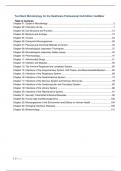
Test Bank Microbiology for the Healthcare Professional 2nd Edition VanMeter Table of Contents PREFACE ...............................................................................................................................................2 Chapter 01: Scope of Microbiology ...................................................................................................3 Chapter 02: Chemistry of Life ...........................................................................................................8 Chapter 03: Cell Structure and Function ........................................................................................ 13 Chapter 04: Bacteria and Archaea ................................................................................................... 21 Chapter 05: Viruses .......................................................................................................................... 25 Chapter 06: Eukaryotic Microorganisms ........................................................................................ 30 Chapter 07: Physical and Chemical Methods of Control ............................................................... 35 Chapter 08: Microbiological Laboratory Techniques .................................................................... 39 Chapter 09: Microbiological Laboratory Safety Issues .................................................................. 44 Chapter 10: Pharmacology .............................................................................................................. 49 Chapter 11: Antimicrobial Drugs .................................................................................................... 53 Chapter 12: Infection and Disease .................................................................................................. 58 Chapter 13: The Immune Response and Lymphatic System ........................................................ 62 Chapter 14: Infections of the Integumentary System, Soft Tissue, and Musculoskeletal System ............................................................................................................................................................ 68 Chapter 15: Infections of the Respiratory System ......................................................................... 72 Chapter 16: Infections of the Gastrointestinal System ................................................................. 76 Chapter 17: Infections of the Nervous System and Sensory Structures ...................................... 81 Chapter 18: Infections of the Cardiovascular and Circulatory System ........................................ 85 Chapter 19: Infections of the Urinary System ................................................................................ 89 Chapter 20: Infections of the Reproductive System ...................................................................... 94 Chapter 21: Sexually Transmitted Infections/Diseases ................................................................ 98 Chapter 22: Human Age and Microorganisms ............................................................................. 103 Chapter 23: Microorganisms in the Environment and Effects on Human Health ..................... 108 Chapter 24: Emerging Infectious Diseases .................................................................................. 112 Chapter 25: Biotechnology ............................................................................................................ 116 1PREFACE TEST BANK with Complete Questions and Solutions. To clarify, this is the TEST BANK, not the textbook. You get immediate access to download your test bank. You will receive a complete test bank; in other words, all chapters will be there. Test banks come in PDF format; therefore, you do not need specialized software to open them. 2Chapter 01: Scope of Microbiology MULTIPLE CHOICE 1. In the sixteenth century a father-and-son team, by the name of , produced a compound microscope consisting of a simple tube with lenses at each end. a. van Leeuwenhoek b. Semmelweis c. Janssen d. Hooke ANS: C REF: p. 3 2. “Animalcules” were first described by a. Robert Hooke. b. Antony van Leeuwenhoek. c. Hans Janssen. d. John Needham. ANS: B REF: p. 3 3. Micrographia, a publication illustrating insects, sponges, as well as plant cells, was published by a. Robert Hooke. b. Antony van Leeuwenhoek. c. Hans Janssen. d. John Needham. ANS: A REF: p. 3 4. Low-power microscopes designed for observing fairly large objects such as insects or worms are a. electron microscopes. b. dark-field microscopes. c. fluorescence microscopes. d. stereomicroscopes. ANS: D REF: p. 5 5. A microscope that provides a three-dimensional image of a specimen is a a. dark-field microscope. b. transmission electron microscope. c. bright-field microscope. d. scanning electron microscope. ANS: D REF: p. 7 6. The tool of choice to observe living microorganisms is the a. bright-field microscope. b. phase-contrast microscope. c. fluorescence microscope. 3d. electron microscope. ANS: B REF: p. 6 7. Which scientist is most responsible for ending the controversy about spontaneous generation? a. John Needham b. Joseph Lister c. Louis Pasteur d. Robert Koch ANS: C REF: p. 8 8. Fossils of prokaryotes go back a. 4.0 to 5.0 b. 3.5 to 4.0 c. 2.5 to 3.0 d. 2.2 to 2.7 ANS: B REF: p. 9 9. Molds belong to which of the following groups of eukaryotic organisms? a. Protozoans b. Archaea c. Fungi d. Algae ANS: C 10. The correct descending order of taxonomic categories is a. species, domain, phylum, kingdom, order, division, class, genus. b. domain, kingdom, phylum, class, family, order, genus, species. c. domain, kingdom, phylum, class, order, family, genus, species. d. kingdom, domain, phylum, order, class, family, genus, species. REF: p. 11 ANS: C REF: p. 10 11. Complex communities of microorganisms on surfaces are called a. colonies. b. biofilms. c. biospheres. d. flora. ANS: B REF: p. 12 12. 12. A relationship between organisms in which the waste product of one provides nutrients for another is called a. mutualism. b. competition. c. synergism. d. commensalism. ANS: D REF: p. 12 13. Which of the following sites of the human body does not have a normal flora? a. Intestine 4 billion years.b. Skin c. Vagina d. Blood ANS: D REF: p. 12 14. Which of the following lack nucleic acids? a. Archaea b. Viruses c. Prions d. Bacteria ANS: C REF: p. 11 15. The binominal system of nomenclature was originally developed by a. Pasteur. b. Linnaeus. c. Martini. d. Jenner. ANS: B REF: p. 11 16. Which of the following scientists performed the first vaccination against smallpox? a. Pasteur b. Jenner c. Semmelweis d. Koch ANS: B REF: p. 9 17. Which of the following diseases is generally caused by contaminated food? a. Mumps b. Shigellosis c. Legionellosis d. Tuberculosis ANS: B REF: p. 13 18. Which of the following diseases is transmitted via aerosols? a. Psittacosis b. Shigellosis c. Leptospirosis d. Giardiasis ANS: A REF: p. 14 19. Which of the following organisms is used in the production of cheese? a. Propionibacterium shermanii b. Acetobacter aceti c. Giardia d. Fusobacterium ANS: A REF: p. 14 520. Which of the following scientists discovered the antibiotic properties of Penicillium? a. Alexander Fleming b. Louis Pasteur c. Joseph Lister d. Edward Jenner ANS: A REF: p. 15 COMPLETION 1. In a compound light microscope the lens closest to the eye is the ANS: ocular REF: p. 3 2. The total magnification of an object viewed with a compound microscope with an ocular lens of 10 and an objective lens of 40 is . ANS: 400 REF: p. 4 3. Another term for spontaneous generations ANS: abiogenesis REF: p. 7 4. Microorganisms of various species are often organized into complex communities on a surface and are called . ANS: biofilms REF: p. 12 5. All bacteria are ANS: prokaryotic REF: p. 10 6. Cells that contain a nucleus are ANS: eukaryotic REF: p. 10 7. The taxonomic resource for information on bacteria is ANS: Bergey’s Manual of Systematic Bacteriology 6 . cells. cells. lens.REF: p. 11 8. A relationship in which two organisms benefit is referred to as ANS: mutualism REF: p. 12 9. The proteins implicated in spongiform encephalopathy are ANS: prions REF: p. 11 10. The cleanup of various industrial wastes by living organisms is referred to as ANS: bioremediation REF: p. 15 MATCHING Match the description below with the correct item from the list a. Observing insects b. Three-dimensional images c. Cytoplasmic streaming d. Fluorescent dye e. Ultrathin sectioned specimens 1. Scanning electron microscope 2. Phase-contrast microscope 3. Transmission electron microscope 4. Stereomicroscope 1. ANS: B 2. ANS: C 3. ANS: E 4. ANS: A REF: p. 7 REF: p. 6 REF: p. 7 REF: p. 5 Match the description below to the correct name from this list. a. Robert Koch b. Edward Jenner c. Louis Pasteur d. John Needham e. Joseph Lister f. Antony van Leeuwenhoek 5. Animalcules 6. Vaccination 7. Aseptic technique 8. Germ theory of disease 7 . . .5. ANS: F 6. ANS: B 7. ANS: E 8. ANS: C REF: p. 7 | p. 8 REF: p. 9 REF: p. 9 REF: p. 8 Chapter 02: Chemistry of Life MULTIPLE CHOICE 1. The atomic number equals the number of a. protons. b. neutrons. c. electrons. d. protons and neutrons. ANS: A REF: p. 20 2. The atomic weight is equal to the sum of a. neutrons. b. protons and neutrons. c. neutrons and electrons. d. electrons. ANS: B REF: p. 20 3. The smallest units of matter are a. molecules. b. atoms. c. protons. d. compounds. ANS: B REF: p. 20 4. Protons are a. located in the shells. b. part of the atomic nucleus. c. negatively charged. d. uncharged particles. ANS: B REF: p. 20 5. Particles of an atom located in the outermost shell and available for chemical bonding are called a. valence electrons. b. isotopes. c. excess electrons. d. neutrons. 8ANS: A REF: p. 21 6. Isotopes are atoms with a. the same number of electrons and protons. b. different numbers of protons and electrons. c. the same numbers of protons but a different number of neutrons. d. different numbers of electrons. ANS: C REF: p. 21 7. A chemical bond in which electrons are equally shared is a(n) a. ionic bond. b. polar covalent bond. c. nonpolar covalent bond. d. hydrogen bond. ANS: C REF: p. 23 8. The transfer of electrons in a chemical bond represents a(n) a. ionic bond. b. polar covalent bond. c. nonpolar covalent bond. d. hydrogen bond. ANS: A REF: p. 24 9. The bond of oxygen and hydrogen between water molecules is a(n) a. ionic bond. b. polar covalent bond. c. nonpolar covalent bond. d. hydrogen bond. ANS: D REF: p. 24 10. The isotope deuterium has a. one proton. b. one proton and one neutron. c. one proton and two neutrons. d. one proton and three neutrons. ANS: B REF: p. 21 11. After filling the first shell, the outermost shell of an atom can hold up to electrons. a. 2 b. 6 c. 8 d. 10 ANS: C REF: p. 23 12. 12. a. hydrogen bond. The bond between sodium and chlorine atoms in sodium chloride is a(n) 9b. ionic bond. c. polar covalent bond. d. nonpolar covalent bond. ANS: B REF: p. 24 13. Sucrose is composed of a. glucose and galactose. b. glucose and fructose. c. fructose and maltose. d. glucose and maltose. ANS: B REF: p. 31 14. The unit molecules (monomers) of carbohydrates are a. monosaccharides. b. amino acids. c. nucleic acids. d. fatty acids. ANS: A REF: p. 31 15. The bond between amino acids is a(n) a. ionic bond. b. peptide bond. c. hydrogen bond. d. covalent bond. ANS: B REF: p. 32 16. Glucose and fructose are examples of a. monosaccharides. b. disaccharides. c. polysaccharides. d. lipids. ANS: A REF: p. 31 17. 17. a. galactose. b. lactose. c. maltose. d. fructose. Two glucose molecules form ANS: C REF: p. 31 18. Starch is an example of a a. monosaccharide. b. polysaccharide. c. peptide. d. protein. ANS: B REF: p. 31 1019. Cytosine always undergoes complementary base pairing with a. adenine. b. guanine. c. thymine. d. uracil. ANS: B REF: p. 36 20. 20. a. cytosine. b. guanine. c. thymine. d. uracil. The RNA nucleotide base that pairs with adenine of DNA is ANS: D REF: p. 36 COMPLETION 1. Neutrons are ANS: not REF: p. 20 2. An atom with the same number of protons but a different number of neutrons is called a(n) . ANS: isotope REF: p. 21 3. A positively charged ion is a(n) ANS: cation REF: p. 22 4. The breakdown of large molecules into smaller ones in the presence of water is called . ANS: hydrolysis REF: p. 25 5. Molecules that can absorb hydrogen ions and not change the pH of the substance are . ANS: 11 . _ charged rs REF: p. 28 6. The formation of polymers from simpler substances is referred to as ANS: synthesis REF: p. 25 7. When the solute concentration outside a cell is the same as the concentration inside the cell, the solution is called . ANS: isotonic REF: p. 29 8. The monomers of triglycerides are ANS: glycerol REF: p. 31 9. Lactose is composed of glucose and ANS: galactose REF: p. 31 10. Chemically, ATP is a(n) ANS: nucleic acid REF: p. 38 MATCHING Match the description below with correct item from the list a. Redox b. Electron c. Neutron d. Acid e. Base f. Salt g. Glucose h. Protein i. Polysaccharide j. Nucleic acid k. Lipid l. Tritium 1. Radioactive isotope 2. Negatively charged particle 12 . . and fatty acids. .3. Reduction–oxidation reactions 4. Hydrogen ion donor 5. Ammonium chloride 6. Monomer 7. Cellulose 8. Particle with no charge 9. Prostaglandin 10. Amino acid chain 1. ANS: L 2. ANS: B 3. ANS: A 4. ANS: D 5. ANS: F 6. ANS: G 7. ANS: I 8. ANS: C 9. ANS: K 10. ANS: H REF: p. 22 REF: p. 20 REF: p. 25 REF: p. 27 REF: p. 28 REF: p. 31 REF: p. 31 REF: p. 20 REF: p. 33 REF: p. 32 Chapter 03: Cell Structure and Function MULTIPLE CHOICE 1. Matrix formed outside the plasma membrane is referred to as a. cytoplasm. b. glycocalyx. c. exoplasm. d. cell wall. ANS: B REF: p. 44 2. The cell organelles found only in algae and plant cells are a. chloroplasts. b. mitochondria. c. vacuoles. d. vesicles. ANS: A REF: p. 54 3. Peptidoglycan is typically found in the a. cell wall. b. plasma membrane. c. nucleus. d. endoplasmic reticulum. 13ANS: A REF: p. 45 4. Chitin is a component of the cell wall of a. algae. b. bacteria. c. fungi. d. viruses. ANS: C REF: p. 46 5. Bacteria that have a single polar flagellum at one end are referred to as a. amphitrichous. b. monotrichous. c. peritrichous. d. lophotrichous. ANS: B REF: p. 47 6. Bacteria that have flagella that are distributed over the general cell surface are referred to as a. amphitrichous. b. monotrichous. c. peritrichous. d. lophotrichous. ANS: C 7. Pili are also called a. microvilli. b. fimbriae. c. cilia. d. flagella. ANS: B REF: p. 48 8. The structures that can move fluid, mucus, or cells over the surface of a cell are a. microvilli. b. fimbriae. c. cilia. d. flagella. ANS: C REF: p. 48 9. The fluidlike portion of a cell is referred to as a. inclusion. b. cytoplasm. c. cytosol. d. nucleoplasm. 14 REF: p. 48ANS: C REF: p. 51 10. Which of the following structures is shaped like a hollow cylinder made out of tubulin proteins? a. Intermediate filaments b. Microtubules c. Microfilaments d. Flagella ANS: B REF: p. 51 11. The cell organelle responsible for the packaging of proteins is the a. ribosome. b. Golgi complex. c. rER. d. lysosome. ANS: B REF: p. 54 12. Which of the following cell organelles contain digestive enzymes? a. Mitochondria b. Chloroplasts c. Lysosomes d. Peroxisomes ANS: C REF: p. 54 13. Which of the following organelles contain oxidative enzymes capable of oxidizing toxic substances? a. Mitochondria b. Chloroplasts c. Lysosomes d. Peroxisomes ANS: D REF: p. 54 14. 14. a. mitochondria. b. chloroplasts. c. lysosomes. d. peroxisomes. Stroma is a component of ANS: B REF: p. 55 15. 15. a. Aeromonas hydrophila b. Escherichia coli c. Streptococcus pyogenes d. Corynebacterium diphtheriae Which of the following organisms produces toxins that target cholesterol? ANS: C REF: p. 57 16. 16. a. sodium. b. potassium. The intracellular fluid has a high concentration of 15c. bicarbonate. d. sulfate. ANS: B REF: p 58 17. Which of the following is an active transport mechanism? a. Osmosis b. Facilitated diffusion c. Filtration d. Pinocytosis ANS: D REF: p. 60 18. Which of the following transport mechanisms transports water across the plasma membrane? a. Osmosis b. Facilitated diffusion c. Phagocytosis d. Exocytosis ANS: A REF: p. 58 19. The movement of molecules through a membrane from an area of high hydrostatic pressure to an area of lower hydrostatic pressure is a. osmosis. b. exocytosis. c. simple diffusion. d. filtration. ANS: D REF: p. 59 20. Enzymatic reactions can be expressed in which of the following chemical notations? a. S + P = E b. P + P = E c. E + S = P d. S + S = P ANS: C REF: p. 61 21. 21. Enzymes that remove functional groups from a substrate without adding water, or that add functional groups to a double bond, are called a. oxidoreductases. b. transferases. c. hydrolases. d. lyases. ANS: D REF: p. 62 22. 22. a. proteins. b. lipids. c. nucleic acids. d. carbohydrates. Chemically, most enzymes are ANS: A REF: p. 61 1623. The net gain of ATP molecules a is a. 1 b. 2 c. 3 d. 4 N fter R I bre G ak B . own C M ANS: B REF: p. 67 24. 24. a. citric acid. b. pyruvic acid. c. acetyl-CoA. d. phosphoglyceraldehyde. The compound that enters the Krebs cycle and combines with oxaloacetic acid is the d of one glucose molecule in glycolysis ANS: C REF: p. 68 25. 25. a. Streptococcus. b. Klebsiella. c. Clostridium. d. Actinomyces. Formic acid is a fermentation product of ANS: D REF: p. 68 26. 26. The central dogma concerning the flow of information from genetic material was first introduced by a. Ernst Ruska. b. Francis Crick. c. Camillo Golgi. d. Carl Bender. ANS: B REF: p. 70 27. 27. a. tRNA. b. rRNA. c. mRNA. d. ribosomes. The anticodons are located in ANS: A REF: p. 71 28. Binary fission is a form of reproduction used by a. viruses. b. bacteria. c. fungi. d. helminths. ANS: B 29. 29. 17 REF: p. 74In which phase of mitosis do the chromatids separate? a. Prophase b. Metaphase c. Anaphase d. Telophase ANS: C REF: p. 75 30. 30. a. G phase b. Prophase c. Metaphase d. S phase DNA replication occurs in which phase of the cell cycle? ANS: D REF: p. 74 31. 31. a. endospores. b. transposons. c. plasmids. d. prions. Nonchromosomal DNA molecules found in a bacterial cell are ANS: C REF: p. 77 32. The actual genetic makeup of an organism is referred to as its a. phenotype. b. genotype. c. conjugation. d. construct. ANS: B REF: p. 78 COMPLETION 1. Cells without a nucleus are ANS: prokaryotic REF: p. 43 2. Proteins that are partially embedded on one side of the plasma membrane are referred to as protein s. ANS: peripheral REF: p. 43 3. The sterol-like molecule in bacterial plasma membranes is a(n) ANS: hopanoid _. cells. 18REF: p. 43 4. Movement of bacteria toward or away from a particular stimulus is called ANS: taxis REF: p. 48 5. The nucleus is surrounded by a(n) ANS: nuclear envelope REF: p. 52 6. An enzyme that requires a coenzyme/cofactor to function, but does not have one bound, is called a(n) . ANS: apoenzyme REF: p. 63 7. The allosteric site is a component of ANS: enzymes REF: p. 62 | p. 63 8. The organelle necessary for photosynthesis is a(n) ANS: chloroplast REF: p. 68 9. A special structure formed by some bacterial cells to allow them to survive in harsh conditions is called a(n) . ANS: endospore REF: p. 57 10. The transfer of genetic material during direct cell-to-cell contact is called . ANS: conjugation REF: p. 79 MATCHING Match the description below with the correct item from this list. a. Cytoskeleton 19 . . . .b. Cytosol c. Mitochondria d. Golgi apparatus e. rER f. Bacterial ribosome subunit g. Enzyme h. Dental plaque i. Phospholipids j. Endocytosis k. Cell wall l. Passive transport 1. Plasma membrane 2. Peptidoglycan 3. Biofilm 4. Microtubules 5. Protein synthesis 6. ATP production 7. 70S 8. Brownian movement 9. Phagocytosis 10. Hydrolase 1. ANS: I 2. ANS: K 3. ANS: H 4. ANS: A 5. ANS: E 6. ANS: C 7. ANS: F 8. ANS: L 9. ANS: J 10. ANS: G REF: p. 42 REF: p. 45 REF: p. 50 REF: p. 51 REF: p. 56 REF: p. 54 REF: p. 54 REF: p. 58 REF: p. 60 REF: p. 62 Match the description below to the correct name from this list. a. Robert Hooke b. Rudolph Kölliker c. Naegeli and Cramer d. Schleiden and Schwann e. Antony van Leeuwenhoek f. Richard Altmann g. Ernst Ruska 11. Observed cells of a cork 12. Proposed the cell theory 13. Developed mitochondrial stain 14. Described the cell membrane as a barrier 15. Built the first TEM 11. ANS: A REF: p. 42 2012. ANS: D 13. ANS: F 14. ANS: C 15. ANS: G REF: p. 42 REF: p. 43 REF: p. 43 REF: p. 43 Chapter 04: Bacteria and Archaea MULTIPLE CHOICE 1. Rod-shaped bacteria, some of which are endospore forming, are referred to as a. cocci. b. bacilli. c. spirals. d. vibrios. ANS: B REF: p. 83 2. Beadlike chains of cocci formed after cell division along a single axis are called a. diplococci. b. streptococci. c. tetrads. d. sarcinae.
Written for
- Institution
- Harvard University
- Module
- Health Care
Document information
- Uploaded on
- August 11, 2023
- Number of pages
- 120
- Written in
- 2023/2024
- Type
- Exam (elaborations)
- Contains
- Questions & answers
Subjects
-
vanmeter
-
test bank
-
microbiology for the healthcare professional