

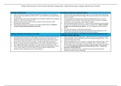
‘Wolsey’s fall from power in 1529 was due to his failure in foreign policy.’ Explain why you agree or disagree with this view. [25 marks]
Paragraph 1: Domestic policy Paragraph 2: underpinned by foreign policy failures
1. Failures in domestic policy meant little public opposition to Wolsey’s arrest. Requested 1. Underpinned by foreign policy aim to achieve glory in France. Wolsey encouraged Henry to
series of ‘loans’ from wealthiest in 1522 and 1523 – sum of £260,000 never repaid, leading capture Paris (initial aim had been Boulogne); this required Amicable Grant/ considerable
to resentment. increase in taxation.
2. Equally, Amicable Grant 1525 caused rebellions in East Anglia and 10,000 men converged on 2. Henry requested an amicable grant to fund the campaign against France. This was a
Lavenham – most serious rising since 1497. considerable financial extraction. Taxation had been heavy in recent years and popular
3. Eltham Ordinances of 1526 removed numerous members of Privy Chamber, further enthusiasm for war was minimal. It was ultimately rescinded.
detracting from Wolsey support. 3. Failure following the Battle of Pavia 1525 – Charles refused to attack France and annulled
4. Wolsey deeply unpopular for forcing the 1523 subsidy through Parliament, and former the proposed marriage between himself and Henry’s daughter Mary. Wolsey’s domestic
associates had been distancing themselves from him. prestige never recovered from the episode – far more damaging than other domestic
failures.
4. 1522 and 1523 invasions cost Wolsey his public image.
5. Fallout Wolsey suffered from Amicable Grant indicated by Eltham Ordinances in 1526 –
David Starkey argued that this marked attempt to bolster reputation.
Paragraph 3 Opposition from enemies at court/ nobility Paragraph 4: Wolsey’s inability to resolve KGM stemmed from foreign policy failures. KGM
inextricably linked to foreign policy.
1. Anne Boleyn pursued a personal vendetta against Wolsey (the cardinal had terminated her 1. Wolsey suspended trade with Netherlands – diplomatic tool to force Habsburgs to further
initial betrothal to Lord Henry Percy). Anne Boleyn convinced Henry that Wolsey was amendment policy. Forced to abandon as there were widespread public protests – truce
intentionally delaying a papal decision in the hope that the king would tire of his romantic made with Netherlands in 1528.
pursuit. Henry wrote over 36 letters to Boleyn – would have been prone to influence. 2. Wolsey persuaded Henry to rely on Francis I to recapture Rome and free the Pope. Henry
2. Wolsey was deeply unpopular amongst members of the nobility. Diluted their power e.g. agreed to help fund the French army that was travelling to Italy – ultimately failure, as
Elton suggests Wolsey partly responsible for execution of Duke of Buckingham in 1521. French defeated at June 1529 Battle of Landriano. Cardinal Cameggio adjourned hearing on
3. Duke of Norfolk and Suffolk headed faction opposed to Wolsey and demanding his removal 30th July. Just 4 months later in October 1529 Wolsey fell from power – charged with
– Henry valued nobility more than his father (as demonstrated by establishment of praemunire. Indicates direct link.
Gentleman of Privy Chamber) thus prone to their influence. 3. Wolsey ‘did not dominate the king… and when he ceased to serve him to Henry’s
satisfaction, he fell from power’ (Wooding)
Paragraph 1: Domestic policy Paragraph 2: underpinned by foreign policy failures
1. Failures in domestic policy meant little public opposition to Wolsey’s arrest. Requested 1. Underpinned by foreign policy aim to achieve glory in France. Wolsey encouraged Henry to
series of ‘loans’ from wealthiest in 1522 and 1523 – sum of £260,000 never repaid, leading capture Paris (initial aim had been Boulogne); this required Amicable Grant/ considerable
to resentment. increase in taxation.
2. Equally, Amicable Grant 1525 caused rebellions in East Anglia and 10,000 men converged on 2. Henry requested an amicable grant to fund the campaign against France. This was a
Lavenham – most serious rising since 1497. considerable financial extraction. Taxation had been heavy in recent years and popular
3. Eltham Ordinances of 1526 removed numerous members of Privy Chamber, further enthusiasm for war was minimal. It was ultimately rescinded.
detracting from Wolsey support. 3. Failure following the Battle of Pavia 1525 – Charles refused to attack France and annulled
4. Wolsey deeply unpopular for forcing the 1523 subsidy through Parliament, and former the proposed marriage between himself and Henry’s daughter Mary. Wolsey’s domestic
associates had been distancing themselves from him. prestige never recovered from the episode – far more damaging than other domestic
failures.
4. 1522 and 1523 invasions cost Wolsey his public image.
5. Fallout Wolsey suffered from Amicable Grant indicated by Eltham Ordinances in 1526 –
David Starkey argued that this marked attempt to bolster reputation.
Paragraph 3 Opposition from enemies at court/ nobility Paragraph 4: Wolsey’s inability to resolve KGM stemmed from foreign policy failures. KGM
inextricably linked to foreign policy.
1. Anne Boleyn pursued a personal vendetta against Wolsey (the cardinal had terminated her 1. Wolsey suspended trade with Netherlands – diplomatic tool to force Habsburgs to further
initial betrothal to Lord Henry Percy). Anne Boleyn convinced Henry that Wolsey was amendment policy. Forced to abandon as there were widespread public protests – truce
intentionally delaying a papal decision in the hope that the king would tire of his romantic made with Netherlands in 1528.
pursuit. Henry wrote over 36 letters to Boleyn – would have been prone to influence. 2. Wolsey persuaded Henry to rely on Francis I to recapture Rome and free the Pope. Henry
2. Wolsey was deeply unpopular amongst members of the nobility. Diluted their power e.g. agreed to help fund the French army that was travelling to Italy – ultimately failure, as
Elton suggests Wolsey partly responsible for execution of Duke of Buckingham in 1521. French defeated at June 1529 Battle of Landriano. Cardinal Cameggio adjourned hearing on
3. Duke of Norfolk and Suffolk headed faction opposed to Wolsey and demanding his removal 30th July. Just 4 months later in October 1529 Wolsey fell from power – charged with
– Henry valued nobility more than his father (as demonstrated by establishment of praemunire. Indicates direct link.
Gentleman of Privy Chamber) thus prone to their influence. 3. Wolsey ‘did not dominate the king… and when he ceased to serve him to Henry’s
satisfaction, he fell from power’ (Wooding)


