
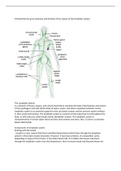
P3) Describe the gross anatomy and function of the organs of the lymphatic system.
The Lymphatic System
Is a network of tissues, organs, and vessels that help to maintain the body’s fluid balance and protect
it from pathogens and help rid the body of toxins, waste, and other unwanted materials. As the
lymphatic system is an essential support for the circulatory system and the immune system without
it, they would not function. The lymphatic system is a system of thin tubes that runs throughout the
body, as this tubes are called lymph vessels (lymphatic vessels). The lymphatic system is
characterised by it is thine tubes which are finer than arteries and veins. Also, it carries a colourless
liquid called lymph.
Components of lymphatic system
Starting with the lymph
Lymph is a clear, watery fluid that resembles blood plasma which flows through the lymphatic
system in the lymph vessels (channels). However, it has fewer proteins, its composition varies
depending on organs that it drains. It has white blood cells. As it bathes the tissues and drains
through the lymphatic system into the bloodstream. Also it contains dead and diseased tissues for
, disposal by carrying it to the lymph nodes where the lymph is filtered before it re-enters circulation .
Lymphatic capillaries: First of all, a quick understanding of the circulatory system, which transports
blood throughout the body, will help understanding how the lymphatic capillaries function. That is
because these two systems depend on each other. As the circulatory system consists of a pump
(their heart) and a network of tubes (blood vessels that conduct the blood throughout the body).
With each beat of the heart the blood forces the arteries (carry blood away from the heart toward
all the tissues and organs). As the arteries travel further from the heart, they divide into
progressively smaller vessels called arterioles which themselves are divided into tiny-walled, leaky
vessels called capillaries. As blood travels through the capillaries oxygen, nutrients and fluid are
pushed into the surrounding tissues, and carbon dioxide and other cellular wastes are retrieved. The
blood then proceeds on its way, coursing into progressively larger vessels called venules and then
into even larger veins which return the blood to the heart. If the body does not have a mechanism
for recovering the fluid leaking from the capillaries. Sooner the tissue will resemble water sponges
and the cells within the tissues will quickly drown.
Here is where the lymphatic system works. mingled among the million blood capillaries is another
network of thin, tiny walled vessels called lymphatic capillaries. As the blood pressures force plasma
out of the arteriole end of the capillaries and into the interstitial fluid between the surrounded cells
and tissues. After that most of that fluid gets drawn right back into the capillaries on the venous by
osmotic pressure but some is left behind. As of the 20 Liters a day that is forced through the
arteriolar only 17 Liters, which is 85%, is taken back up by the venous end. The other 3 Liters (15%)
which left behind as it is almost immediately picked up by the nearby lymphatic capillaries. So
lymphatic capillaries are made of loosely overlapping and endothelial cells forming little flap valves
that only open in one direction. As a result, when the pressure in the interstitial fluid becomes
greater than the pressure inside the lymphatic capillaries. The valves open and take the fluid to
relieve the pressure.
Once the fluid (plasma) inside a lymphatic capillary, it is officially called lymph.
The small intestine has special types of lymphatic capillaries called lacteals. As it picks up interstitial
fluid and dietary lipids and lipid-soluble vitamins. The Lymph of this area has a milky colour due to
the lipid and it is called chyle.
These lymphatic capillaries form a pre-collecting vessel, which may merge with other pre-collecting
vessels nearby. These will eventually join to form a real lymphatic channel.
The Lymphatic System
Is a network of tissues, organs, and vessels that help to maintain the body’s fluid balance and protect
it from pathogens and help rid the body of toxins, waste, and other unwanted materials. As the
lymphatic system is an essential support for the circulatory system and the immune system without
it, they would not function. The lymphatic system is a system of thin tubes that runs throughout the
body, as this tubes are called lymph vessels (lymphatic vessels). The lymphatic system is
characterised by it is thine tubes which are finer than arteries and veins. Also, it carries a colourless
liquid called lymph.
Components of lymphatic system
Starting with the lymph
Lymph is a clear, watery fluid that resembles blood plasma which flows through the lymphatic
system in the lymph vessels (channels). However, it has fewer proteins, its composition varies
depending on organs that it drains. It has white blood cells. As it bathes the tissues and drains
through the lymphatic system into the bloodstream. Also it contains dead and diseased tissues for
, disposal by carrying it to the lymph nodes where the lymph is filtered before it re-enters circulation .
Lymphatic capillaries: First of all, a quick understanding of the circulatory system, which transports
blood throughout the body, will help understanding how the lymphatic capillaries function. That is
because these two systems depend on each other. As the circulatory system consists of a pump
(their heart) and a network of tubes (blood vessels that conduct the blood throughout the body).
With each beat of the heart the blood forces the arteries (carry blood away from the heart toward
all the tissues and organs). As the arteries travel further from the heart, they divide into
progressively smaller vessels called arterioles which themselves are divided into tiny-walled, leaky
vessels called capillaries. As blood travels through the capillaries oxygen, nutrients and fluid are
pushed into the surrounding tissues, and carbon dioxide and other cellular wastes are retrieved. The
blood then proceeds on its way, coursing into progressively larger vessels called venules and then
into even larger veins which return the blood to the heart. If the body does not have a mechanism
for recovering the fluid leaking from the capillaries. Sooner the tissue will resemble water sponges
and the cells within the tissues will quickly drown.
Here is where the lymphatic system works. mingled among the million blood capillaries is another
network of thin, tiny walled vessels called lymphatic capillaries. As the blood pressures force plasma
out of the arteriole end of the capillaries and into the interstitial fluid between the surrounded cells
and tissues. After that most of that fluid gets drawn right back into the capillaries on the venous by
osmotic pressure but some is left behind. As of the 20 Liters a day that is forced through the
arteriolar only 17 Liters, which is 85%, is taken back up by the venous end. The other 3 Liters (15%)
which left behind as it is almost immediately picked up by the nearby lymphatic capillaries. So
lymphatic capillaries are made of loosely overlapping and endothelial cells forming little flap valves
that only open in one direction. As a result, when the pressure in the interstitial fluid becomes
greater than the pressure inside the lymphatic capillaries. The valves open and take the fluid to
relieve the pressure.
Once the fluid (plasma) inside a lymphatic capillary, it is officially called lymph.
The small intestine has special types of lymphatic capillaries called lacteals. As it picks up interstitial
fluid and dietary lipids and lipid-soluble vitamins. The Lymph of this area has a milky colour due to
the lipid and it is called chyle.
These lymphatic capillaries form a pre-collecting vessel, which may merge with other pre-collecting
vessels nearby. These will eventually join to form a real lymphatic channel.


