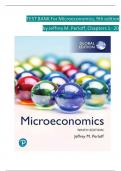
TESTBANKForMicroeconomics,9thedition
byJeffreyM.Perloff,Chapters1-20
,Tableofcontents
1. Introduction
2. SupplyandDemand
t t
3. ApplyingtheSupply-and-Demand Model
t t t
4. ConsumerChoice t
5. ApplyingConsumerTheory
t t
6. FirmsandProduction
t t
7. Costs
8. CompetitiveFirmsandMarkets t t t
9. ApplyingtheCompetitiveModel
t t t
10. GeneralEquilibrium andEconomicWelfare
t t t t
11. Monopoly
12. PricingandAdvertising t t
13. Oligopolyand MonopolisticCompetitiont t t
14. GameTheory t
15. FactorMarkets t
16. InterestRates,Investments,andCapital Markets
t t t t t
17. Uncertainty
18. Externalities,Open-Access,and PublicGoods t t t t
19. AsymmetricInformation t
20. ContractsandMoralHazards t t t
,Chapter 1 t Introduction
1.1 Microeconomics: The Allocation of Scarce Resources
t t t t t
1) Microeconomics tstudies tthe tallocation tof
A) decision tmakers.
B) scarce tresources.
C) models.
D) unlimited tresources.
E) TANSWER: tB
Section:
The tAllocation tof tScarce tResourcesQu
estion tStatus:
t Old
AACSB: Analytic tthinking
2) Microeconomics tisToften tcalled
A) price ttheory.
B) decision tscience.
C) scarcity.
D) resourcettheory.
ANSWER:
t t A
Section:
The tAllocation tof tScarce tResourcesQu
estion tStatus:
t Old
AACSB: Analytic tthinking
3) Most tmicroeconomic tmodels tassume tthatTdecision tmakersTwish tto
A) make tthemselves tas twell toff tas tpossible.
B) act tselfishly.
C) make tothers tas twell toff tas tpossible.
D) None tof tthe tabove.
ANSWER:
t t A
Section:
The tAllocation tof tScarce tResourcesQu
estion tStatus:
t Old
AACSB: Analytic tthinking
4) Society t faces t trade---‑offs t because t of
A) government tregulations.
B) profit tmotive.
C) faceless tbureaucrats.
, D) scarcity. tA
t NSWER: D
Section:
The tAllocation tof tScarce tResourcesQu
estion tStatus:
t Old
AACSB: Analytic tthinking
byJeffreyM.Perloff,Chapters1-20
,Tableofcontents
1. Introduction
2. SupplyandDemand
t t
3. ApplyingtheSupply-and-Demand Model
t t t
4. ConsumerChoice t
5. ApplyingConsumerTheory
t t
6. FirmsandProduction
t t
7. Costs
8. CompetitiveFirmsandMarkets t t t
9. ApplyingtheCompetitiveModel
t t t
10. GeneralEquilibrium andEconomicWelfare
t t t t
11. Monopoly
12. PricingandAdvertising t t
13. Oligopolyand MonopolisticCompetitiont t t
14. GameTheory t
15. FactorMarkets t
16. InterestRates,Investments,andCapital Markets
t t t t t
17. Uncertainty
18. Externalities,Open-Access,and PublicGoods t t t t
19. AsymmetricInformation t
20. ContractsandMoralHazards t t t
,Chapter 1 t Introduction
1.1 Microeconomics: The Allocation of Scarce Resources
t t t t t
1) Microeconomics tstudies tthe tallocation tof
A) decision tmakers.
B) scarce tresources.
C) models.
D) unlimited tresources.
E) TANSWER: tB
Section:
The tAllocation tof tScarce tResourcesQu
estion tStatus:
t Old
AACSB: Analytic tthinking
2) Microeconomics tisToften tcalled
A) price ttheory.
B) decision tscience.
C) scarcity.
D) resourcettheory.
ANSWER:
t t A
Section:
The tAllocation tof tScarce tResourcesQu
estion tStatus:
t Old
AACSB: Analytic tthinking
3) Most tmicroeconomic tmodels tassume tthatTdecision tmakersTwish tto
A) make tthemselves tas twell toff tas tpossible.
B) act tselfishly.
C) make tothers tas twell toff tas tpossible.
D) None tof tthe tabove.
ANSWER:
t t A
Section:
The tAllocation tof tScarce tResourcesQu
estion tStatus:
t Old
AACSB: Analytic tthinking
4) Society t faces t trade---‑offs t because t of
A) government tregulations.
B) profit tmotive.
C) faceless tbureaucrats.
, D) scarcity. tA
t NSWER: D
Section:
The tAllocation tof tScarce tResourcesQu
estion tStatus:
t Old
AACSB: Analytic tthinking