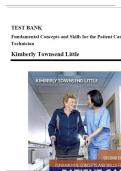
TEST BANK
Fundamental Concepts and Skills for the Patient Care Technician
KIMBERLY TOWNSEND LITTLE
2nd Edition
, Table of Contents
Unit 1: Introduction to Health Care
1. Today’s Health Care
2. The Role of the Patient Care Technician
3. Professionalism and Work Ethics
4. Communicating with the Health Care Team
Unit 2: The Patient
5. Understanding the Patient as a Person
6. Patient Rights, Ethics, and Laws
7. Body Structure and Function / Growth and Development
8. Pain Management, Comfort, Rest, and Sleep
Unit 3: Safety
9. Asepsis and Infection Control
10. Workplace Safety and Body Mechanics
11. Patient Safety
12. Moving, Positioning, and Preventing Falls
13. Basic Emergency Care
14. Medication Administration
Unit 4: Patient Assessment
15. Assisting with the Physical Examination
16. Measuring and Recording Vital Signs
17. Obtaining and Monitoring an Electrocardiogram
Unit 5: Patient Care and Comfort
18. Assisting with Admission and Discharge
19. Bedmaking and Hygiene
20. Assisting with Grooming
Page 2 of 206
,21. Assisting with Nutrition and Fluids
22. Assisting with Urinary Elimination
23. Assisting with Bowel Elimination
24. Assisting with Oxygen Needs
Unit 6: Blood and Specimen Collecting and Testing
25. Blood Collecting and Processing
26. Specimen Collecting and Testing
Unit 7: Surgery and Immobility
27. Care of the Surgical Patient
28. Heat and Cold Applications
29. Care of Wounds and Pressure Ulcers
30. Rehabilitative and Restorative Care
Unit 8: Special Care Concerns and Settings
31. Care of Women and Children
32. Caring for the Older Adult
33. Caring for Patients with Mental Health Needs
34. Caring for Patients with Chronic Conditions
35. End‑of‑Life Care
Page 3 of 206
, Chapter 01: Today’s Healthcare
MULTIPLE CHOICE
1. Which of the following must the patient care technician (PCT) recognize regarding the
healthcare delivery system?
a. It includes all states.
b. It affects the illness of patients.
c. Insurance companies are not involved.
d. The major goal is to achieve optimal levels of healthcare.
CORRECT ANSWER: D
The PCT must recognize that in the healthcare delivery system, the major goal is to achieve optimal
levels of healthcare. The healthcare system consists of a network of agencies, facilities, and providers
involved with healthcare in a specified geographic area. Insurance companies do have involvement in
the healthcare system. The illness of patients is not necessarily affected by the healthcare system.
OBJ: 1
2. What is required by the healthcare team to identify the needs of a patient and to design care to
meet those needs?
a. The white board
b. The nurse’s notes
c. The physician’s order sheet
d. An individualized care plan
CORRECT ANSWER: D
An individualized care plan involves all healthcare workers and outlines care to meet the needs of the
individual patient. The white board, physician’s order sheet, and nurse’s notes do not identify the needs
of the patient nor are they designed to assist all members of the healthcare team to meet those needs.
OBJ: 3
3. How does an interdisciplinary approach to patient treatment enhance care?
a. By improving efficiency of care
b. By reducing the number of caregivers
c. By preventing the fragmentation of patient care
d. By shortening hospital
stay CORRECT ANSWER: C
An interdisciplinary approach prevents fragmentation of care by involving and including all care
providers. An interdisciplinary approach does not improve the efficiency of care, reduce the number of
caregivers, or shorten hospital stay.
Page 4 of 206
Fundamental Concepts and Skills for the Patient Care Technician
KIMBERLY TOWNSEND LITTLE
2nd Edition
, Table of Contents
Unit 1: Introduction to Health Care
1. Today’s Health Care
2. The Role of the Patient Care Technician
3. Professionalism and Work Ethics
4. Communicating with the Health Care Team
Unit 2: The Patient
5. Understanding the Patient as a Person
6. Patient Rights, Ethics, and Laws
7. Body Structure and Function / Growth and Development
8. Pain Management, Comfort, Rest, and Sleep
Unit 3: Safety
9. Asepsis and Infection Control
10. Workplace Safety and Body Mechanics
11. Patient Safety
12. Moving, Positioning, and Preventing Falls
13. Basic Emergency Care
14. Medication Administration
Unit 4: Patient Assessment
15. Assisting with the Physical Examination
16. Measuring and Recording Vital Signs
17. Obtaining and Monitoring an Electrocardiogram
Unit 5: Patient Care and Comfort
18. Assisting with Admission and Discharge
19. Bedmaking and Hygiene
20. Assisting with Grooming
Page 2 of 206
,21. Assisting with Nutrition and Fluids
22. Assisting with Urinary Elimination
23. Assisting with Bowel Elimination
24. Assisting with Oxygen Needs
Unit 6: Blood and Specimen Collecting and Testing
25. Blood Collecting and Processing
26. Specimen Collecting and Testing
Unit 7: Surgery and Immobility
27. Care of the Surgical Patient
28. Heat and Cold Applications
29. Care of Wounds and Pressure Ulcers
30. Rehabilitative and Restorative Care
Unit 8: Special Care Concerns and Settings
31. Care of Women and Children
32. Caring for the Older Adult
33. Caring for Patients with Mental Health Needs
34. Caring for Patients with Chronic Conditions
35. End‑of‑Life Care
Page 3 of 206
, Chapter 01: Today’s Healthcare
MULTIPLE CHOICE
1. Which of the following must the patient care technician (PCT) recognize regarding the
healthcare delivery system?
a. It includes all states.
b. It affects the illness of patients.
c. Insurance companies are not involved.
d. The major goal is to achieve optimal levels of healthcare.
CORRECT ANSWER: D
The PCT must recognize that in the healthcare delivery system, the major goal is to achieve optimal
levels of healthcare. The healthcare system consists of a network of agencies, facilities, and providers
involved with healthcare in a specified geographic area. Insurance companies do have involvement in
the healthcare system. The illness of patients is not necessarily affected by the healthcare system.
OBJ: 1
2. What is required by the healthcare team to identify the needs of a patient and to design care to
meet those needs?
a. The white board
b. The nurse’s notes
c. The physician’s order sheet
d. An individualized care plan
CORRECT ANSWER: D
An individualized care plan involves all healthcare workers and outlines care to meet the needs of the
individual patient. The white board, physician’s order sheet, and nurse’s notes do not identify the needs
of the patient nor are they designed to assist all members of the healthcare team to meet those needs.
OBJ: 3
3. How does an interdisciplinary approach to patient treatment enhance care?
a. By improving efficiency of care
b. By reducing the number of caregivers
c. By preventing the fragmentation of patient care
d. By shortening hospital
stay CORRECT ANSWER: C
An interdisciplinary approach prevents fragmentation of care by involving and including all care
providers. An interdisciplinary approach does not improve the efficiency of care, reduce the number of
caregivers, or shorten hospital stay.
Page 4 of 206