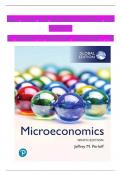
TEST BANK For Microeconomics, 9th edition
f# f# f# f# f#
by Jeffrey M. Perloff, Chapters 1 - 20
f# f# f# f# f# f# f#
,Table of contents
f# f#
1. Introduction
2. Supply and Demand
f# f#
3. Applying the Supply-and-Demand Model
f# f# f#
4. Consumer Choice f#
5. Applying Consumer Theory
f# f#
6. Firms and Production
f# f#
7. Costs
8. Competitive Firms and Markets f# f# f#
9. Applying the Competitive Model
f# f# f#
10. General Equilibrium and Economic Welfare
f# f# f# f#
11. Monopoly
12. Pricing and Advertising f# f#
13. Oligopoly and Monopolistic Competition
f# f# f#
14. Game Theory f#
15. Factor Markets f#
16. Interest Rates, Investments, and Capital Markets
f# f# f# f# f#
17. Uncertainty
18. Externalities, Open-Access, and Public Goods f# f# f# f#
19. Asymmetric Information f#
20. Contracts and Moral Hazards f# f# f#
,Chapter f#1 Introduction
1.1 Microeconomics: f#The f#Allocation f#of f#Scarce f#Resources
1) Microeconomics f#studies f#the f#allocation f#of
A) decision f#makers.
B) scarce f#resources.
C) models.
D) unlimited f#resources.
ANSWER: B
#f
Section: The f#Allocation f#of f#Scarce
f# Resources#Q
f uestion f#Status: Old
AACSB: Analytic f#thinking
2) Microeconomics f#is f#often f#called
A) price f#theory.
B) decision f#science.
C) scarcity.
D) resource f#theory.
ANSWER: A
#f
Section: The f#Allocation f#of f#Scarce
f# Resources#Q
f uestion f#Status: Old
AACSB: Analytic f#thinking
3) Most f#microeconomic f#models f#assume f#that f#decision f#makers f#wish f#to
A) make f#themselves f#as f#well f#off f#as f#possible.
B) act f#selfishly.
C) make f#others f#as f#well f#off f#as f#possible.
D) None f#of f#the
f# above.#A
f NSWER: A
Section: The f#Allocation f#of f#Scarce
f# Resources#Q
f uestion f#Status: Old
AACSB: Analytic f#thinking
4) Society f# faces f#trade- ‑offs f#because f#of
A) government f#regulations.
B) profit f#motive.
C) faceless f#bureaucrats.
, D) scarcity.
ANSWER: D
f#
Section: The f#Allocation f#of f#Scarce
Resources#Q
f# f uestion f#Status: Old
AACSB: Analytic f#thinking
f# f# f# f# f#
by Jeffrey M. Perloff, Chapters 1 - 20
f# f# f# f# f# f# f#
,Table of contents
f# f#
1. Introduction
2. Supply and Demand
f# f#
3. Applying the Supply-and-Demand Model
f# f# f#
4. Consumer Choice f#
5. Applying Consumer Theory
f# f#
6. Firms and Production
f# f#
7. Costs
8. Competitive Firms and Markets f# f# f#
9. Applying the Competitive Model
f# f# f#
10. General Equilibrium and Economic Welfare
f# f# f# f#
11. Monopoly
12. Pricing and Advertising f# f#
13. Oligopoly and Monopolistic Competition
f# f# f#
14. Game Theory f#
15. Factor Markets f#
16. Interest Rates, Investments, and Capital Markets
f# f# f# f# f#
17. Uncertainty
18. Externalities, Open-Access, and Public Goods f# f# f# f#
19. Asymmetric Information f#
20. Contracts and Moral Hazards f# f# f#
,Chapter f#1 Introduction
1.1 Microeconomics: f#The f#Allocation f#of f#Scarce f#Resources
1) Microeconomics f#studies f#the f#allocation f#of
A) decision f#makers.
B) scarce f#resources.
C) models.
D) unlimited f#resources.
ANSWER: B
#f
Section: The f#Allocation f#of f#Scarce
f# Resources#Q
f uestion f#Status: Old
AACSB: Analytic f#thinking
2) Microeconomics f#is f#often f#called
A) price f#theory.
B) decision f#science.
C) scarcity.
D) resource f#theory.
ANSWER: A
#f
Section: The f#Allocation f#of f#Scarce
f# Resources#Q
f uestion f#Status: Old
AACSB: Analytic f#thinking
3) Most f#microeconomic f#models f#assume f#that f#decision f#makers f#wish f#to
A) make f#themselves f#as f#well f#off f#as f#possible.
B) act f#selfishly.
C) make f#others f#as f#well f#off f#as f#possible.
D) None f#of f#the
f# above.#A
f NSWER: A
Section: The f#Allocation f#of f#Scarce
f# Resources#Q
f uestion f#Status: Old
AACSB: Analytic f#thinking
4) Society f# faces f#trade- ‑offs f#because f#of
A) government f#regulations.
B) profit f#motive.
C) faceless f#bureaucrats.
, D) scarcity.
ANSWER: D
f#
Section: The f#Allocation f#of f#Scarce
Resources#Q
f# f uestion f#Status: Old
AACSB: Analytic f#thinking