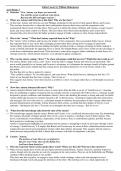
Julius Caesar by William Shakespeare
Act 5 Scene: I
A. Octavius: "Now, Antony, our hopes are answerèd.
You said the enemy would not come down,
But keep the hills and upper regions."
1. Where are Antony and Octavius at this time? Why are they here?
→ At this time, Antony and Octavius are near Philippi, preparing for the decisive battle against Brutus and Cassius.
They are here because this is where the final confrontation between their forces and the conspirators who
assassinated Julius Caesar will take place. Their goal is to defeat the armies of Brutus and Cassius, avenge Caesar’s
death, and secure their control over Rome. The line reflects their observation that Brutus and Cassius have
unexpectedly come down from the higher ground to engage in battle, contrary to what Antony had predicted.
2. Who is the "enemy"? What had Antony expected them to do? Why?
→ The "enemy" refers to Brutus and Cassius, the leaders of the conspirators who assassinated Julius Caesar. Antony
had expected them to stay on the hills and higher ground rather than coming down to engage in open battle.
Antony likely expected this because holding the higher ground provides a strategic advantage in battle, making it
easier to defend and harder for opposing forces to attack. He thought Brutus and Cassius would use this advantage to
avoid direct confrontation until forced. Their decision to come down suggests either confidence in their forces or a
strategic necessity, which Antony dismisses as an attempt to appear courageous.
3. Why was the enemy coming "down"? To whose advantage would this move be? Which line above tells us so?
→ The enemy, Brutus and Cassius, came "down" from the hills to engage Antony and Octavius in open battle. This
move would generally be to Antony and Octavius’s advantage, as it eliminates the strategic benefit of higher ground
that Brutus and Cassius initially had. By coming down, they place themselves on even terrain, which is less
defensible.
The line that tells us this is spoken by Antony:
"They could be content / To visit other places, and come down / With fearful bravery, thinking by this face / To
fasten in our thoughts that they have courage. / But 'tis not so."
This suggests that Antony views their descent as a bluff or a show of courage rather than a well-thought-out tactical
decision.
4. How does Antony interpret this move? Why?
→ Antony interprets Brutus and Cassius's move to come down from the hills as an act of "fearful bravery," meaning
they are attempting to appear courageous but are actually insecure or uncertain. He believes this is a strategic facade
designed to project confidence and intimidate Antony's forces into thinking the enemy is strong and ready for battle.
Antony thinks this because he considers himself to be "in their bosoms," meaning he understands their motivations
and strategies. He views the move as a calculated attempt to influence the perception of their courage rather than a
genuine demonstration of strength. Antony dismisses their actions, asserting that their display of bravery is not
authentic: "thinking by this face / To fasten in our thoughts that they have courage. / But 'tis not so."
5. What does this interchange talk about the state of the enemy?
→ This interchange suggests that the enemy, Brutus and Cassius, is in a conflicted and precarious state. By abandoning
the strategic advantage of higher ground, they reveal a sense of urgency or perhaps a lack of better options. This
move could indicate overconfidence, desperation, or the desire to force a confrontation quickly, possibly because
their position is weakening over time.
Antony's interpretation highlights his perception that the enemy is attempting to mask its insecurity through a show
of courage ("fearful bravery"). It implies that Brutus and Cassius may be aware of their vulnerable position and are
making decisions based on psychological strategy rather than military advantage. This suggests that the enemy is
under pressure and possibly divided, a theme that resonates with later developments in the play.
B. Cassius: "Antony,
The posture of your blows are yet unknown;
But, for your words, they rob the Hybla bees,
And leave them honeyless."
1. Who else is present when Cassius speaks these words? Where are they all? Why have they met here?
→ When Cassius speaks these words, the key figures present include Brutus, Antony, Octavius, and their respective
armies, though only the generals are actively engaging in the conversation. They are on the battlefield near Philippi,
standing within speaking range of one another.
They have met here to parley, or engage in a pre-battle verbal exchange, where each side attempts to assert
dominance through words and gauge the intentions of the other. This meeting serves as a final opportunity for
, confrontation through dialogue before the inevitable battle begins. It is also a moment of dramatic tension where
personal grievances, accusations, and insults are exchanged, further heightening the stakes of the conflict.
2. What does Cassius mean by, "The posture of your blows are yet unknown,"
→ By saying, "The posture of your blows are yet unknown," Cassius means that Antony's abilities or actions in battle
are unproven. He is taunting Antony by pointing out that, while Antony is skilled with words, he has not yet
demonstrated his prowess in combat against them.
This remark is part of Cassius's larger effort to undermine Antony, contrasting his eloquence with his untested
martial skills. It reflects the tension and animosity between the two sides, as well as Cassius's sharp wit and
confidence in his own experience as a soldier.
3. Why does Cassius speak of "words" and "blows" here? Explain the reference to the Hybla bees.
→ Cassius contrasts "words" and "blows" to highlight the difference between rhetoric and action. He is accusing
Antony of being more skilled at speaking eloquently than at proving his strength through battle. This contrast also
serves as a taunt, suggesting that Antony relies on words to compensate for his lack of demonstrated military power.
The reference to the Hybla bees is a metaphor. Hybla, an ancient region in Sicily, was renowned for its high-quality
honey. By saying Antony's words "rob the Hybla bees and leave them honeyless," Cassius implies that Antony's
words are excessively sweet, eloquent, and persuasive, but they deplete the source of sweetness itself, leaving it
barren. This is both a compliment to Antony's rhetorical skill and an insult, suggesting that his words are hollow and
ultimately leave nothing substantial behind.
4. What does Cassius refer to when he comments on Antony's words?
→ When Cassius comments on Antony's words, he is referring to Antony’s verbal attack on Brutus and Cassius,
particularly the accusations and insults he has levelled at them in previous exchanges. Antony's words are sharp,
cutting, and emotionally charged, which Cassius recognizes as powerful in stirring up anger and passion but not
necessarily effective in military combat.
Cassius is critical of the persuasive power of Antony's speech, noting that although Antony's words are clever and
can stir emotions, they are ultimately empty like the honeyless Hybla bees. He contrasts these words with actual
blows in battle, implying that Antony's verbal skill, though impressive, doesn’t compare to the real threat posed by
physical action on the battlefield.
5. What is Antony's retort to this?
→ Antony’s retort to Cassius’s comment about his words is a sharp and sarcastic response: "Not stingless too?"
Antony is countering Cassius's metaphor of the "Hybla bees" by suggesting that, while his words may be sweet and
persuasive, they are far from ineffective or harmless. He implies that his words still have a powerful impact, much
like how bees can sting, despite their sweetness. Antony is defending the potency of his rhetoric, signalling that his
words, like his blows, can strike with force and leave a lasting effect. This retort demonstrates Antony’s quick wit
and his ability to turn insults back onto his opponents.
C. Cassius: "Flatterers? Now, Brutus, thank yourself!
This tongue had not offended so today
If Cassius might have ruled.
Octavius. Come, come, the cause."
1. What makes Cassius exclaim in anger?
→ Cassius exclaims in anger after Antony accuses him and Brutus of being "flatterers." This accusation stirs Cassius
because he believes that Antony is dishonouring their actions and the intentions behind their betrayal of Caesar. In
response, Cassius shifts blame onto Brutus, suggesting that had Cassius been in control, he would have handled
things differently and possibly avoided such accusations.
His anger is fuelled by the feeling that Antony is undermining his and Brutus’s actions and motives, which leads
him to accuse Brutus of being the reason for the current situation. Cassius's pride and frustration with how things
have unfolded, as well as his belief that Brutus's influence has weakened their position, contribute to his outburst.
2. Who is referred to as "This tongue"? What had he said?
→ The phrase "This tongue" refers to Cassius's own tongue, or his own speech. He is speaking in the third person,
acknowledging that it is his words that have provoked the conflict in this moment.
What Cassius is specifically reacting to is Antony's earlier remark about the "flatterers," accusing him and Brutus of
deceitfully flattering Caesar while secretly plotting his assassination. Cassius is angered by this, as he feels Antony’s
words are a direct insult to their actions and their honour. In this line, Cassius laments that if he had been the one in
charge ("If Cassius might have ruled"), he would have handled things differently and likely avoided such verbal
confrontations.
Act 5 Scene: I
A. Octavius: "Now, Antony, our hopes are answerèd.
You said the enemy would not come down,
But keep the hills and upper regions."
1. Where are Antony and Octavius at this time? Why are they here?
→ At this time, Antony and Octavius are near Philippi, preparing for the decisive battle against Brutus and Cassius.
They are here because this is where the final confrontation between their forces and the conspirators who
assassinated Julius Caesar will take place. Their goal is to defeat the armies of Brutus and Cassius, avenge Caesar’s
death, and secure their control over Rome. The line reflects their observation that Brutus and Cassius have
unexpectedly come down from the higher ground to engage in battle, contrary to what Antony had predicted.
2. Who is the "enemy"? What had Antony expected them to do? Why?
→ The "enemy" refers to Brutus and Cassius, the leaders of the conspirators who assassinated Julius Caesar. Antony
had expected them to stay on the hills and higher ground rather than coming down to engage in open battle.
Antony likely expected this because holding the higher ground provides a strategic advantage in battle, making it
easier to defend and harder for opposing forces to attack. He thought Brutus and Cassius would use this advantage to
avoid direct confrontation until forced. Their decision to come down suggests either confidence in their forces or a
strategic necessity, which Antony dismisses as an attempt to appear courageous.
3. Why was the enemy coming "down"? To whose advantage would this move be? Which line above tells us so?
→ The enemy, Brutus and Cassius, came "down" from the hills to engage Antony and Octavius in open battle. This
move would generally be to Antony and Octavius’s advantage, as it eliminates the strategic benefit of higher ground
that Brutus and Cassius initially had. By coming down, they place themselves on even terrain, which is less
defensible.
The line that tells us this is spoken by Antony:
"They could be content / To visit other places, and come down / With fearful bravery, thinking by this face / To
fasten in our thoughts that they have courage. / But 'tis not so."
This suggests that Antony views their descent as a bluff or a show of courage rather than a well-thought-out tactical
decision.
4. How does Antony interpret this move? Why?
→ Antony interprets Brutus and Cassius's move to come down from the hills as an act of "fearful bravery," meaning
they are attempting to appear courageous but are actually insecure or uncertain. He believes this is a strategic facade
designed to project confidence and intimidate Antony's forces into thinking the enemy is strong and ready for battle.
Antony thinks this because he considers himself to be "in their bosoms," meaning he understands their motivations
and strategies. He views the move as a calculated attempt to influence the perception of their courage rather than a
genuine demonstration of strength. Antony dismisses their actions, asserting that their display of bravery is not
authentic: "thinking by this face / To fasten in our thoughts that they have courage. / But 'tis not so."
5. What does this interchange talk about the state of the enemy?
→ This interchange suggests that the enemy, Brutus and Cassius, is in a conflicted and precarious state. By abandoning
the strategic advantage of higher ground, they reveal a sense of urgency or perhaps a lack of better options. This
move could indicate overconfidence, desperation, or the desire to force a confrontation quickly, possibly because
their position is weakening over time.
Antony's interpretation highlights his perception that the enemy is attempting to mask its insecurity through a show
of courage ("fearful bravery"). It implies that Brutus and Cassius may be aware of their vulnerable position and are
making decisions based on psychological strategy rather than military advantage. This suggests that the enemy is
under pressure and possibly divided, a theme that resonates with later developments in the play.
B. Cassius: "Antony,
The posture of your blows are yet unknown;
But, for your words, they rob the Hybla bees,
And leave them honeyless."
1. Who else is present when Cassius speaks these words? Where are they all? Why have they met here?
→ When Cassius speaks these words, the key figures present include Brutus, Antony, Octavius, and their respective
armies, though only the generals are actively engaging in the conversation. They are on the battlefield near Philippi,
standing within speaking range of one another.
They have met here to parley, or engage in a pre-battle verbal exchange, where each side attempts to assert
dominance through words and gauge the intentions of the other. This meeting serves as a final opportunity for
, confrontation through dialogue before the inevitable battle begins. It is also a moment of dramatic tension where
personal grievances, accusations, and insults are exchanged, further heightening the stakes of the conflict.
2. What does Cassius mean by, "The posture of your blows are yet unknown,"
→ By saying, "The posture of your blows are yet unknown," Cassius means that Antony's abilities or actions in battle
are unproven. He is taunting Antony by pointing out that, while Antony is skilled with words, he has not yet
demonstrated his prowess in combat against them.
This remark is part of Cassius's larger effort to undermine Antony, contrasting his eloquence with his untested
martial skills. It reflects the tension and animosity between the two sides, as well as Cassius's sharp wit and
confidence in his own experience as a soldier.
3. Why does Cassius speak of "words" and "blows" here? Explain the reference to the Hybla bees.
→ Cassius contrasts "words" and "blows" to highlight the difference between rhetoric and action. He is accusing
Antony of being more skilled at speaking eloquently than at proving his strength through battle. This contrast also
serves as a taunt, suggesting that Antony relies on words to compensate for his lack of demonstrated military power.
The reference to the Hybla bees is a metaphor. Hybla, an ancient region in Sicily, was renowned for its high-quality
honey. By saying Antony's words "rob the Hybla bees and leave them honeyless," Cassius implies that Antony's
words are excessively sweet, eloquent, and persuasive, but they deplete the source of sweetness itself, leaving it
barren. This is both a compliment to Antony's rhetorical skill and an insult, suggesting that his words are hollow and
ultimately leave nothing substantial behind.
4. What does Cassius refer to when he comments on Antony's words?
→ When Cassius comments on Antony's words, he is referring to Antony’s verbal attack on Brutus and Cassius,
particularly the accusations and insults he has levelled at them in previous exchanges. Antony's words are sharp,
cutting, and emotionally charged, which Cassius recognizes as powerful in stirring up anger and passion but not
necessarily effective in military combat.
Cassius is critical of the persuasive power of Antony's speech, noting that although Antony's words are clever and
can stir emotions, they are ultimately empty like the honeyless Hybla bees. He contrasts these words with actual
blows in battle, implying that Antony's verbal skill, though impressive, doesn’t compare to the real threat posed by
physical action on the battlefield.
5. What is Antony's retort to this?
→ Antony’s retort to Cassius’s comment about his words is a sharp and sarcastic response: "Not stingless too?"
Antony is countering Cassius's metaphor of the "Hybla bees" by suggesting that, while his words may be sweet and
persuasive, they are far from ineffective or harmless. He implies that his words still have a powerful impact, much
like how bees can sting, despite their sweetness. Antony is defending the potency of his rhetoric, signalling that his
words, like his blows, can strike with force and leave a lasting effect. This retort demonstrates Antony’s quick wit
and his ability to turn insults back onto his opponents.
C. Cassius: "Flatterers? Now, Brutus, thank yourself!
This tongue had not offended so today
If Cassius might have ruled.
Octavius. Come, come, the cause."
1. What makes Cassius exclaim in anger?
→ Cassius exclaims in anger after Antony accuses him and Brutus of being "flatterers." This accusation stirs Cassius
because he believes that Antony is dishonouring their actions and the intentions behind their betrayal of Caesar. In
response, Cassius shifts blame onto Brutus, suggesting that had Cassius been in control, he would have handled
things differently and possibly avoided such accusations.
His anger is fuelled by the feeling that Antony is undermining his and Brutus’s actions and motives, which leads
him to accuse Brutus of being the reason for the current situation. Cassius's pride and frustration with how things
have unfolded, as well as his belief that Brutus's influence has weakened their position, contribute to his outburst.
2. Who is referred to as "This tongue"? What had he said?
→ The phrase "This tongue" refers to Cassius's own tongue, or his own speech. He is speaking in the third person,
acknowledging that it is his words that have provoked the conflict in this moment.
What Cassius is specifically reacting to is Antony's earlier remark about the "flatterers," accusing him and Brutus of
deceitfully flattering Caesar while secretly plotting his assassination. Cassius is angered by this, as he feels Antony’s
words are a direct insult to their actions and their honour. In this line, Cassius laments that if he had been the one in
charge ("If Cassius might have ruled"), he would have handled things differently and likely avoided such verbal
confrontations.