TESTBANKS BY TESTBANKSNERD
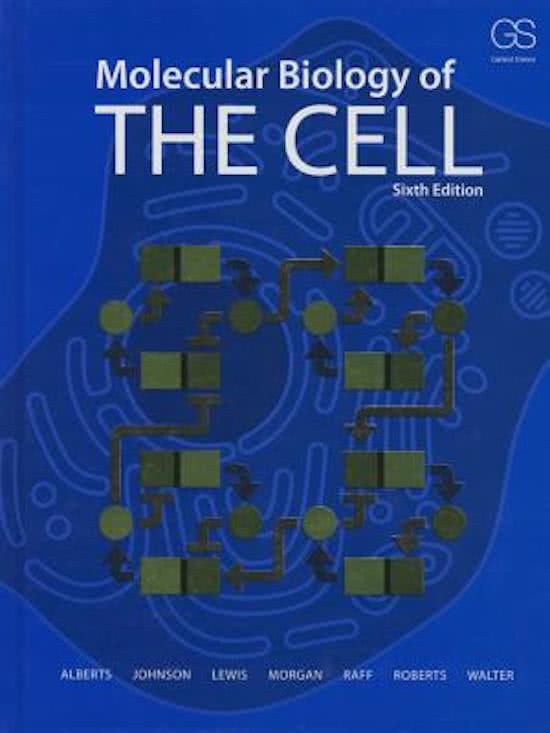
Test Bank for Molecular Biology of the Cell 6th Edition
By Bruce Alberts
All Chapters (1–24) |Expert Verified Answers | Graded A+
,TESTBANKS BY TESTBANKSNERD
Chapter 1: Cells And Genomes
1 Scientists discover more than ten thousand new species of living organisms every
year. What is shared between all of these organisms?
A. They are made of cells, whose nuclei enclose their DNA.
B. They obtain their energy from sunlight.
C. They produce and use adenosine triphosphate (ATP).
D. Their genome contains at least 1000 genes.
E. All of the above.
2 All cells …
A. have membrane transport proteins.
B. synthesize proteins on the ribosome.
C. replicate their genome by DNA polymerization.
D. transcribe their genetic information by RNA polymerization.
E. All of the above.
3 Imagine a segment of DNA (within a gene) encoding a certain amount of information
in its nucleotide sequence. When this segment is fully transcribed into mRNA and then
translated into protein, in general, …
A. the protein sequence would carry more information compared to the DNA and
mRNA sequences, because its alphabet has 20 letters.
B. the protein sequence would carry less information compared to the DNA and
mRNA sequences, because several codons can correspond to one amino acid.
C. the amount of information in the mRNA sequence is lower, because the mRNA
has been transcribed using only one of the DNA strands as the template.
D. the amount of information in the mRNA sequence is higher, because several
mRNA molecules can be transcribed from one DNA molecule.
4 Which of the following processes that happens inside a cell DOES NOT normally
require consumption of free energy by the cell?
,TESTBANKS BY TESTBANKSNERD
A. Replication of the genetic material
B. Import of nutrients from the environment
C. Diffusion of small molecules within the cell
D. Regulation of gene expression
E. Synthesis of enzymes that catalyze cellular reactions
5 Which of the following would you NOT expect to find in a bacterial cell?
A. Swimming using flagella
B. Having a cell wall around the plasma membrane
C. ATP production in mitochondria
D. Protein production on the ribosome
E. Sexual exchange of DNA with other bacteria
6 To trace family relationships between distantly related organisms such as humans,
algae, bacteria, and archaea, one should compare their genomes in regions …
A. that evolve rapidly.
B. that have a higher mutation rate.
C. that code for proteins.
D. where mutations are hardly tolerated.
E. where most mutations are selectively neutral.
7 Laboratory strains of the model organism Escherichia coli that are resistant to
antibiotics are very often used in research laboratories as well as in the biotechnology
industry. If cultures of such bacteria were allowed to contaminate the environment
uncontrollably, it is possible that at some point, pathogenic bacteria such as Neisseria
meningitidis (which causes meningitis and can cause death, especially in children) could
acquire the same antibiotic-resistance gene, causing a meningitis outbreak that is difficult
to treat. In this scenario, which of the following mechanisms is a more likely source of the
antibiotic-resistance gene in N. meningitidis?
A. Random new gene generation
B. Intragenic mutation
C. Gene duplication
D. DNA segment shuffling
E. Horizontal gene transfer
8 A virus …
A. is a type of cell.
, TESTBANKS BY TESTBANKSNERD
B. has genetic material made of proteins.
C. can only infect a single host species.
D. can act as a vector for gene transfer.
E. cannot persist in its host for more than one cell generation.
9 Which of the following does NOT typically involve horizontal gene transfer?
A. Sexual reproduction in humans
B. Bacteriophage infection of bacteria
C. The evolutionary history of the eukaryotic cell
D. The accidental duplication of a small region of a bacterial chromosome followed
by cell division
E. Introduction of plasmids into bacteria in a laboratory
10 Gene duplication can give rise to homologous genes that are part of gene families.
For example, there are six actin genes in the genome of most mammalian species. In
humans, the ACTB gene, which encodes a cytoskeletal actin, is expressed ubiquitously, while
ACTC1 is expressed mainly in cardiac cells. Although bacteria lack the eukaryotic
cytoskeletal organization, the bacterial MreB gene bears recognizable sequence similarity
to mammalian actin genes and codes for a protein that is similar to actin in structure and
function. Which of the following statements is true about these genes?
A. ACTB is homologous to ACTC1 but not to MreB.
B. ACTB is orthologous to ACTC1 but not to MreB.
C. ACTB is paralogous to ACTC1 but not to MreB.
D. MreB is orthologous to ACTB but not to ACTC1.
E. ACTB is paralogous to both ACTC1 and MreB.
11 Out of nearly 5000 protein-coding gene families, there is a set of nearly 300
conserved gene families that are found in species from all domains of life. When one looks
at the general functions assigned to these gene families, it is found that …
A. the majority of them function in cell-to-cell signaling.
B. the majority of them are poorly characterized.
C. more than one-third of them are involved in translation or amino acid
transport and metabolism.
D. more than one-half of the shared families are involved in DNA replication
and transcription.
E. Nearly all of them are involved in energy production and carbohydrate metabolism.
Test Bank for Molecular Biology of the Cell 6th Edition
By Bruce Alberts
All Chapters (1–24) |Expert Verified Answers | Graded A+
,TESTBANKS BY TESTBANKSNERD
Chapter 1: Cells And Genomes
1 Scientists discover more than ten thousand new species of living organisms every
year. What is shared between all of these organisms?
A. They are made of cells, whose nuclei enclose their DNA.
B. They obtain their energy from sunlight.
C. They produce and use adenosine triphosphate (ATP).
D. Their genome contains at least 1000 genes.
E. All of the above.
2 All cells …
A. have membrane transport proteins.
B. synthesize proteins on the ribosome.
C. replicate their genome by DNA polymerization.
D. transcribe their genetic information by RNA polymerization.
E. All of the above.
3 Imagine a segment of DNA (within a gene) encoding a certain amount of information
in its nucleotide sequence. When this segment is fully transcribed into mRNA and then
translated into protein, in general, …
A. the protein sequence would carry more information compared to the DNA and
mRNA sequences, because its alphabet has 20 letters.
B. the protein sequence would carry less information compared to the DNA and
mRNA sequences, because several codons can correspond to one amino acid.
C. the amount of information in the mRNA sequence is lower, because the mRNA
has been transcribed using only one of the DNA strands as the template.
D. the amount of information in the mRNA sequence is higher, because several
mRNA molecules can be transcribed from one DNA molecule.
4 Which of the following processes that happens inside a cell DOES NOT normally
require consumption of free energy by the cell?
,TESTBANKS BY TESTBANKSNERD
A. Replication of the genetic material
B. Import of nutrients from the environment
C. Diffusion of small molecules within the cell
D. Regulation of gene expression
E. Synthesis of enzymes that catalyze cellular reactions
5 Which of the following would you NOT expect to find in a bacterial cell?
A. Swimming using flagella
B. Having a cell wall around the plasma membrane
C. ATP production in mitochondria
D. Protein production on the ribosome
E. Sexual exchange of DNA with other bacteria
6 To trace family relationships between distantly related organisms such as humans,
algae, bacteria, and archaea, one should compare their genomes in regions …
A. that evolve rapidly.
B. that have a higher mutation rate.
C. that code for proteins.
D. where mutations are hardly tolerated.
E. where most mutations are selectively neutral.
7 Laboratory strains of the model organism Escherichia coli that are resistant to
antibiotics are very often used in research laboratories as well as in the biotechnology
industry. If cultures of such bacteria were allowed to contaminate the environment
uncontrollably, it is possible that at some point, pathogenic bacteria such as Neisseria
meningitidis (which causes meningitis and can cause death, especially in children) could
acquire the same antibiotic-resistance gene, causing a meningitis outbreak that is difficult
to treat. In this scenario, which of the following mechanisms is a more likely source of the
antibiotic-resistance gene in N. meningitidis?
A. Random new gene generation
B. Intragenic mutation
C. Gene duplication
D. DNA segment shuffling
E. Horizontal gene transfer
8 A virus …
A. is a type of cell.
, TESTBANKS BY TESTBANKSNERD
B. has genetic material made of proteins.
C. can only infect a single host species.
D. can act as a vector for gene transfer.
E. cannot persist in its host for more than one cell generation.
9 Which of the following does NOT typically involve horizontal gene transfer?
A. Sexual reproduction in humans
B. Bacteriophage infection of bacteria
C. The evolutionary history of the eukaryotic cell
D. The accidental duplication of a small region of a bacterial chromosome followed
by cell division
E. Introduction of plasmids into bacteria in a laboratory
10 Gene duplication can give rise to homologous genes that are part of gene families.
For example, there are six actin genes in the genome of most mammalian species. In
humans, the ACTB gene, which encodes a cytoskeletal actin, is expressed ubiquitously, while
ACTC1 is expressed mainly in cardiac cells. Although bacteria lack the eukaryotic
cytoskeletal organization, the bacterial MreB gene bears recognizable sequence similarity
to mammalian actin genes and codes for a protein that is similar to actin in structure and
function. Which of the following statements is true about these genes?
A. ACTB is homologous to ACTC1 but not to MreB.
B. ACTB is orthologous to ACTC1 but not to MreB.
C. ACTB is paralogous to ACTC1 but not to MreB.
D. MreB is orthologous to ACTB but not to ACTC1.
E. ACTB is paralogous to both ACTC1 and MreB.
11 Out of nearly 5000 protein-coding gene families, there is a set of nearly 300
conserved gene families that are found in species from all domains of life. When one looks
at the general functions assigned to these gene families, it is found that …
A. the majority of them function in cell-to-cell signaling.
B. the majority of them are poorly characterized.
C. more than one-third of them are involved in translation or amino acid
transport and metabolism.
D. more than one-half of the shared families are involved in DNA replication
and transcription.
E. Nearly all of them are involved in energy production and carbohydrate metabolism.