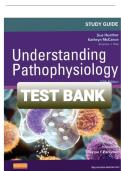
Test Bank - Understanding Pathophysiology 7th Edition (Huether, 2020)
TEST BANK
Understanding Pathophysiology
Sue E. Huether, Kathryn L. McCance,Valentina L.Brashers
7th Edition
, Test Bank - Understanding Pathophysiology 7th Edition (Huether, 2020)
Table of Contents
PART ONE: BASIC CONCEPTS OF PATHOPHYSIOLOGY
Unit 1: The Cell
1. Cellular Biology
2. Genes and Genetic Diseases
3. Epigenetics and Disease
4. Altered Cellular and Tissue Biology
5. Fluids and Electrolytes, Acids and Bases
Unit 2: Mechanisms of Self-Defense
6. Innate Immunity: Inflammation and Wound Healing
7. Adaptive Immunity
8. Alterations in Immunity NEW
9. Infection and Defects in Mechanisms of Defense
10. Stress and Disease
Unit 3: Cellular Proliferation: Cancer
11. Biology of Cancer
12. Cancer Epidemiology
13. Cancer in Children and Adolescents
PART TWO: BODY SYSTEMS AND DISEASES
Unit 4: The Neurologic System
14. Structure and Function of the Neurologic System
15. Pain, Temperature, Sleep, and Sensory Function
16. Alterations in Cognitive Systems, Cerebral Hemodynamics, and Motor Function
17. Disorders of the Central and Peripheral Nervous Systems and Neuromuscular Junction
18. Alterations of Neurologic Function in Children
Unit 5: The Endocrine System
19. Mechanisms of Hormonal Regulation
20. Alterations of Hormonal Regulation
21. Obesity and Disorders of Nutrition NEW
Unit 6: The Hematologic System
22. Structure and Function of the Hematologic System
23. Alterations of Hematologic Function
24. Alterations of Hematologic Function in Children
, Test Bank - Understanding Pathophysiology 7th Edition (Huether, 2020)
Unit 7: The Cardiovascular and Lymphatic Systems
25. Structure and Function of the Cardiovascular and Lymphatic Systems
26. Alterations of Cardiovascular Function
27. Alterations of Cardiovascular Function in Children
Unit 8: The Pulmonary System
28. Structure and Function of the Pulmonary System
29. Alterations of Pulmonary Function
30. Alterations of Pulmonary Function in Children
Unit 9: The Renal and Urologic Systems
31. Structure and Function of the Renal and Urologic Systems
32. Alterations of Renal and Urinary Tract Function
33. Alterations of Renal and Urinary Tract Function in Children
Unit 10: The Reproductive Systems
34. Structure and Function of the Reproductive Systems
35. Alterations of the Female Reproductive System
36. Alterations of the Male Reproductive System
Unit 11: The Digestive System
37. Structure and Function of the Digestive System
38. Alterations of Digestive Function
39. Alterations of Digestive Function in Children
Unit 12: The Musculoskeletal and Integumentary Systems
40. Structure and Function of the Musculoskeletal System
41. Alterations of Musculoskeletal Function
42. Alterations of Musculoskeletal Function in Children
43. Structure, Function, and Disorders of the Integument
44. Alterations of the Integument in Children
, Test Bank - Understanding Pathophysiology 7th Edition (Huether, 2020)
Chapter 1. Cellular Biology
Huether: Understanding Pathophysiology, 7th Edition
MULTIPLE CHOICE
1. A student is observing a cell under the microscope. It is observed to have supercoiled DNA
with histones. Which of the following would also be observed by the student?
a. A single circular chromosome
b. A nucleus
c. Free-floating nuclear material
d. No organelles
ANS: B
The cell described is a eukaryotic cell, so it has histones and a supercoiled DNA within its
nucleus; thus, the nucleus should be observed.
A single circular chromosome is characteristic of prokaryotic cells, which do not have histones.
Free-floating nuclear material describes a prokaryotic cell, which would not have a distinct
nucleus.
Eukaryotic cells have membrane bounded cellular components called organelles. No organelles
describes a prokaryotic cell.
2. A nurse is instructing the staff about cellular functions. Which cellular function is the nurse
describing when an isolated cell absorbs oxygen and uses it to transform nutrients to energy?
a. Metabolic absorption
b. Communication
c. Secretion
d. Respiration
, Test Bank - Understanding Pathophysiology 7th Edition (Huether, 2020)
ANS : D
The ability of the cell to absorb oxygen refers to the cells function of respiration.
The ability of the cell to function within a society of cells refers to its function of
communication.
The ability of the cell to take in nutrients refers to the cells function of metabolic absorption.
The ability of the cell to synthesize new substances and secrete these elsewhere refers to the cells
function of secretion.
3. A eukaryotic cell is undergoing DNA replication. In which region of the cell would most of
the genetic information be contained?
a. Mitochondria
b. Ribosome
c. Nucleolus
d. Nucleus
ANS: C
The region of the cell that contains genetic material, including a large amount of ribonucleic
acid, most of the DNA, and DNA-binding proteins, is the nucleolus.
The mitochondria is the site of cellular respiration.
The ribosomes are involved in manufacturing of proteins within the cell.
The nucleus contains the nucleolus, and it is the nucleolus that contains genetic material.
4. The fluid mosaic model for biologic membranes describes membrane behavior. According to
this model, which of the following float singly or as aggregates in the fluid lipid bilayer?
a. Peripheral membrane proteins
b. Integral membrane proteins
, Test Bank - Understanding Pathophysiology 7th Edition (Huether, 2020)
c. Glycoproteins
d. Cell adhesion molecules
ANS: B
Integral membrane proteins float freely in the fluid lipid bilayer.
Peripheral membrane proteins are not embedded in the layer, but reside at the surface.
Glycoproteins act as cell surface markers.
Cell adhesion molecules are on the outside of the membrane and allow cells to hook together.
5. Which of the following can bind to plasma membrane receptors?
a. Oxygen
b. Ribosomes
c. Amphipathic lipids
d. Ligands
ANS: D
Ligands are specific molecules that can bind with receptors on the cell membrane.
Oxygen moves by diffusion; it does not bind to receptors.
Ribosomes make proteins and are not involved in binding.
Amphipathic lipids are a portion of the cell membrane.
6. A nurse is reviewing a report from a patient with metastatic cancer. What finding would
support the diagnosis of metastatic cancer? Alterations in extracellular matrix that include:
a. Decreased fibronectin
b. Increased collagen
c. Decreased elastin
, Test Bank - Understanding Pathophysiology 7th Edition (Huether, 2020)
d. Increased glycoproteins
ANS: A
Reduced amounts of fibronectin are found in some types of cancerous cells, allowing cancer
cells to travel, or metastasize.
Collagen provides strength, and its breakdown is associated with osteoarthritis, not cancer.
Elastin is found in the lungs and allows tissues to stretch; it is not associated with cancerous
cells.
Decreased, not increased, glycoproteins are associated with cancerous cells.
7. Which form of cell communication is used to relate to other cells in direct physical contact?
a. Cell junction
b. Gap junction
c. Desmosomes
d. Tight junctions
ANS: A
Cell junctions hold cells together and permit molecules to pass from cell to cell.
Gap junctions allow communication from the inside of one cell to the inside of another.
Desmosomes are not involved in communication, but allow cells to hold together.
Tight junctions are barriers that prevent movement of some substances and leakages of others.
8. Pancreatic beta cells secrete insulin, which inhibits secretion of glucagon from neighboring
alpha cells. This action is an example of which of the following signaling types?
a. Paracrine
b. Autocrine
, Test Bank - Understanding Pathophysiology 7th Edition (Huether, 2020)
c. Neurohormonal
d. Hormonal
ANS: A
Paracrine signaling involves the release of local chemical mediators that are quickly taken up,
destroyed, or immobilized, as in the case of insulin and the inhibition of the secretion of
glucagon.
When cells produce signals that they themselves respond to, autocrine signaling is used.
Neurohormonal signaling involves secretion of hormones into the bloodstream by neurosecretory
hormones.
Hormonal signaling involves specialized endocrine cells that secrete hormone chemicals released
by one set of cells that travel through the tissue through the bloodstream to produce a response in
other sets of cells.
9. In cellular metabolism, each enzyme has a high affinity for a:
a. Solute
b. Substrate
c. Receptor
d. Ribosome
ANS: B
Each enzyme has a high affinity for a substrate, a specific substance converted to a product of the
reaction.
Solutes are small particles that pass through the cell membrane.
A receptor is a site on the cell wall that allows transport into the cell.
Ribosomes are located inside the cell and are not related to the work of enzymes.
, Test Bank - Understanding Pathophysiology 7th Edition (Huether, 2020)
10. An athlete runs a marathon, after which his muscles feel fatigued and unable to contract. The
athlete asks the nurse why this happened. How should the nurse respond? A deficiency in
can cause impaired muscle contraction.
a. GTP
b. AMP
c. ATP
d. GMP
ANS: C
The cell uses ATP for muscle contraction. when it is deficient, impaired muscle contraction
results.
GTP is involved in cell signaling, not muscle contraction.
AMP is not involved in muscle contraction.
GMP is not involved in muscle contraction.
11. Which phase of catabolism produces the most ATP?
a. Digestion
b. Glycolysis
c. Oxidation
d. Citric acid cycle
ANS: D
Most of the ATP is generated during the citric acid cycle.
Larger molecules are broken down into smaller units during digestion; no ATP is produced
during this cycle.
, Test Bank - Understanding Pathophysiology 7th Edition (Huether, 2020)
During glycolysis, two molecules of ATP are produced from each glucose molecule, but the
most ATP is produced during the citric acid cycle.
Oxidation is part of the glycolysis process and ATP is produced, but more ATP is produced
during the citric acid cycle.
12. A nurse is teaching the staff about the three phases of cellular catabolism. Which of the
following should the nurse include?
a. Digestion, glycolysis and oxidation, and the citric acid cycle
b. Diffusion, osmosis, and mediated transport
c. S phase, G phase, and M phase
d. Metabolic absorption, respiration, and excretion
ANS: A
Digestion, glycolysis and oxidation, and the citric acid cycle are the three phases of cellular
catabolism.
Diffusion, osmosis, and mediated transport are parts of the movement of fluids in and out of
cells.
The S, G, and M phases are phases of cellular division, not catabolism.
Metabolic absorption, respiration, and excretion are functions of the cell.
13. A runner has depleted all the oxygen available for muscle energy. Which of the following
will facilitate his continued muscle performance?
a. Electron-transport chain
b. Aerobic glycolysis
c. Anaerobic glycolysis
d. Oxidative phosphorylation
ANS: C
TEST BANK
Understanding Pathophysiology
Sue E. Huether, Kathryn L. McCance,Valentina L.Brashers
7th Edition
, Test Bank - Understanding Pathophysiology 7th Edition (Huether, 2020)
Table of Contents
PART ONE: BASIC CONCEPTS OF PATHOPHYSIOLOGY
Unit 1: The Cell
1. Cellular Biology
2. Genes and Genetic Diseases
3. Epigenetics and Disease
4. Altered Cellular and Tissue Biology
5. Fluids and Electrolytes, Acids and Bases
Unit 2: Mechanisms of Self-Defense
6. Innate Immunity: Inflammation and Wound Healing
7. Adaptive Immunity
8. Alterations in Immunity NEW
9. Infection and Defects in Mechanisms of Defense
10. Stress and Disease
Unit 3: Cellular Proliferation: Cancer
11. Biology of Cancer
12. Cancer Epidemiology
13. Cancer in Children and Adolescents
PART TWO: BODY SYSTEMS AND DISEASES
Unit 4: The Neurologic System
14. Structure and Function of the Neurologic System
15. Pain, Temperature, Sleep, and Sensory Function
16. Alterations in Cognitive Systems, Cerebral Hemodynamics, and Motor Function
17. Disorders of the Central and Peripheral Nervous Systems and Neuromuscular Junction
18. Alterations of Neurologic Function in Children
Unit 5: The Endocrine System
19. Mechanisms of Hormonal Regulation
20. Alterations of Hormonal Regulation
21. Obesity and Disorders of Nutrition NEW
Unit 6: The Hematologic System
22. Structure and Function of the Hematologic System
23. Alterations of Hematologic Function
24. Alterations of Hematologic Function in Children
, Test Bank - Understanding Pathophysiology 7th Edition (Huether, 2020)
Unit 7: The Cardiovascular and Lymphatic Systems
25. Structure and Function of the Cardiovascular and Lymphatic Systems
26. Alterations of Cardiovascular Function
27. Alterations of Cardiovascular Function in Children
Unit 8: The Pulmonary System
28. Structure and Function of the Pulmonary System
29. Alterations of Pulmonary Function
30. Alterations of Pulmonary Function in Children
Unit 9: The Renal and Urologic Systems
31. Structure and Function of the Renal and Urologic Systems
32. Alterations of Renal and Urinary Tract Function
33. Alterations of Renal and Urinary Tract Function in Children
Unit 10: The Reproductive Systems
34. Structure and Function of the Reproductive Systems
35. Alterations of the Female Reproductive System
36. Alterations of the Male Reproductive System
Unit 11: The Digestive System
37. Structure and Function of the Digestive System
38. Alterations of Digestive Function
39. Alterations of Digestive Function in Children
Unit 12: The Musculoskeletal and Integumentary Systems
40. Structure and Function of the Musculoskeletal System
41. Alterations of Musculoskeletal Function
42. Alterations of Musculoskeletal Function in Children
43. Structure, Function, and Disorders of the Integument
44. Alterations of the Integument in Children
, Test Bank - Understanding Pathophysiology 7th Edition (Huether, 2020)
Chapter 1. Cellular Biology
Huether: Understanding Pathophysiology, 7th Edition
MULTIPLE CHOICE
1. A student is observing a cell under the microscope. It is observed to have supercoiled DNA
with histones. Which of the following would also be observed by the student?
a. A single circular chromosome
b. A nucleus
c. Free-floating nuclear material
d. No organelles
ANS: B
The cell described is a eukaryotic cell, so it has histones and a supercoiled DNA within its
nucleus; thus, the nucleus should be observed.
A single circular chromosome is characteristic of prokaryotic cells, which do not have histones.
Free-floating nuclear material describes a prokaryotic cell, which would not have a distinct
nucleus.
Eukaryotic cells have membrane bounded cellular components called organelles. No organelles
describes a prokaryotic cell.
2. A nurse is instructing the staff about cellular functions. Which cellular function is the nurse
describing when an isolated cell absorbs oxygen and uses it to transform nutrients to energy?
a. Metabolic absorption
b. Communication
c. Secretion
d. Respiration
, Test Bank - Understanding Pathophysiology 7th Edition (Huether, 2020)
ANS : D
The ability of the cell to absorb oxygen refers to the cells function of respiration.
The ability of the cell to function within a society of cells refers to its function of
communication.
The ability of the cell to take in nutrients refers to the cells function of metabolic absorption.
The ability of the cell to synthesize new substances and secrete these elsewhere refers to the cells
function of secretion.
3. A eukaryotic cell is undergoing DNA replication. In which region of the cell would most of
the genetic information be contained?
a. Mitochondria
b. Ribosome
c. Nucleolus
d. Nucleus
ANS: C
The region of the cell that contains genetic material, including a large amount of ribonucleic
acid, most of the DNA, and DNA-binding proteins, is the nucleolus.
The mitochondria is the site of cellular respiration.
The ribosomes are involved in manufacturing of proteins within the cell.
The nucleus contains the nucleolus, and it is the nucleolus that contains genetic material.
4. The fluid mosaic model for biologic membranes describes membrane behavior. According to
this model, which of the following float singly or as aggregates in the fluid lipid bilayer?
a. Peripheral membrane proteins
b. Integral membrane proteins
, Test Bank - Understanding Pathophysiology 7th Edition (Huether, 2020)
c. Glycoproteins
d. Cell adhesion molecules
ANS: B
Integral membrane proteins float freely in the fluid lipid bilayer.
Peripheral membrane proteins are not embedded in the layer, but reside at the surface.
Glycoproteins act as cell surface markers.
Cell adhesion molecules are on the outside of the membrane and allow cells to hook together.
5. Which of the following can bind to plasma membrane receptors?
a. Oxygen
b. Ribosomes
c. Amphipathic lipids
d. Ligands
ANS: D
Ligands are specific molecules that can bind with receptors on the cell membrane.
Oxygen moves by diffusion; it does not bind to receptors.
Ribosomes make proteins and are not involved in binding.
Amphipathic lipids are a portion of the cell membrane.
6. A nurse is reviewing a report from a patient with metastatic cancer. What finding would
support the diagnosis of metastatic cancer? Alterations in extracellular matrix that include:
a. Decreased fibronectin
b. Increased collagen
c. Decreased elastin
, Test Bank - Understanding Pathophysiology 7th Edition (Huether, 2020)
d. Increased glycoproteins
ANS: A
Reduced amounts of fibronectin are found in some types of cancerous cells, allowing cancer
cells to travel, or metastasize.
Collagen provides strength, and its breakdown is associated with osteoarthritis, not cancer.
Elastin is found in the lungs and allows tissues to stretch; it is not associated with cancerous
cells.
Decreased, not increased, glycoproteins are associated with cancerous cells.
7. Which form of cell communication is used to relate to other cells in direct physical contact?
a. Cell junction
b. Gap junction
c. Desmosomes
d. Tight junctions
ANS: A
Cell junctions hold cells together and permit molecules to pass from cell to cell.
Gap junctions allow communication from the inside of one cell to the inside of another.
Desmosomes are not involved in communication, but allow cells to hold together.
Tight junctions are barriers that prevent movement of some substances and leakages of others.
8. Pancreatic beta cells secrete insulin, which inhibits secretion of glucagon from neighboring
alpha cells. This action is an example of which of the following signaling types?
a. Paracrine
b. Autocrine
, Test Bank - Understanding Pathophysiology 7th Edition (Huether, 2020)
c. Neurohormonal
d. Hormonal
ANS: A
Paracrine signaling involves the release of local chemical mediators that are quickly taken up,
destroyed, or immobilized, as in the case of insulin and the inhibition of the secretion of
glucagon.
When cells produce signals that they themselves respond to, autocrine signaling is used.
Neurohormonal signaling involves secretion of hormones into the bloodstream by neurosecretory
hormones.
Hormonal signaling involves specialized endocrine cells that secrete hormone chemicals released
by one set of cells that travel through the tissue through the bloodstream to produce a response in
other sets of cells.
9. In cellular metabolism, each enzyme has a high affinity for a:
a. Solute
b. Substrate
c. Receptor
d. Ribosome
ANS: B
Each enzyme has a high affinity for a substrate, a specific substance converted to a product of the
reaction.
Solutes are small particles that pass through the cell membrane.
A receptor is a site on the cell wall that allows transport into the cell.
Ribosomes are located inside the cell and are not related to the work of enzymes.
, Test Bank - Understanding Pathophysiology 7th Edition (Huether, 2020)
10. An athlete runs a marathon, after which his muscles feel fatigued and unable to contract. The
athlete asks the nurse why this happened. How should the nurse respond? A deficiency in
can cause impaired muscle contraction.
a. GTP
b. AMP
c. ATP
d. GMP
ANS: C
The cell uses ATP for muscle contraction. when it is deficient, impaired muscle contraction
results.
GTP is involved in cell signaling, not muscle contraction.
AMP is not involved in muscle contraction.
GMP is not involved in muscle contraction.
11. Which phase of catabolism produces the most ATP?
a. Digestion
b. Glycolysis
c. Oxidation
d. Citric acid cycle
ANS: D
Most of the ATP is generated during the citric acid cycle.
Larger molecules are broken down into smaller units during digestion; no ATP is produced
during this cycle.
, Test Bank - Understanding Pathophysiology 7th Edition (Huether, 2020)
During glycolysis, two molecules of ATP are produced from each glucose molecule, but the
most ATP is produced during the citric acid cycle.
Oxidation is part of the glycolysis process and ATP is produced, but more ATP is produced
during the citric acid cycle.
12. A nurse is teaching the staff about the three phases of cellular catabolism. Which of the
following should the nurse include?
a. Digestion, glycolysis and oxidation, and the citric acid cycle
b. Diffusion, osmosis, and mediated transport
c. S phase, G phase, and M phase
d. Metabolic absorption, respiration, and excretion
ANS: A
Digestion, glycolysis and oxidation, and the citric acid cycle are the three phases of cellular
catabolism.
Diffusion, osmosis, and mediated transport are parts of the movement of fluids in and out of
cells.
The S, G, and M phases are phases of cellular division, not catabolism.
Metabolic absorption, respiration, and excretion are functions of the cell.
13. A runner has depleted all the oxygen available for muscle energy. Which of the following
will facilitate his continued muscle performance?
a. Electron-transport chain
b. Aerobic glycolysis
c. Anaerobic glycolysis
d. Oxidative phosphorylation
ANS: C