
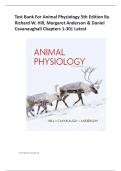
Test Bank For Animal Physiology 5th Edition By
Richard W. Hill, Margaret Anderson & Daniel
Cavanaughall Chapters 1-30| Latest
© 2016 Sinauer Associates, Inc.
, chapter 1: animals and environments: function on the ecological stage
test bank questions
multiple choice
1. which statement about the discipline of physiology is false?
a. it is a key discipline for understanding how animals change over earth’s history.
b. it is a key discipline for understanding the fundamental biology of all animals.
c. it is a key discipline for understanding human health and disease.
it is a key discipline for understanding the health and disease of
nonhuman animals.ans: a
textbook reference: the importance of physiology bloom’s
category: 5. evaluating
2. to understand how a fish propels itself by applying forces to the water, physiologists
would study its
a. biomechanics.
b. evolution.
c. ecology.
cell physiology.ans: a
textbook reference: the highly integrative nature of physiology
bloom’s category: 2. understanding
3. the data in the graph below would be relevant to which subdiscipline of physiology?
© 2016 Sinauer Associates, Inc.
,a. evolution
b. cell physiology
c. morphology
ecologyans: d
textbook reference: the highly integrative nature of physiology
bloom’s category: 2. understanding
4. in the study of physiology, the term “ ” refers to the components of living
animals and the interactions among those components that enable animals to perform
as they do.
a. feedback
b. regulation
c. natural selection
mechanismans: d
textbook reference: mechanism and origin: physiology’s two central questions bloom’s
category: 1. remembering
5. how is the light reaction in the firefly inhibited?
a. mitochondria prevent oxygen from reacting with luciferyl-amp.
b. nitric oxide combines with oxygen to prevent reaction with luciferyl-amp.
c. atp is prevented from combining with luciferin.
luciferase is prevented from catalyzing the reaction.ans: a
textbook reference: mechanism and origin: physiology’s two central questions bloom’s
category: 2. understanding
6. which of the following is not needed in the mechanism of light production in the
firefly?
a. oxygen
b. atp
c. light
luciferinans: c
textbook reference: mechanism and origin: physiology’s two central questions bloom’s
category: 2. understanding
7. in the firefly, light is emitted when
a. atp combines with luciferin, forming luciferyl-amp.
b. released nitric oxide blocks the mitochondria’s use of oxygen.
c. the electron-excited product of o2 and luciferyl-amp returns to its ground state.
luciferase is activated by oxygen.ans: c
textbook reference: mechanism and origin: physiology’s two central questions
© 2016 Sinauer Associates, Inc.
, bloom’s category: 5. evaluating
8. which of the following is considered the “on” switch for the light-emitting reaction of
the firefly?
a. oxygen
b. luciferase
c. nitric oxide
d. atp
ans: c
textbook reference: mechanism and origin: physiology’s two central questions bloom’s
category: 3. applying
9. a physiological mechanism or other trait that is a product of evolution and
is advantageous is called
a. an adaptation.
b. natural selection.
c. adaptive significance.
evolution.ans: a
textbook reference: mechanism and origin: physiology’s two central questions bloom’s
category: 1. remembering
10. what is the adaptive significance of light emission in the firefly?
a. female fireflies emit light in such a way that distinguishes their species.
b. all fireflies emit light to lure prey.
c. male fireflies emit light to attract mates.
male fireflies emit light to evade predators.ans: c
textbook reference: mechanism and origin: physiology’s two central questions bloom’s
category: 2. understanding
11. which of the following is a similarity between an octopus and a fish?
a. the evolutionary adaptation of excellent vision
b. the mechanism of vision
c. the processing of visual signals before reaching the optic nerve
the neuroanatomy of the eyeans: a
textbook reference: mechanism and origin: physiology’s two central questions bloom’s
category: 5. evaluating
12. research in the field of physiology emphasizes synthesis across levels of
biological organization.
a. evolutionary
b. comparative
c. environmental
d. integrative
© 2016 Sinauer Associates, Inc.
Richard W. Hill, Margaret Anderson & Daniel
Cavanaughall Chapters 1-30| Latest
© 2016 Sinauer Associates, Inc.
, chapter 1: animals and environments: function on the ecological stage
test bank questions
multiple choice
1. which statement about the discipline of physiology is false?
a. it is a key discipline for understanding how animals change over earth’s history.
b. it is a key discipline for understanding the fundamental biology of all animals.
c. it is a key discipline for understanding human health and disease.
it is a key discipline for understanding the health and disease of
nonhuman animals.ans: a
textbook reference: the importance of physiology bloom’s
category: 5. evaluating
2. to understand how a fish propels itself by applying forces to the water, physiologists
would study its
a. biomechanics.
b. evolution.
c. ecology.
cell physiology.ans: a
textbook reference: the highly integrative nature of physiology
bloom’s category: 2. understanding
3. the data in the graph below would be relevant to which subdiscipline of physiology?
© 2016 Sinauer Associates, Inc.
,a. evolution
b. cell physiology
c. morphology
ecologyans: d
textbook reference: the highly integrative nature of physiology
bloom’s category: 2. understanding
4. in the study of physiology, the term “ ” refers to the components of living
animals and the interactions among those components that enable animals to perform
as they do.
a. feedback
b. regulation
c. natural selection
mechanismans: d
textbook reference: mechanism and origin: physiology’s two central questions bloom’s
category: 1. remembering
5. how is the light reaction in the firefly inhibited?
a. mitochondria prevent oxygen from reacting with luciferyl-amp.
b. nitric oxide combines with oxygen to prevent reaction with luciferyl-amp.
c. atp is prevented from combining with luciferin.
luciferase is prevented from catalyzing the reaction.ans: a
textbook reference: mechanism and origin: physiology’s two central questions bloom’s
category: 2. understanding
6. which of the following is not needed in the mechanism of light production in the
firefly?
a. oxygen
b. atp
c. light
luciferinans: c
textbook reference: mechanism and origin: physiology’s two central questions bloom’s
category: 2. understanding
7. in the firefly, light is emitted when
a. atp combines with luciferin, forming luciferyl-amp.
b. released nitric oxide blocks the mitochondria’s use of oxygen.
c. the electron-excited product of o2 and luciferyl-amp returns to its ground state.
luciferase is activated by oxygen.ans: c
textbook reference: mechanism and origin: physiology’s two central questions
© 2016 Sinauer Associates, Inc.
, bloom’s category: 5. evaluating
8. which of the following is considered the “on” switch for the light-emitting reaction of
the firefly?
a. oxygen
b. luciferase
c. nitric oxide
d. atp
ans: c
textbook reference: mechanism and origin: physiology’s two central questions bloom’s
category: 3. applying
9. a physiological mechanism or other trait that is a product of evolution and
is advantageous is called
a. an adaptation.
b. natural selection.
c. adaptive significance.
evolution.ans: a
textbook reference: mechanism and origin: physiology’s two central questions bloom’s
category: 1. remembering
10. what is the adaptive significance of light emission in the firefly?
a. female fireflies emit light in such a way that distinguishes their species.
b. all fireflies emit light to lure prey.
c. male fireflies emit light to attract mates.
male fireflies emit light to evade predators.ans: c
textbook reference: mechanism and origin: physiology’s two central questions bloom’s
category: 2. understanding
11. which of the following is a similarity between an octopus and a fish?
a. the evolutionary adaptation of excellent vision
b. the mechanism of vision
c. the processing of visual signals before reaching the optic nerve
the neuroanatomy of the eyeans: a
textbook reference: mechanism and origin: physiology’s two central questions bloom’s
category: 5. evaluating
12. research in the field of physiology emphasizes synthesis across levels of
biological organization.
a. evolutionary
b. comparative
c. environmental
d. integrative
© 2016 Sinauer Associates, Inc.


