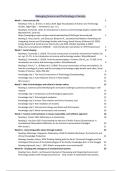
Managing Science and Technology in Society
Week 1 - Intro and Lab Life 1
Reading 1: Felt, U., & Irwin, A. (Eds.) 2024. Elgar Encyclopedia of Science and Technology
Studies. Edgar Elgar. -- Introduction, pp. 1-11. 1
Reading 2: Sismondo. 2010. An Introduction to Science and Technology Studies. Malden MA:
Blackwell Pub. (2nd ed.)
https://yvesgingras.uqam.ca/wp-content/uploads/sites/150/Sergio-Sismondo.pdf 2
Reading 3: Hess, David J. and Sovacool, Benjamin K., Sociotechnical Matters: Reviewing and
Integrating Science and Technology Studies with Energy Social Science (February 18, 2020).
Energy Research & Social Science Volume 65, July 2020, 101462, Available at SSRN:
https://ssrn.com/abstract=3540100 -- Only Introduction and Section 2 (‘STS Perspectives’) 2
Week 2 - Social shaping 3
Reading 1: Sismondo, S. (2010). The social construction of scientific and technical realities (2e
ed., pp. 57–71). In An introduction to science and technology studies. Wiley-Blackwell. 3
Reading 2: Sismondo, S. (2010). Feminist epistemologies of science (2e ed., pp. 72–80). In An
Introduction to science and technology studies. Wiley-Blackwell. 6
Reading 3: Pinch, T. J., & Bijker, W. E. (1984). The social construction of facts and artefacts: Or
how the sociology of science and the sociology of technology might benefit each other. Social
Studies of Science, 14(3), 399–441. 8
Knowledge clip 1: The Social Construction of Technology (Snowboarding): 10
Knowledge clip 2: Actor-Network Theory in Plain English: 11
Mini essay 1: 12
Week 3 - Role of technologies and culture in human values 13
Reading 1: Swierstra 2015 Identifying the normative challenges posed by technology’s ‘soft’
impacts 13
Knowledge clip 1: Introduction and technological approaches 14
Knowledge clip 2: Technological mediation 15
Knowledge clip 3: Human-Tech relations and Voice Assistants case 15
Knowledge clip 4: Tech mediation of morality 16
Knowledge clip 5: Technomoral change and (Hard and) Soft Impacts 17
Knowledge clip 6: Moral hermeneutics and summary 18
Week 4 - Science communication: A visual, responsible, and reflexive approach 18
Reading 1: Davies 2022 Reflecting on a relationship 18
Reading 2: Van Even 2023 Transcending the Horizon of Public Science Dissemination: A
Foundational Philosophical Reflection on the Science Communication Paradigm 20
Mini essay 2: 21
Week 5a - Governing public values through markets 22
Reading: Mavhunga, Clapperton Chakanetsa, 2018 The Mobile Workshop: The Tsetse Fly and
African Knowledge Production 22
Reading: Escobar, Arturo, 2016 Thinking-Feeling with the Earth: Territorial Struggles and the
Ontological Dimension of the Epistemologies of the South, Knowledges Born in the Struggle 24
Reading (optional): Law, J., 2015 What's wrong with a one-world world? 27
Week 5b - Studying the emergence of sociotechnical systems 29
Reading: Hess, David J. and Sovacool, Benjamin K Reviewing and Integrating Science and
Technology Studies with Energy Social Science - Only section 4.4 (Sociotechnical systems,
, practices, and users) 29
Reading: Winner 1980 Do Artifacts Have Politics - 121–36 31
Week 6 - Public engagement, citizen science, dialogue & responsible research and innovation 32
Reading: Stilgoe, J., Richard Owen, Phil Macnaghten (2013). Developing a framework for
responsible innovation 32
Reading: Van Oudheusden, M., Berti Suman, A., Huyse, T., Huyse, H. and Medvecky, F. (2023)
“The Valuable Plurality of the Citizen Sciences”, 34
Reading optional: Broerse JE, Zweekhorst MB, van Rensen AJ, de Haan MJ. Involving burn
survivors in agenda setting on burn research: an added value? 36
Reading: A Definition of Responsible Research and Innovation 37
Discussion board 38
General ideas STS 40
From WG discussions 41
Rubric 41
Essay zinnen 42
Matrix 43
Lectures key messages 68
Important names and contribution 69
Week 1 - Intro and Lab Life
Reading 1: Felt, U., & Irwin, A. (Eds.) 2024. Elgar Encyclopedia of Science and Technology Studies.
Edgar Elgar. -- Introduction, pp. 1-11.
Science and technology studies = fluid definition; interdisciplinary field of research and teaching that
takes science and technology as its principal focus.
- a co-productive understanding of science, technology and society
- how science and technology shape and order our lives and the world in which we live
- AND how societies shape the ways in which science and technology should and can develop
- knowledge and social orders are inseparably intertwined
Encyclopedia = a good fit with STS because it acknowledges the different perspectives people might
have and can all be true → an encyclopedia is not a map of reality it shapes our perception of what
the field is like rather than merely reflecting it
Script = defining the framework of action, who are the actors, space
De-scription = to redefine or partly reject the script formulated before → not a critique but as an
opportunity for the authors/scientists own perspective
STS is a balance between standardizing (too much → killing invention and imagination) and a broad
format (too much → losing the reader and keeping a vague concept)
1
,Reading 2: Sismondo. 2010. An Introduction to Science and Technology Studies. Malden MA:
Blackwell Pub. (2nd ed.)
https://yvesgingras.uqam.ca/wp-content/uploads/sites/150/Sergio-Sismondo.pdf
Logical positivism = a form of positivism, developed by members of the Vienna Circle, which
considers that the only meaningful problems are those which can be solved by logical and empirical
analysis
- inductive
- problems: 1) when meanings are reduced to observations there are many ‘truths’ that say
different things (e.g. the earth is in the middle or the sun is the middle of the universe)
2) claims/theories are not systematically related to observations, because theories are often
too abstract to be immediately cashed out in terms of data
Falsification (karl popper) = a philosophy of science, pioneered by Karl Popper, that asserts that
scientific theories cannot be proven true but can be disproven
- problem: 1) theories are often abstract and few make hard predictions which can be falsified
2) if a theory makes an incorrect prediction, scientists often look for reasons to explain the
observation or prediction rather than rejecting the theory
Duhem-Quine thesis = the claim that a theory can never be conclusively tested in isolation (an entire
framework/web of beliefs is tested). → an observation not in line with the theory tested doesn’t
necessarily mean that the theory is incorrect, it could also be because of other assumptions. →
shows a problem of deduction
Realism = the idea that many or most scientific theories are approximately true.
Determinism = The belief that technological innovation is the primary driver of social change
Mumford distinguished between polytechnics (small-scale, life-oriented tools serving diverse human
needs) and monotechnics (large, regimented “megamachines” that enhance power but
dehumanize). Heidegger made a similar point: modern technology, unlike traditional craft, reduces
the world to exploitable resources, leading to disenchantment. Dewey (1929) also saw science as a
kind of abstract technology and technology (in practice) as applied science. This idea that technology
is applied science leans toward technological determinism, as seen in Ellul’s (1964) definition of
technique as methods pursued for maximum efficiency at a given stage of development.
In STS knowledge and artefacts are constructed → human products and marked by the
circumstances of their production and scientists and engineers use the material world in their work
Reading 3: Hess, David J. and Sovacool, Benjamin K., Sociotechnical Matters: Reviewing and
Integrating Science and Technology Studies with Energy Social Science (February 18, 2020). Energy
Research & Social Science Volume 65, July 2020, 101462, Available at SSRN:
https://ssrn.com/abstract=3540100 -- Only Introduction and Section 2 (‘STS Perspectives’)
The text discusses how energy social science and Science and Technology Studies (STS) intersect.
Energy research draws on multiple disciplines (economics, sociology, psychology, etc.), but STS
perspectives are becoming increasingly important. At the same time, STS researchers are focusing
2
, more on energy and climate issues, especially electricity and mobility systems. Despite this overlap,
the two fields remain largely separate in methods, communities, and geography.
STS Overview:
● Broad sense: An interdisciplinary study of science and technology from social sciences and
humanities perspectives.
● Narrow/field sense: Studies how scientific knowledge and technology are constructed and
co-produced with society and the environment.
Central to STS is the sociotechnical lens, emphasizing that science and technology are shaped
not only by technical criteria but also by social, cultural, and political factors.
Key insights from the 1980s:
● Interpretive flexibility: Knowledge and technology gain meaning through social processes.
● Politics of design: Artifacts reflect social and political choices.
● Sociotechnical systems: Technologies exist within networks of people, institutions,
infrastructures, and resources.
● Distributed agency: Objects and technologies can influence outcomes within networks.
Developments in the 1990s–2000s:
STS diversified into five main directions:
● Cultural/anthropological approaches (race, gender, postcolonial perspectives).
● Policy-focused STS (expertise, risk, and boundary organizations).
● Actor-network theory and performativity (how science and economic theories shape reality).
● Public engagement (moving beyond the deficit model (only experts decide).
● Sociotechnical systems and users (users influence technological design and adaptation).
Week 2 - Social shaping
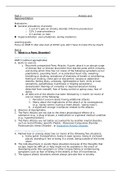
Reading 1: Sismondo, S. (2010). The social construction of scientific and technical realities (2e ed., pp.
57–71). In An introduction to science and technology studies. Wiley-Blackwell.
Assumptions social construction for STS:
1. Reminder that science and technology are important socially
2. Science and technology are active (a construct is active)
3. Science and technology do not provide a direct route from nature to ideas about
nature, that the products of science and technology are not themselves naturally.
The concept of social construction became central to Science and Technology Studies (STS)
in the late 1970s. While constructivism has taken many forms it consistently points out that
knowledge, facts, and technologies emerge through social processes rather than purely from
nature. Realism, by contrast, assumes that truths depend primarily on the natural world, not
on human activity.
3
Week 1 - Intro and Lab Life 1
Reading 1: Felt, U., & Irwin, A. (Eds.) 2024. Elgar Encyclopedia of Science and Technology
Studies. Edgar Elgar. -- Introduction, pp. 1-11. 1
Reading 2: Sismondo. 2010. An Introduction to Science and Technology Studies. Malden MA:
Blackwell Pub. (2nd ed.)
https://yvesgingras.uqam.ca/wp-content/uploads/sites/150/Sergio-Sismondo.pdf 2
Reading 3: Hess, David J. and Sovacool, Benjamin K., Sociotechnical Matters: Reviewing and
Integrating Science and Technology Studies with Energy Social Science (February 18, 2020).
Energy Research & Social Science Volume 65, July 2020, 101462, Available at SSRN:
https://ssrn.com/abstract=3540100 -- Only Introduction and Section 2 (‘STS Perspectives’) 2
Week 2 - Social shaping 3
Reading 1: Sismondo, S. (2010). The social construction of scientific and technical realities (2e
ed., pp. 57–71). In An introduction to science and technology studies. Wiley-Blackwell. 3
Reading 2: Sismondo, S. (2010). Feminist epistemologies of science (2e ed., pp. 72–80). In An
Introduction to science and technology studies. Wiley-Blackwell. 6
Reading 3: Pinch, T. J., & Bijker, W. E. (1984). The social construction of facts and artefacts: Or
how the sociology of science and the sociology of technology might benefit each other. Social
Studies of Science, 14(3), 399–441. 8
Knowledge clip 1: The Social Construction of Technology (Snowboarding): 10
Knowledge clip 2: Actor-Network Theory in Plain English: 11
Mini essay 1: 12
Week 3 - Role of technologies and culture in human values 13
Reading 1: Swierstra 2015 Identifying the normative challenges posed by technology’s ‘soft’
impacts 13
Knowledge clip 1: Introduction and technological approaches 14
Knowledge clip 2: Technological mediation 15
Knowledge clip 3: Human-Tech relations and Voice Assistants case 15
Knowledge clip 4: Tech mediation of morality 16
Knowledge clip 5: Technomoral change and (Hard and) Soft Impacts 17
Knowledge clip 6: Moral hermeneutics and summary 18
Week 4 - Science communication: A visual, responsible, and reflexive approach 18
Reading 1: Davies 2022 Reflecting on a relationship 18
Reading 2: Van Even 2023 Transcending the Horizon of Public Science Dissemination: A
Foundational Philosophical Reflection on the Science Communication Paradigm 20
Mini essay 2: 21
Week 5a - Governing public values through markets 22
Reading: Mavhunga, Clapperton Chakanetsa, 2018 The Mobile Workshop: The Tsetse Fly and
African Knowledge Production 22
Reading: Escobar, Arturo, 2016 Thinking-Feeling with the Earth: Territorial Struggles and the
Ontological Dimension of the Epistemologies of the South, Knowledges Born in the Struggle 24
Reading (optional): Law, J., 2015 What's wrong with a one-world world? 27
Week 5b - Studying the emergence of sociotechnical systems 29
Reading: Hess, David J. and Sovacool, Benjamin K Reviewing and Integrating Science and
Technology Studies with Energy Social Science - Only section 4.4 (Sociotechnical systems,
, practices, and users) 29
Reading: Winner 1980 Do Artifacts Have Politics - 121–36 31
Week 6 - Public engagement, citizen science, dialogue & responsible research and innovation 32
Reading: Stilgoe, J., Richard Owen, Phil Macnaghten (2013). Developing a framework for
responsible innovation 32
Reading: Van Oudheusden, M., Berti Suman, A., Huyse, T., Huyse, H. and Medvecky, F. (2023)
“The Valuable Plurality of the Citizen Sciences”, 34
Reading optional: Broerse JE, Zweekhorst MB, van Rensen AJ, de Haan MJ. Involving burn
survivors in agenda setting on burn research: an added value? 36
Reading: A Definition of Responsible Research and Innovation 37
Discussion board 38
General ideas STS 40
From WG discussions 41
Rubric 41
Essay zinnen 42
Matrix 43
Lectures key messages 68
Important names and contribution 69
Week 1 - Intro and Lab Life
Reading 1: Felt, U., & Irwin, A. (Eds.) 2024. Elgar Encyclopedia of Science and Technology Studies.
Edgar Elgar. -- Introduction, pp. 1-11.
Science and technology studies = fluid definition; interdisciplinary field of research and teaching that
takes science and technology as its principal focus.
- a co-productive understanding of science, technology and society
- how science and technology shape and order our lives and the world in which we live
- AND how societies shape the ways in which science and technology should and can develop
- knowledge and social orders are inseparably intertwined
Encyclopedia = a good fit with STS because it acknowledges the different perspectives people might
have and can all be true → an encyclopedia is not a map of reality it shapes our perception of what
the field is like rather than merely reflecting it
Script = defining the framework of action, who are the actors, space
De-scription = to redefine or partly reject the script formulated before → not a critique but as an
opportunity for the authors/scientists own perspective
STS is a balance between standardizing (too much → killing invention and imagination) and a broad
format (too much → losing the reader and keeping a vague concept)
1
,Reading 2: Sismondo. 2010. An Introduction to Science and Technology Studies. Malden MA:
Blackwell Pub. (2nd ed.)
https://yvesgingras.uqam.ca/wp-content/uploads/sites/150/Sergio-Sismondo.pdf
Logical positivism = a form of positivism, developed by members of the Vienna Circle, which
considers that the only meaningful problems are those which can be solved by logical and empirical
analysis
- inductive
- problems: 1) when meanings are reduced to observations there are many ‘truths’ that say
different things (e.g. the earth is in the middle or the sun is the middle of the universe)
2) claims/theories are not systematically related to observations, because theories are often
too abstract to be immediately cashed out in terms of data
Falsification (karl popper) = a philosophy of science, pioneered by Karl Popper, that asserts that
scientific theories cannot be proven true but can be disproven
- problem: 1) theories are often abstract and few make hard predictions which can be falsified
2) if a theory makes an incorrect prediction, scientists often look for reasons to explain the
observation or prediction rather than rejecting the theory
Duhem-Quine thesis = the claim that a theory can never be conclusively tested in isolation (an entire
framework/web of beliefs is tested). → an observation not in line with the theory tested doesn’t
necessarily mean that the theory is incorrect, it could also be because of other assumptions. →
shows a problem of deduction
Realism = the idea that many or most scientific theories are approximately true.
Determinism = The belief that technological innovation is the primary driver of social change
Mumford distinguished between polytechnics (small-scale, life-oriented tools serving diverse human
needs) and monotechnics (large, regimented “megamachines” that enhance power but
dehumanize). Heidegger made a similar point: modern technology, unlike traditional craft, reduces
the world to exploitable resources, leading to disenchantment. Dewey (1929) also saw science as a
kind of abstract technology and technology (in practice) as applied science. This idea that technology
is applied science leans toward technological determinism, as seen in Ellul’s (1964) definition of
technique as methods pursued for maximum efficiency at a given stage of development.
In STS knowledge and artefacts are constructed → human products and marked by the
circumstances of their production and scientists and engineers use the material world in their work
Reading 3: Hess, David J. and Sovacool, Benjamin K., Sociotechnical Matters: Reviewing and
Integrating Science and Technology Studies with Energy Social Science (February 18, 2020). Energy
Research & Social Science Volume 65, July 2020, 101462, Available at SSRN:
https://ssrn.com/abstract=3540100 -- Only Introduction and Section 2 (‘STS Perspectives’)
The text discusses how energy social science and Science and Technology Studies (STS) intersect.
Energy research draws on multiple disciplines (economics, sociology, psychology, etc.), but STS
perspectives are becoming increasingly important. At the same time, STS researchers are focusing
2
, more on energy and climate issues, especially electricity and mobility systems. Despite this overlap,
the two fields remain largely separate in methods, communities, and geography.
STS Overview:
● Broad sense: An interdisciplinary study of science and technology from social sciences and
humanities perspectives.
● Narrow/field sense: Studies how scientific knowledge and technology are constructed and
co-produced with society and the environment.
Central to STS is the sociotechnical lens, emphasizing that science and technology are shaped
not only by technical criteria but also by social, cultural, and political factors.
Key insights from the 1980s:
● Interpretive flexibility: Knowledge and technology gain meaning through social processes.
● Politics of design: Artifacts reflect social and political choices.
● Sociotechnical systems: Technologies exist within networks of people, institutions,
infrastructures, and resources.
● Distributed agency: Objects and technologies can influence outcomes within networks.
Developments in the 1990s–2000s:
STS diversified into five main directions:
● Cultural/anthropological approaches (race, gender, postcolonial perspectives).
● Policy-focused STS (expertise, risk, and boundary organizations).
● Actor-network theory and performativity (how science and economic theories shape reality).
● Public engagement (moving beyond the deficit model (only experts decide).
● Sociotechnical systems and users (users influence technological design and adaptation).
Week 2 - Social shaping
Reading 1: Sismondo, S. (2010). The social construction of scientific and technical realities (2e ed., pp.
57–71). In An introduction to science and technology studies. Wiley-Blackwell.
Assumptions social construction for STS:
1. Reminder that science and technology are important socially
2. Science and technology are active (a construct is active)
3. Science and technology do not provide a direct route from nature to ideas about
nature, that the products of science and technology are not themselves naturally.
The concept of social construction became central to Science and Technology Studies (STS)
in the late 1970s. While constructivism has taken many forms it consistently points out that
knowledge, facts, and technologies emerge through social processes rather than purely from
nature. Realism, by contrast, assumes that truths depend primarily on the natural world, not
on human activity.
3