# Class 10 — Chemical Reactions & Equations
**Complete notes (detailed) — includes definitions, step-by-step methods, worked examples, ionic
& net ionic equations, diagrams, practice problems & answers.**
---
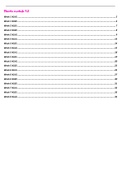
## Table of Contents
1. What is a chemical reaction? — Signs & definitions
2. Chemical equations — symbols, states, catalysts, heat
3. Law of conservation of mass
4. How to balance chemical equations — step-by-step methods
5. Types of chemical reactions (with examples and mini-diagrams)
6. Ionic and net ionic equations
7. Important class-10 level reactions (common examples)
8. Laboratory setups & diagrams (how to draw & label)
9. Practice questions (with answers)
10. Quick revision sheet (one-page)
---
## 1. What is a chemical reaction?
A chemical reaction is a process in which one or more substances (reactants) change into one or
more different substances (products) with different chemical and physical properties. During a
reaction, chemical bonds break and form.
**Signs of a chemical reaction:**
- Evolution of gas (bubbles)
- Change of color
- Formation of a precipitate (insoluble solid)
- Change in temperature (heat released or absorbed)
- Emission of light or change in smell
**Example (word form):** magnesium + oxygen → magnesium oxide
## 2. Chemical equations — representation & symbols
A chemical equation is a symbolic representation of a chemical reaction, using chemical formulas
and symbols.
**Parts:**
- Reactants → Products
- Arrow (→) shows direction
- Coefficients show number of molecules/atoms
- Symbols for physical state: (s) solid, (l) liquid, (g) gas, (aq) aqueous (dissolved in water)
- A catalyst can be written over the arrow, e.g. MnO2 above arrow; heat can be shown as ∆ or the
word heat.
**Example (chemical equation):**
2 H2 + O2 → 2 H2O
Interpretation: 2 molecules of hydrogen react with 1 molecule of oxygen to give 2 molecules of
water.
## 3. Law of conservation of mass
In a chemical reaction, mass is neither created nor destroyed. This means the number of atoms of
each element must be the same on both sides of a balanced chemical equation.
**Why balance?** To reflect conservation of atoms and mass.
## 4. How to balance chemical equations — step-by-step
**General strategy (inspection method):**
**Complete notes (detailed) — includes definitions, step-by-step methods, worked examples, ionic
& net ionic equations, diagrams, practice problems & answers.**
---
## Table of Contents
1. What is a chemical reaction? — Signs & definitions
2. Chemical equations — symbols, states, catalysts, heat
3. Law of conservation of mass
4. How to balance chemical equations — step-by-step methods
5. Types of chemical reactions (with examples and mini-diagrams)
6. Ionic and net ionic equations
7. Important class-10 level reactions (common examples)
8. Laboratory setups & diagrams (how to draw & label)
9. Practice questions (with answers)
10. Quick revision sheet (one-page)
---
## 1. What is a chemical reaction?
A chemical reaction is a process in which one or more substances (reactants) change into one or
more different substances (products) with different chemical and physical properties. During a
reaction, chemical bonds break and form.
**Signs of a chemical reaction:**
- Evolution of gas (bubbles)
- Change of color
- Formation of a precipitate (insoluble solid)
- Change in temperature (heat released or absorbed)
- Emission of light or change in smell
**Example (word form):** magnesium + oxygen → magnesium oxide
## 2. Chemical equations — representation & symbols
A chemical equation is a symbolic representation of a chemical reaction, using chemical formulas
and symbols.
**Parts:**
- Reactants → Products
- Arrow (→) shows direction
- Coefficients show number of molecules/atoms
- Symbols for physical state: (s) solid, (l) liquid, (g) gas, (aq) aqueous (dissolved in water)
- A catalyst can be written over the arrow, e.g. MnO2 above arrow; heat can be shown as ∆ or the
word heat.
**Example (chemical equation):**
2 H2 + O2 → 2 H2O
Interpretation: 2 molecules of hydrogen react with 1 molecule of oxygen to give 2 molecules of
water.
## 3. Law of conservation of mass
In a chemical reaction, mass is neither created nor destroyed. This means the number of atoms of
each element must be the same on both sides of a balanced chemical equation.
**Why balance?** To reflect conservation of atoms and mass.
## 4. How to balance chemical equations — step-by-step
**General strategy (inspection method):**