
Chapter 8
Bioassay
Bioassay the estimation of the concentration or potency of a substance by the measurement of
the biological response that it produces. Necessary to compare the properties of different substances,
or the same substance under different circumstances. Used to:
- Measure the pharmacological activity of new or chemically undefined substances
- Investigate the function of endogenous mediators
- Measure drug toxicity and unwanted effects
The recent growth of biopharmaceuticals as therapeutic agents has relied on bioassay techniques and
the establishment of standard preparations.
Biological test systems
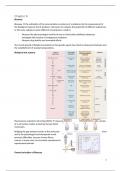
Fluorescence-activated cell sorting (FACS) measure the effect of a corticosteroid on the expression
of a cell surface marker protein by human blood
monocytes.
Bridging the gap between events at the molecular level
and at the physiological and therapeutic levels
presents difficulties, because human illness
cannot, in many cases, be accurately reproduced in
experimental animals.
General principles of Bioassay
1
, Bioassays were originally designed to measure the relative potency of two preparations, a standard
and a unknown. Nowadays the bioassays are used to compare a new drug to a standard drug
(prototypical drug).
Design
The aim of comparing the activity of a standard (S) and an
unknown (U), on a particular preparation, a bioassay must
provide an estimate of the dose or concentration of U that will
produce the same biological effect as that of a known dose or
concentration of S.
M provides an estimate of the potency ratio of the two
preparations.
The main problem with bioassay is that of biological variation, and the design is aimed at:
- Minimising variation
- Avoiding systematic errors resulting from variation
- Estimation of the limits of error of the assay result.
Nowadays we use cell lines genetically engineered to express a specific receptor type, which has
several advantages:
- Expression of only a single type of receptor
- Human receptors can be expressed and studied
- Multiple signaling pathways can be monitored
- Signaling bias can be analyzed.
- Replacement of living animals.
Overexpression of receptors can result in weak partial agonist drugs appearing as ‘full’ agonists when
the receptor reserve is larger than it would be for endogenously expressed receptors in native tissues.
Comparisons are based on analysis of dose-response curves, from which the matching dose of S and
U are calculated. Using a logarithmic dose scale means that the curve of S and U will normally be
parallel, and the potency ratio (M) is estimated from the horizontal distance between the two curves.
Assays of this type are known as parallel line assays two doses of standard and two for unknown
are used.
Problems arise if the two log dose-response curves are not parallel, or if the maximal responses differ,
which can happen if the mechanism of action of the two drugs differs, or if one is a partial agonist.
Animal model of disease
Aim of disease model to recapitulate in an animal the same pathological process which underlie
the human disorder.
Not all animal models can be based on a known disease pathway as for many conditions, these are
not known or are not fully recapitulated in a non-human species and this can lead to limitations in
how well the findings in animals translate to clinical benefits.
2
Bioassay
Bioassay the estimation of the concentration or potency of a substance by the measurement of
the biological response that it produces. Necessary to compare the properties of different substances,
or the same substance under different circumstances. Used to:
- Measure the pharmacological activity of new or chemically undefined substances
- Investigate the function of endogenous mediators
- Measure drug toxicity and unwanted effects
The recent growth of biopharmaceuticals as therapeutic agents has relied on bioassay techniques and
the establishment of standard preparations.
Biological test systems
Fluorescence-activated cell sorting (FACS) measure the effect of a corticosteroid on the expression
of a cell surface marker protein by human blood
monocytes.
Bridging the gap between events at the molecular level
and at the physiological and therapeutic levels
presents difficulties, because human illness
cannot, in many cases, be accurately reproduced in
experimental animals.
General principles of Bioassay
1
, Bioassays were originally designed to measure the relative potency of two preparations, a standard
and a unknown. Nowadays the bioassays are used to compare a new drug to a standard drug
(prototypical drug).
Design
The aim of comparing the activity of a standard (S) and an
unknown (U), on a particular preparation, a bioassay must
provide an estimate of the dose or concentration of U that will
produce the same biological effect as that of a known dose or
concentration of S.
M provides an estimate of the potency ratio of the two
preparations.
The main problem with bioassay is that of biological variation, and the design is aimed at:
- Minimising variation
- Avoiding systematic errors resulting from variation
- Estimation of the limits of error of the assay result.
Nowadays we use cell lines genetically engineered to express a specific receptor type, which has
several advantages:
- Expression of only a single type of receptor
- Human receptors can be expressed and studied
- Multiple signaling pathways can be monitored
- Signaling bias can be analyzed.
- Replacement of living animals.
Overexpression of receptors can result in weak partial agonist drugs appearing as ‘full’ agonists when
the receptor reserve is larger than it would be for endogenously expressed receptors in native tissues.
Comparisons are based on analysis of dose-response curves, from which the matching dose of S and
U are calculated. Using a logarithmic dose scale means that the curve of S and U will normally be
parallel, and the potency ratio (M) is estimated from the horizontal distance between the two curves.
Assays of this type are known as parallel line assays two doses of standard and two for unknown
are used.
Problems arise if the two log dose-response curves are not parallel, or if the maximal responses differ,
which can happen if the mechanism of action of the two drugs differs, or if one is a partial agonist.
Animal model of disease
Aim of disease model to recapitulate in an animal the same pathological process which underlie
the human disorder.
Not all animal models can be based on a known disease pathway as for many conditions, these are
not known or are not fully recapitulated in a non-human species and this can lead to limitations in
how well the findings in animals translate to clinical benefits.
2


