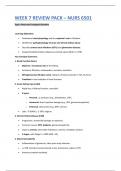
WEEK 7 REVIEW PACK – NURS 6501
Topic: Renal and Urological Disorders
Learning Objectives:
• Understand renal physiology and the nephron’s role in filtration.
• Identify the pathophysiology of acute and chronic kidney injury.
• Describe urinary tract infections (UTIs) and glomerular diseases.
• Analyze fluid/electrolyte imbalances and lab values (BUN, Cr, GFR).
Key Concepts Summary:
1. Renal Function Basics
• Nephron = functional unit of the kidney.
• Functions: filtration, reabsorption, secretion, excretion.
• GFR (glomerular filtration rate): indicator of kidney function (~125 mL/min).
• Creatinine = best indicator of renal function.
2. Acute Kidney Injury (AKI)
• Rapid loss of kidney function, reversible.
• 3 types:
o Prerenal: ↓ perfusion (e.g., dehydration, CHF).
o Intrarenal: direct nephron damage (e.g., ATN, glomerulonephritis).
o Postrenal: obstruction (e.g., BPH, stones).
• Labs: ↑ BUN/Cr, ↓ GFR, oliguria.
3. Chronic Kidney Disease (CKD)
• Progressive, irreversible damage to nephrons.
• Common causes: HTN, diabetes, glomerulonephritis.
• Leads to uremia, electrolyte imbalance, anemia, metabolic acidosis.
• 5 stages, with Stage 5 = ESRD (GFR <15).
4. Glomerulonephritis
• Inflammation of glomeruli, often post-strep infection.
• ↓ GFR, hematuria (cola-colored urine), proteinuria, edema, HTN.
• Immune-complex mediated.
Topic: Renal and Urological Disorders
Learning Objectives:
• Understand renal physiology and the nephron’s role in filtration.
• Identify the pathophysiology of acute and chronic kidney injury.
• Describe urinary tract infections (UTIs) and glomerular diseases.
• Analyze fluid/electrolyte imbalances and lab values (BUN, Cr, GFR).
Key Concepts Summary:
1. Renal Function Basics
• Nephron = functional unit of the kidney.
• Functions: filtration, reabsorption, secretion, excretion.
• GFR (glomerular filtration rate): indicator of kidney function (~125 mL/min).
• Creatinine = best indicator of renal function.
2. Acute Kidney Injury (AKI)
• Rapid loss of kidney function, reversible.
• 3 types:
o Prerenal: ↓ perfusion (e.g., dehydration, CHF).
o Intrarenal: direct nephron damage (e.g., ATN, glomerulonephritis).
o Postrenal: obstruction (e.g., BPH, stones).
• Labs: ↑ BUN/Cr, ↓ GFR, oliguria.
3. Chronic Kidney Disease (CKD)
• Progressive, irreversible damage to nephrons.
• Common causes: HTN, diabetes, glomerulonephritis.
• Leads to uremia, electrolyte imbalance, anemia, metabolic acidosis.
• 5 stages, with Stage 5 = ESRD (GFR <15).
4. Glomerulonephritis
• Inflammation of glomeruli, often post-strep infection.
• ↓ GFR, hematuria (cola-colored urine), proteinuria, edema, HTN.
• Immune-complex mediated.