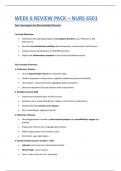
WEEK 6 REVIEW PACK – NURS 6501
Topic: Neurological and Musculoskeletal Disorders
Learning Objectives:
• Understand the pathophysiology of neurological disorders (e.g., Parkinson’s, MS,
Alzheimer’s).
• Describe musculoskeletal conditions like osteoporosis, osteoarthritis, and fractures.
• Analyze clinical manifestations of CNS/PNS disorders.
• Explore the inflammatory response in neuro/musculoskeletal injuries.
Key Concepts Summary:
1. Parkinson’s Disease
• Loss of dopaminergic neurons in substantia nigra.
• Cardinal symptoms: resting tremor, rigidity, bradykinesia, postural instability.
• Lewy bodies = abnormal protein aggregates (alpha-synuclein).
• Decreased dopamine disrupts balance with acetylcholine.
2. Multiple Sclerosis (MS)
• Autoimmune demyelination of CNS neurons.
• Symptoms vary: visual disturbances, fatigue, motor/sensory dysfunction.
• Characterized by remission and relapses.
• CSF: increased IgG, oligoclonal bands.
3. Alzheimer’s Disease
• Neurodegeneration marked by beta-amyloid plaques and neurofibrillary tangles (tau
protein).
• Progressive memory loss, language deterioration.
• Affects hippocampus and cerebral cortex.
• Risk factors: age, ApoE4 gene.
4. Stroke (Cerebrovascular Accident - CVA)
• Ischemic (most common): thrombotic/embolic.
• Hemorrhagic: vessel rupture.
• Time = brain; tissue at risk = penumbra.
Topic: Neurological and Musculoskeletal Disorders
Learning Objectives:
• Understand the pathophysiology of neurological disorders (e.g., Parkinson’s, MS,
Alzheimer’s).
• Describe musculoskeletal conditions like osteoporosis, osteoarthritis, and fractures.
• Analyze clinical manifestations of CNS/PNS disorders.
• Explore the inflammatory response in neuro/musculoskeletal injuries.
Key Concepts Summary:
1. Parkinson’s Disease
• Loss of dopaminergic neurons in substantia nigra.
• Cardinal symptoms: resting tremor, rigidity, bradykinesia, postural instability.
• Lewy bodies = abnormal protein aggregates (alpha-synuclein).
• Decreased dopamine disrupts balance with acetylcholine.
2. Multiple Sclerosis (MS)
• Autoimmune demyelination of CNS neurons.
• Symptoms vary: visual disturbances, fatigue, motor/sensory dysfunction.
• Characterized by remission and relapses.
• CSF: increased IgG, oligoclonal bands.
3. Alzheimer’s Disease
• Neurodegeneration marked by beta-amyloid plaques and neurofibrillary tangles (tau
protein).
• Progressive memory loss, language deterioration.
• Affects hippocampus and cerebral cortex.
• Risk factors: age, ApoE4 gene.
4. Stroke (Cerebrovascular Accident - CVA)
• Ischemic (most common): thrombotic/embolic.
• Hemorrhagic: vessel rupture.
• Time = brain; tissue at risk = penumbra.