WEEK 10 REVIEW PACK – NURS 6501
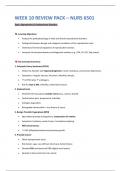
Topic: Reproductive & Genitourinary Disorders
Learning Objectives:
• Analyze the pathophysiology of male and female reproductive disorders.
• Distinguish between benign and malignant conditions of the reproductive tract.
• Understand hormonal regulation of reproductive function.
• Interpret clinical presentations and diagnostic markers (e.g., PSA, CA-125, Pap smear).
Key Concepts Summary:
1. Polycystic Ovary Syndrome (PCOS)
• Endocrine disorder with hyperandrogenism, insulin resistance, and ovarian dysfunction.
• Symptoms: irregular menses, hirsutism, infertility, obesity.
• ↑ LH:FSH ratio; ↑ androgens.
• Risk for Type 2 DM, infertility, endometrial cancer.
2. Endometriosis
• Endometrial tissue grows outside uterus (e.g., ovaries, bowel).
• Cyclical pelvic pain, dyspareunia, infertility.
• Estrogen-dependent.
• Retrograde menstruation = one theory of cause.
3. Benign Prostatic Hyperplasia (BPH)
• Age-related prostate enlargement; compression of urethra.
• Symptoms: hesitancy, weak stream, incomplete emptying.
• NOT precancerous.
• ↑ DHT (dihydrotestosterone) promotes growth.
4. Prostate Cancer
• Often asymptomatic early.
• Risk factors: age, race (African American), family history.
• Elevated PSA and abnormal DRE (digital rectal exam).
• Spreads to bone (common site: spine).
Topic: Reproductive & Genitourinary Disorders
Learning Objectives:
• Analyze the pathophysiology of male and female reproductive disorders.
• Distinguish between benign and malignant conditions of the reproductive tract.
• Understand hormonal regulation of reproductive function.
• Interpret clinical presentations and diagnostic markers (e.g., PSA, CA-125, Pap smear).
Key Concepts Summary:
1. Polycystic Ovary Syndrome (PCOS)
• Endocrine disorder with hyperandrogenism, insulin resistance, and ovarian dysfunction.
• Symptoms: irregular menses, hirsutism, infertility, obesity.
• ↑ LH:FSH ratio; ↑ androgens.
• Risk for Type 2 DM, infertility, endometrial cancer.
2. Endometriosis
• Endometrial tissue grows outside uterus (e.g., ovaries, bowel).
• Cyclical pelvic pain, dyspareunia, infertility.
• Estrogen-dependent.
• Retrograde menstruation = one theory of cause.
3. Benign Prostatic Hyperplasia (BPH)
• Age-related prostate enlargement; compression of urethra.
• Symptoms: hesitancy, weak stream, incomplete emptying.
• NOT precancerous.
• ↑ DHT (dihydrotestosterone) promotes growth.
4. Prostate Cancer
• Often asymptomatic early.
• Risk factors: age, race (African American), family history.
• Elevated PSA and abnormal DRE (digital rectal exam).
• Spreads to bone (common site: spine).