NUR2459 / NUR 2459: Final Exam (Latest 2025) Mental & Behavioral Health Nursing – Rasmussen
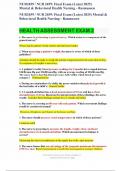
NUR2459 / NUR 2459: Final Exam (Latest 2025) Mental & Behavioral Health Nursing - Rasmussen Downloaded by: tiphanie_swan | Distribution of this document is illegal HEALTH ASSESSMENT EXAM 2 NUR2459 / NUR 2459: Final Exam (Latest 2025) Mental & Behavioral Health Nursing - Rasmussen 1. The nurse is performing a general survey. Which action is a component of the general survey? Observing the patient’s body stature and nutritional status 2. When measuring a patient’s weight, the nurse is aware of which of these guidelines? Attempts should be made to weigh the patient at approximately the same time of day, if a sequence of weights is necessary. 3. A patient’s weekly blood pressure readings for 2 months have ranged between 124/84 mm Hg and 136/88 mm Hg, with an average reading of 126/86 mm Hg. The nurse knows that this blood pressure falls within which blood pressure category? Prehypertension 4. During an examination of a child, the nurse considers that physical growth is the best index of a child’s: General health. 5. A 1-month-old infant has a head measurement of 34 cm and has a chest circumference of 32 cm. Based on the interpretation of these findings, the nurse would: Consider these findings normal for a 1-month-old infant. 6. The nurse is assessing an 80-year-old male patient. Which assessment findings would be considered normal? Presence of kyphosis and flexion in the knees and hips 7. The nurse should measure rectal temperatures in which of these patients? Comatose adult 8. The nurse is preparing to measure the length, weight, chest, and head circumference of a 6-month-old infant. Which measurement technique is correct? Measuring the chest circumference at the nipple line with a tape measure 9. The nurse knows that one advantage of the tympanic membrane thermometer (TMT) is that: Rapid measurement is useful for uncooperative younger children.NUR2459 / NUR 2459: Final Exam (Latest 2025) Mental & Behavioral Health Nursing - Rasmussen Downloaded by: tiphanie_swan | Distribution of this document is illegal 10. When assessing an older adult, which vital sign changes occur with aging? Widened pulse pressure 11. The nurse is examining a patient who is complaining of feeling cold. Which is a mechanism of heat loss in the body? Radiation 12. When measuring a patients body temperature, the nurse keeps in mind that body temperature is influenced by: Diurnal cycle. 13. When evaluating the temperature of older adults, the nurse should remember which aspect about an older adult’s body temperature The body temperature of the older adult is lower than that of a younger adult. 14. A 60-year-old male patient has been treated for pneumonia for the past 6 weeks. He is seen today in the clinic for an unexplained weight loss of 10 pounds over the last 6 weeks. The nurse knows that: Unexplained weight loss often accompanies short-term illnesses. 15. When assessing a 75-year-old patient who has asthma, the nurse notes that he assumes a tripod position, leaning forward with arms braced on the chair. On the basis of this observation, the nurse should: d. Recognize that a tripod position is often used when a patient is having respiratory difficulties. 16. Which of these actions illustrates the correct technique the nurse should use when assessing oral temperature with a mercury thermometer? b. Leave the thermometer in place 3 to 4 minutes if the patient is afebrile. 17. The nurse is taking temperatures in a clinic with a TMT. Which statement is true regarding use of the TMT? c. The risk of cross-contamination is reduced, compared with the rectal route.NUR2459 / NUR 2459: Final Exam (Latest 2025) Mental & Behavioral Health Nursing - Rasmussen Downloaded by: tiphanie_swan | Distribution of this document is illegal 18. To assess a rectal temperature accurately in an adult, the nurse would: a. Use a lubricated blunt tip thermometer. 19. Which technique is correct when the nurse is assessing the radial pulse of a patient? The pulse is counted for: a. 1 minute, if the rhythm is irregular. 20. When assessing a patient’s pulse, the nurse should also notice which of these characteristics? Force 21. When assessing the pulse of a 6-year-old boy, the nurse notices that his heart rate varies with his respiratory cycle, speeding up at the peak of inspiration and slowing to normal with expiration. The nurses next action would be to: b. Consider this finding normal in children and young adults. 22. When assessing the force, or strength, of a pulse, the nurse recalls that the pulse: c. Is a reflection of the hearts stroke volume. 23. The nurse is assessing the vital signs of a 20-year-old male marathon runner and documents the following vital signs: temperature36 C; pulse48 beats per minute; respirations14 breaths per minute; blood pressure104/68 mm Hg. Which statement is true concerning these results? b. These are normal vital signs for a healthy, athletic adult. 24. The nurse is assessing the vital signs of a 3-year-old patient who appears to have an irregular respiratory pattern. How should the nurse assess this child’s respirations? a. Respirations should be counted for 1 full minute, noticing rate and rhythm.NUR2459 / NUR 2459: Final Exam (Latest 2025) Mental & Behavioral Health Nursing - Rasmussen Downloaded by: tiphanie_swan | Distribution of this document is illegal 25. A patient’s blood pressure is 118/82 mm Hg. He asks the nurse, what do the numbers mean? The nurses best reply is: c. The top number is the systolic blood pressure and reflects the pressure of the blood against the arteries when the heart contracts. 26. While measuring a patient’s blood pressure, the nurse recalls that certain factors, such as , help determine blood pressure. d. Peripheral vascular resistance 27. A nurse is helping at a health fair at a local mall. When taking blood pressures on a variety of people, the nurse keeps in mind that: b. The blood pressure of a Black adult is usually higher than that of a White adult of the same age. 28. The nurse notices a colleague is preparing to check the blood pressure of a patient who is obese by using a standard-sized blood pressure cuff. The nurse should expect the reading to: b. Yield a falsely high blood pressure. 29. A student is late for his appointment and has rushed across campus to the health clinic. The nurse should: a. Allow 5 minutes for him to relax and rest before checking his vital signs. 30. The nurse will perform a palpated pressure before auscultating blood pressure. The reason for this is to: b. Detect the presence of an auscultatory gap. 31. The nurse is taking an initial blood pressure reading on a 72-year-old patient with documented hypertension. How should the nurse proceed?NUR2459 / NUR 2459: Final Exam (Latest 2025) Mental & Behavioral Health Nursing - Rasmussen Downloaded by: tiphanie_swan | Distribution of this document is illegal c. Cuff should be inflated 30 mm Hg above the point at which the palpated pulse disappears. 32. The nurse has collected the following information on a patient: palpated blood pressure180 mm Hg; auscultated blood pressure170/100 mm Hg; apical pulse60 beats per minute; radial pulse70 beats per minute. What is the patients pulse pressure? b. 70 33. When auscultating the blood pressure of a 25-year-old patient, the nurse notices the phase I Korotkoff sounds begin at 200 mm Hg. At 100 mm Hg, the Korotkoff sounds muffle. At 92 mm Hg, the Korotkoff sounds disappear. How should the nurse record this patient’s blood pressure? a. 200/92 34. A patient is seen in the clinic for complaints of fainting episodes that started last week. How should the nurse proceed with the examination? c. His blood pressure is recorded in the lying, sitting, and standing positions. 35. A 70-year-old man has a blood pressure of 150/90 mm Hg in a lying position, 130/80 mm Hg in a sitting position, and 100/60 mm Hg in a standing position. How should the nurse evaluate these findings? b. The change in blood pressure readings is called orthostatic hypotension. 36. The nurse is helping another nurse to take a blood pressure reading on a patients thigh. Which action is correct regarding thigh pressure? c. If the blood pressure in the arm is high in an adolescent, then it should be compared with the thigh pressure. 37. The nurse is preparing to measure the vital signs of a 6-month-old infant. Which action by the nurse is correct?NUR2459 / NUR 2459: Final Exam (Latest 2025) Mental & Behavioral Health Nursing - Rasmussen Downloaded by: tiphanie_swan | Distribution of this document is illegal a. Respirations are measured; then pulse and temperature. 38. A 4-month-old child is at the clinic for a well-baby check-up and immunizations. Which of these actions is most appropriate when the nurse is assessing an infant’s vital signs? b. The nurse should auscultate an apical rate for 1 minute and then assess for any normal irregularities, such as sinus arrhythmia. 39. The nurse is conducting a health fair for older adults. Which statement is true regarding vital sign measurements in aging adults? b. An increased respiratory rate and a shallower inspiratory phase are expected findings. 40. In a patient with acromegaly, the nurse will expect to discover which assessment findings? c. Overgrowth of bone in the face, head, hands, and feet 41. The nurse is performing a general survey of a patient. Which finding is considered normal? d. Arm span (fingertip to fingertip) equals the patient’s height. 42. The nurse is assessing children in a pediatric clinic. Which statement is true regarding the measurement of blood pressure in children? d. The disappearance of phase V Korotkoff sounds can be used for the diastolic reading in children. 43. What type of blood pressure measurement error is most likely to occur if the nurse does not check for the presence of an auscultatory gap? c. Systolic blood pressure may be falsely low.NUR2459 / NUR 2459: Final Exam (Latest 2025) Mental & Behavioral Health Nursing - Rasmussen Downloaded by: tiphanie_swan | Distribution of this document is illegal 44. When considering the concepts related to blood pressure, the nurse knows that the concept of mean arterial pressure (MAP) is best described by which statement? c. MAP is the pressure forcing blood into the tissues, averaged over the cardiac cycle. 45. A 75-year-old man with a history of hypertension was recently changed to a new antihypertensive drug. He reports feeling dizzy at times. How should the nurse evaluate his blood pressure? a. Blood pressure and pulse should be recorded in the supine, sitting, and standing positions. 46. Which of these specific measurements is the best index of a child’s general health? b. Height and weight 47. The nurse is assessing an 8-year-old child whose growth rate measures below the third percentile for a child his age. He appears significantly younger than his stated age and is chubby with infantile facial features. Which condition does this child have? a. Hypopituitary dwarfism 48. The nurse is counting an infant’s respirations. Which technique is correct? b. Watching the abdomen for movement 49. When checking for proper blood pressure cuff size, which guideline is correct? d. The width of the rubber bladder should equal 40% of the arm circumference.NUR2459 / NUR 2459: Final Exam (Latest 2025) Mental & Behavioral Health Nursing - Rasmussen Downloaded by: tiphanie_swan | Distribution of this document is illegal 50. During an examination, the nurse notices that a female patient has a round moon face, central trunk obesity, and a cervical hump. Her skin is fragile with bruises. The nurse determines that the patient has which condition? Cushing syndrome MULTIPLE RESPONSE 1. While measuring a patient’s blood pressure, the nurse uses the proper technique to obtain an accurate reading. Which of these situations will result in a falsely high blood pressure reading? Select all that apply. a. The person supports his or her own arm during the blood pressure reading. b. The blood pressure cuff is too narrow for the extremity. d. The cuff is loosely wrapped around the arm. e. The person is sitting with his or her legs crossed. ANS: A, B, D, E SHORT ANSWER 1. What is the pulse pressure for a patient whose blood pressure is 158/96 mm Hg and whose pulse rate is 72 beats per minute? ANS: 62 Chap 10NUR2459 / NUR 2459: Final Exam (Latest 2025) Mental & Behavioral Health Nursing - Rasmussen Downloaded by: tiphanie_swan | Distribution of this document is illegal 1. When evaluating a patient’s pain, the nurse knows that an example of acute pain would be: a. Arthritic pain. b. Fibromyalgia. c. d. Low back pain. ANS: C 2. Which statement indicates that the nurse understands the pain experienced by an older adult? a. Older adults must learn to tolerate pain. b. Pain is a normal process of aging and is to be expected. c. Pain indicates a pathologic condition or an injury and is not a normal process of aging. d. Older individuals perceive pain to a lesser degree than do younger individuals. ANS: C 3. A 4-year-old boy is brought to the emergency department by his mother. She says he points to his stomach and says, it hurts so bad. Which pain assessment tool would be the best choice when assessing this child’s pain? a. Descriptor Scale b. Numeric rating scale c. Brief Pain Inventory d. Faces Pain Scale Revised (FPS-R) ANS: DNUR2459 / NUR 2459: Final Exam (Latest 2025) Mental & Behavioral Health Nursing - Rasmussen Downloaded by: tiphanie_swan | Distribution of this document is illegal 4. A patient states that the pain medication is not working and rates his postoperative pain at a 10 on a 1-to-10 scale. Which of these assessment findings indicates an acute pain response to poorly controlled pain? a. Confusion b. Hyperventilation c. Increased blood pressure and pulse d. Depression ANS: C 5. A 60-year-old woman has developed reflexive sympathetic dystrophy after arthroscopic repair of her shoulder. A key feature of this condition is that the: a. Affected extremity will eventually regain its function. b. Pain is felt at one site but originates from another location. c. Patients pain will be associated with nausea, pallor, and diaphoresis. d. Slightest touch, such as a sleeve brushing against her arm, causes severe and intense pain. ANS: D 6. The nurse is assessing a patient’s pain. The nurse knows that the most reliable indicator of pain would be the: a. Patients vital signs. b. Physical examination. c. Results of a computerized axial tomographic scan. d. Subjective report. ANS: D 7. A patient has had arthritic pain in her hips for several years since a hip fracture. She is able to move around in her room and has not offered anyNUR2459 / NUR 2459: Final Exam (Latest 2025) Mental & Behavioral Health Nursing - Rasmussen Downloaded by: tiphanie_swan | Distribution of this document is illegal complaints so far, this morning. However, when asked, she states that her pain is bad this morning and rates it at an 8 on a 1-to-10 scale. What does the nurse suspect? The patient: a. Is addicted to her pain medications and cannot obtain pain relief. b. Does not want to trouble the nursing staff with her complaints. c. Is not in pain but rates it high to receive pain medication. d. Has experienced chronic pain for years and has adapted to it. ANS: D 8. The nurse is reviewing the principles of pain. Which type of pain is due to an abnormal processing of the pain impulse through the peripheral or central nervous system? a. Visceral b. Referred c. Cutaneous d. Neuropathic ANS: D 9. When assessing the quality of a patient’s pain, the nurse should ask which question? a. When did the pain start? b. Is the pain a stabbing pain? c. Is it a sharp pain or dull pain? d. What does your pain feel like? ANS: D 10. When assessing a patient’s pain, the nurse knows that an example of visceral pain would be:NUR2459 / NUR 2459: Final Exam (Latest 2025) Mental & Behavioral Health Nursing - Rasmussen Downloaded by: tiphanie_swan | Distribution of this document is illegal a. Hip fracture. b. Cholecystitis. c. Second-degree burns. d. Pain after a leg amputation. ANS: B 11. The nurse is reviewing the principles of nociception. During which phase of nociception does the conscious awareness of a painful sensation occur? a. Perception b. Modulation c. Transduction d. Transmission ANS: A 12. When assessing the intensity of a patient’s pain, which question by the nurse is appropriate? a. What makes your pain better or worse? b. How much pain do you have now? c. How does pain limit your activities? d. What does your pain feel like? ANS: B 13. A patient is complaining of severe knee pain after twisting it during a basketball game and is requesting pain medication. Which action by the nurse is appropriate? a. Completing the physical examination first and then giving the pain medicationNUR2459 / NUR 2459: Final Exam (Latest 2025) Mental & Behavioral Health Nursing - Rasmussen Downloaded by: tiphanie_swan | Distribution of this document is illegal b. Telling the patient that the pain medication must wait until after the xray images are completed c. Evaluating the full range of motion of the knee and then medicating for pain d. Administering pain medication and then proceeding with the assessment ANS: D 14. The nurse knows that which statement is true regarding the pain experienced by infants? a. Pain in infants can only be assessed by physiologic changes, such as an increased heart rate. b. The FPS-R can be used to assess pain in infants. c. A procedure that induces pain in adults will also induce pain in the infant. d. Infants feel pain less than do adults. ANS: C 15. A patient has been admitted to the hospital with vertebral fractures related to osteoporosis. She is in extreme pain. This type of pain would be classified as: a. Referred. b. Cutaneous. c. Visceral. d. Deep somatic. ANS: D MULTIPLE RESPONSENUR2459 / NUR 2459: Final Exam (Latest 2025) Mental & Behavioral Health Nursing - Rasmussen Downloaded by: tiphanie_swan | Distribution of this document is illegal 1. During assessment of a patient’s pain, the nurse is aware that certain nonverbal behaviors are associated with chronic pain. Which of these behaviors are associated with chronic pain? Select all that apply. a. Sleeping b. Moaning c. Diaphoresis d. Bracing e. Restlessness f. Rubbing 2. During an admission assessment of a patient with dementia, the nurse assesses for pain because the patient has recently had several falls. Which of these are appropriate for the nurse to assess in a patient with dementia? Select all that apply. a. Ask the patient, Do you have pain? b. Assess the patients breathing independent of vocalization. c. Note whether the patient is calling out, groaning, or crying. d. Have the patient rate pain on a 1-to-10 scale. e. Observe the patient’s body language for pacing and agitation. ANS: B, C, E Chap 11 1. The nurse recognizes which of these persons is at greatest risk for undernutrition? a. 5-month-old infantNUR2459 / NUR 2459: Final Exam (Latest 2025) Mental & Behavioral Health Nursing - Rasmussen Downloaded by: tiphanie_swan | Distribution of this document is illegal 2. When assessing a patient’s nutritional status, the nurse recalls that the best definition of optimal nutritional status is sufficient nutrients that: d. Provide for daily body requirements and support increased metabolic demands. 3. The nurse is providing nutrition information to the mother of a 1-year-old child. Which of these statements represents accurate information for this age group? a. Maintaining adequate fat and caloric intake is important for a child in this age group. 4. A pregnant woman is interested in breastfeeding her baby and asks several questions about the topic. Which information is appropriate for the nurse to share with her? d. Breast milk provides the nutrients necessary for growth, as well as natural immunity. 5. A mother and her 13-year-old daughter express their concern related to the daughter’s recent weight gain and her increase in appetite. Which of these statements represents information the nurse should discuss with them? b. Snacks should be high in protein, iron, and calcium. 6. The nurse is assessing a 30-year-old unemployed immigrant from an underdeveloped country who has been in the United States for 1 month. Which of these problems related to his nutritional status might the nurse expect to find? c. Osteomalacia (softening of the bones) 7. For the first time, the nurse is seeing a patient who has no history of nutritionrelated problems. The initial nutritional screening should include which activity? d. Measurement of weight and weight historyNUR2459 / NUR 2459: Final Exam (Latest 2025) Mental & Behavioral Health Nursing - Rasmussen Downloaded by: tiphanie_swan | Distribution of this document is illegal 8. A patient is asked to indicate on a form how many times he eats a specific food. This method describes which of these tools for obtaining dietary information? d. Food-frequency questionnaire 9. The nurse is providing care for a 68-year-old woman who is complaining of constipation. What concern exists regarding her nutritional status? a. Absorption of nutrients may be impaired. 10. During a nutritional assessment, why is it important for the nurse to ask a patient what medications he or she is taking? a. Certain drugs can affect the metabolism of nutrients. 11. A patient tells the nurse that his food simply does not have any taste anymore. The nurse’s best response would be: b. When did you first notice this change? 12. The nurse is performing a nutritional assessment on a 15-year-old girl who tells the nurse that she is so fat. Assessment reveals that she is 5 feet 4 inches and weighs 110 pounds. The nurses appropriate response would be: a. How much do you think you should weigh? 13. The nurse is discussing appropriate foods with the mother of a 3-year-old child. Which of these foods are recommended? d. Finger foods and nutritious snacks that cannot cause choking 14. The nurse is reviewing the nutritional assessment of an 82-year-old patient. Which of these factors will most likely affect the nutritional status of an older adult? b. Living alone on a fixed incomeNUR2459 / NUR 2459: Final Exam (Latest 2025) Mental & Behavioral Health Nursing - Rasmussen Downloaded by: tiphanie_swan | Distribution of this document is illegal 15. When considering a nutritional assessment, the nurse is aware that the most common anthropometric measurements include: a. Height and weight. 16. If a 29-year-old woman weighs 156 pounds, and the nurse determines her ideal body weight to be 120 pounds, then how would the nurse classify the womans weight? a. Obese 17. How should the nurse perform a triceps skinfold assessment? c. After applying the calipers, the nurse waits 3 seconds before taking a reading. After repeating the procedure three times, an average is recorded. 18. In teaching a patient how to determine total body fat at home, the nurse includes instructions to obtain measurements of: a. Height and weight. 19. The nurse is evaluating patients for obesity-related diseases by calculating the waist-to-hip ratios. Which one of these patients would be at increased risk? a. 29-year-old woman whose waist measures 33 inches and hips measure 36 inches 20. A 50-year-old woman with elevated total cholesterol and triglyceride levels is visiting the clinic to find out about her laboratory results. What would be important for the nurse to include in patient teaching in relation to these tests? c. Provide information regarding a diet low in saturated fat. 21. In performing an assessment on a 49-year-old woman who has imbalanced nutrition as a result of dysphagia, which data would the nurse expect to find? b. Inadequate nutrient food intakeNUR2459 / NUR 2459: Final Exam (Latest 2025) Mental & Behavioral Health Nursing - Rasmussen Downloaded by: tiphanie_swan | Distribution of this document is illegal 22. A 21-year-old woman has been on a low-protein liquid diet for the past 2 months. She has had adequate intake of calories and appears well nourished. After further assessment, what would the nurse expect to find? b. Decreased serum albumin 23. The nurse is performing a nutritional assessment on an 80-year-old patient. The nurse knows that physiologic changes can directly affect the nutritional status of the older adult and include: a. Slowed gastrointestinal motility. 24. Which of these interventions is most appropriate when the nurse is planning nutritional interventions for a healthy, active 74-year-old woman? c. Decreasing the number of calories she is eating because of the decrease in energy requirements from the loss of lean body mass 25. A 16-year-old girl is being seen at the clinic for gastrointestinal complaints and weight loss. The nurse determines that many of her complaints may be related to erratic eating patterns, eating predominantly fast foods, and high caffeine intake. In this situation, which is most appropriate when collecting current dietary intake information? c. Having the patient complete a food diary for 3 days, including 2 weekdays and 1 weekend day 26. The nurse is preparing to measure fat and lean body mass and bone mineral density. Which tool is appropriate? d. Dual-energy x-ray absorptiometry (DEXA) 27. Which of these conditions is due to an inadequate intake of both protein and calories? c. MarasmusNUR2459 / NUR 2459: Final Exam (Latest 2025) Mental & Behavioral Health Nursing - Rasmussen Downloaded by: tiphanie_swan | Distribution of this document is illegal 28. During an assessment of a patient who has been homeless for several years, the nurse notices that his tongue is magenta in color, which is an indication of a deficiency in what mineral and/or vitamin? b. Riboflavin 29. A 50-year-old patient has been brought to the emergency department after a housemate found that the patient could not get out of bed alone. He has lived in a group home for years but for several months has not participated in the activities and has stayed in his room. The nurse assesses for signs of undernutrition, and an x-ray study reveals that he has osteomalacia, which is a deficiency of: d. Vitamin C. 30. An older adult patient in a nursing home has been receiving tube feedings for several months. During an oral examination, the nurse notes that patients gums are swollen, ulcerated, and bleeding in some areas. The nurse suspects that the patient has what condition? d. Vitamin C deficiency 31. The nurse is assessing the body weight as a percentage of ideal body weight on an adolescent patient who was admitted for suspected anorexia nervosa. The patients usual weight was 125 pounds, but today she weighs 98 pounds. The nurse calculates the patients ideal body weight and concludes that the patient is: b. Experiencing moderate malnutrition. MULTIPLE RESPONSE 1. The nurse is assessing a patient who is obese for signs of metabolic syndrome. This condition is diagnosed when three or more certain risk factors are present. Which of these assessment findings are risk factors for metabolic syndrome? Select all that apply. b. Fasting plasma glucose level greater than or equal to 110 mg/dLNUR2459 / NUR 2459: Final Exam (Latest 2025) Mental & Behavioral Health Nursing - Rasmussen Downloaded by: tiphanie_swan | Distribution of this document is illegal c. Blood pressure reading of 140/90 mm Hg SHORT ANSWER 1. A patient has been unable to eat solid food for 2 weeks and is in the clinic today complaining of weakness, tiredness, and hair loss. The patient states that her usual weight is 175 pounds, but today she weighs 161 pounds. What is her recent weight change percentage? To calculate recent weight change percentage, use this formula: Usual weight current weight 100 usual weight ANS: 8% 175 161 = 14 pounds 14 175 = 0.08 0.08 100 = 8% Chap 12 1. The nurse educator is preparing an education module for the nursing staff on the epidermal layer of skin. Which of these statements would be included in the module? The epidermis is: a. Highly vascular. b. Thick and tough. c. Thin and nonstratified. d. Replaced every 4 weeks. ANS: D 2. The nurse educator is preparing an education module for the nursing staff on the dermis layer of skin. Which of these statements would be included in the module? The dermis:NUR2459 / NUR 2459: Final Exam (Latest 2025) Mental & Behavioral Health Nursing - Rasmussen Downloaded by: tiphanie_swan | Distribution of this document is illegal a. Contains mostly fat cells. b. Consists mostly of keratin. c. Is replaced every 4 weeks. d. Contains sensory receptors. ANS: D 3. The nurse is examining a patient who tells the nurse, I sure sweat a lot, especially on my face and feet but it doesn’t have an odor. The nurse knows that this condition could be related to: a. Eccrine glands. b. Apocrine glands. c. Disorder of the stratum corneum. d. Disorder of the stratum germinativum. ANS: A 4. A newborn infant is in the clinic for a well-baby checkup. The nurse observes the infant for the possibility of fluid loss because of which of these factors? a. Subcutaneous fat deposits are high in the newborn. b. Sebaceous glands are overproductive in the newborn. c. The newborns skin is more permeable than that of the adult. d. The amount of vernix caseosa dramatically rises in the newborn. ANS: C 5. The nurse is bathing an 80-year-old man and notices that his skin is wrinkled, thin, lax, and dry. This finding would be related to which factor in the older adult? a. Increased vascularity of the skinNUR2459 / NUR 2459: Final Exam (Latest 2025) Mental & Behavioral Health Nursing - Rasmussen Downloaded by: tiphanie_swan | Distribution of this document is illegal b. Increased numbers of sweat and sebaceous glands c. An increase in elastin and a decrease in subcutaneous fat d. An increased loss of elastin and a decrease in subcutaneous fat ANS: D 6. During the aging process, the hair can look gray or white and begin to feel thin and fine. The nurse knows that this occurs because of a decrease in the number of functioning: a. Metrocytes. b. Fungacytes. c. Phagocytes. d. Melanocytes. ANS: D 7. During an examination, the nurse finds that a patient has excessive dryness of the skin. The best term to describe this condition is: a. Xerosis. b. Pruritus. c. Alopecia. d. Seborrhea. ANS: A 8. A 22-year-old woman comes to the clinic because of severe sunburn and states, I was out in the sun for just a couple of minutes. The nurse begins a medication review with her, paying special attention to which medication class? a. Nonsteroidal antiinflammatory drugs for pain b. Tetracyclines for acneNUR2459 / NUR 2459: Final Exam (Latest 2025) Mental & Behavioral Health Nursing - Rasmussen Downloaded by: tiphanie_swan | Distribution of this document is illegal c. Proton pump inhibitors for heartburn d. Thyroid replacement hormone for hypothyroidism ANS: B 9. A woman is leaving on a trip to Hawaii and has come in for a checkup. During the examination, the nurse learns that she has diabetes and takes oral hypoglycemic agents. The patient needs to be concerned about which possible effect of her medications? a. Increased possibility of bruising b. Skin sensitivity as a result of exposure to salt water c. Lack of availability of glucose-monitoring supplies d. Importance of sunscreen and avoiding direct sunlight ANS: D 10. A 13-year-old girl is interested in obtaining information about the cause of her acne. The nurse should share with her that acne: a. Is contagious. b. Has no known cause. c. Is caused by increased sebum production. d. Has been found to be related to poor hygiene. ANS: C 11. A 75-year-old woman who has a history of diabetes and peripheral vascular disease has been trying to remove a corn on the bottom of her foot with a pair of scissors. The nurse will encourage her to stop trying to remove the corn with scissors because: a. The woman could be at increased risk for infection and lesions because of her chronic disease.NUR2459 / NUR 2459: Final Exam (Latest 2025) Mental & Behavioral Health Nursing - Rasmussen Downloaded by: tiphanie_swan | Distribution of this document is illegal b. With her diabetes, she has increased circulation to her foot, and it could cause severe bleeding. c. She is 75 years old and is unable to see; consequently, she places herself at greater risk for self-injury with the scissors. d. With her peripheral vascular disease, her range of motion is limited and she may not be able to reach the corn safely. ANS: A 12. The nurse keeps in mind that a thorough skin assessment is extremely important because the skin holds information about a persons: a. Support systems. b. Circulatory status. c. Socioeconomic status. d. Psychological wellness. ANS: B 13. A patient comes in for a physical examination and complains of freezing to death while waiting for her examination. The nurse notes that her skin is pale and cool and attributes this finding to: a. Venous pooling. b. Peripheral vasodilation. c. Peripheral vasoconstriction. d. Decreased arterial perfusion. ANS: C 14. A patient comes to the clinic and tells the nurse that he has been confined to his recliner chair for approximately 3 days with his feet down and he asks the nurse to evaluate his feet. During the assessment, the nurse might expect to find:NUR2459 / NUR 2459: Final Exam (Latest 2025) Mental & Behavioral Health Nursing - Rasmussen Downloaded by: tiphanie_swan | Distribution of this document is illegal a. Pallor b. Coolness c. Distended veins d. Prolonged capillary filling time ANS: C 15. A patient is especially worried about an area of skin on her feet that has turned white. The health care provider has told her that her condition is vitiligo. The nurse explains to her that vitiligo is: a. Caused by an excess of melanin pigment b. Caused by an excess of apocrine glands in her feet c. Caused by the complete absence of melanin pigment d. Related to impetigo and can be treated with an ointment ANS: C 16. A patient tells the nurse that he has noticed that one of his moles has started to burn and bleed. When assessing his skin, the nurse pays special attention to the danger signs for pigmented lesions and is concerned with which additional finding? a. Color variation b. Border regularity c. Symmetry of lesions d. Diameter of less than 6 mm ANS: A 17. A patient comes to the clinic and states that he has noticed that his skin is redder than normal. The nurse understands that this condition is due to hyperemia and knows that it can be caused by:NUR2459 / NUR 2459: Final Exam (Latest 2025) Mental & Behavioral Health Nursing - Rasmussen Downloaded by: tiphanie_swan | Distribution of this document is illegal a. Decreased amounts of bilirubin in the blood b. Excess blood in the underlying blood vessels c. Decreased perfusion to the surrounding tissues d. Excess blood in the dilated superficial capillaries ANS: D 18. During a skin assessment, the nurse notices that a Mexican-American patient has skin that is yellowish-brown; however, the skin on the hard and soft palate is pink and the patients scleras are not yellow. From this finding, the nurse could probably rule out: a. Pallor b. Jaundice c. Cyanosis d. Iron deficiency ANS: B 19. A black patient is in the intensive care unit because of impending shock after an accident. The nurse expects to find what characteristics in this patient’s skin? a. Ruddy blue. b. Generalized pallor. c. Ashen, gray, or dull. d. Patchy areas of pallor. ANS: C 20. An older adult woman is brought to the emergency department after being found lying on the kitchen floor for 2 days; she is extremely dehydrated. What would the nurse expect to see during the examination? a. Smooth mucous membranes and lipsNUR2459 / NUR 2459: Final Exam (Latest 2025) Mental & Behavioral Health Nursing - Rasmussen Downloaded by: tiphanie_swan | Distribution of this document is illegal b. Dry mucous membranes and cracked lips c. Pale mucous membranes d. White patches on the mucous membranes ANS: B 21. A 42-year-old woman complains that she has noticed several small, slightly raised, bright red dots on her chest. On examination, the nurse expects that the spots are probably: a. Anasarca. b. Scleroderma. c. Senile angiomas. d. Latent myeloma. ANS: C 22. A 65-year-old man with emphysema and bronchitis has come to the clinic for a follow-up appointment. On assessment, the nurse might expect to see which finding? a. Anasarca b. Scleroderma c. Pedal erythema d. Clubbing of the nails ANS: D 23. A newborn infant has Down syndrome. During the skin assessment, the nurse notices a transient mottling in the trunk and extremities in response to the cool temperature in the examination room. The infants mother also notices the mottling and asks what it is. The nurse knows that this mottling is called: a. Caf au lait.NUR2459 / NUR 2459: Final Exam (Latest 2025) Mental & Behavioral Health Nursing - Rasmussen Downloaded by: tiphanie_swan | Distribution of this document is illegal b. Carotenemia. c. Acrocyanosis. d. Cutis marmorata. ANS: D 24. A 35-year-old pregnant woman comes to the clinic for a monthly appointment. During the assessment, the nurse notices that she has a brown patch of hyperpigmentation on her face. The nurse continues the skin assessment aware that another finding may be: a. Keratoses. b. Xerosis. c. Chloasma. d. Acrochordons. ANS: C 25. A man has come in to the clinic for a skin assessment because he is worried he might have skin cancer. During the skin assessment the nurse notices several areas of pigmentation that look greasy, dark, and stuck on his skin. Which is the best prediction? a. Senile lentigines, which do not become cancerous b. Actinic keratoses, which are precursors to basal cell carcinoma c. Acrochordons, which are precursors to squamous cell carcinoma d. Seborrheic keratoses, which do not become cancerous ANS: D 26. A 70-year-old woman who loves to garden has small, flat, brown macules over her arms and hands. She asks, what causes these liver spots? The nurse tells her, they are:NUR2459 / NUR 2459: Final Exam (Latest 2025) Mental & Behavioral Health Nursing - Rasmussen Downloaded by: tiphanie_swan | Distribution of this document is illegal a. Signs of decreased hematocrit related to anemia. b. Due to the destruction of melanin in your skin from exposure to the sun. c. Clusters of melanocytes that appear after extensive sun exposure. d. Areas of hyperpigmentation related to decreased perfusion and vasoconstriction. ANS: C 27. The nurse notices that a patient has a solid, elevated, circumscribed lesion that is less than 1 cm in diameter. When documenting this finding, the nurse reports this as a: a. Bulla. b. Wheal. c. Nodule. d. Papule. ANS: D 28. The nurse just noted from the medical record that the patient has a lesion that is confluent in nature. On examination, the nurse expects to find: a. Lesions that run together. b. Annular lesions that have grown together. c. Lesions arranged in a line along a nerve route. d. Lesions that are grouped or clustered together. ANS: A 29. A patient has had a terrible itch for several months that he has been continuously scratching. On examination, the nurse might expect to find: a. A keloid.NUR2459 / NUR 2459: Final Exam (Latest 2025) Mental & Behavioral Health Nursing - Rasmussen Downloaded by: tiphanie_swan | Distribution of this document is illegal b. A fissure. c. Keratosis. d. Lichenification. ANS: D 30. A physician has diagnosed a patient with purpura. After leaving the room, a nursing student asks the nurse what the physician saw that led to that diagnosis. The nurse should say, The physician is referring to the: a. Blue dilation of blood vessels in a star-shaped linear pattern on the legs. b. Fiery red, star-shaped marking on the cheek that has a solid circular center. c. Confluent and extensive patch of petechiae and ecchymoses on the feet. d. Tiny areas of hemorrhage that are less than 2 mm, round, discrete, and dark red in color. ANS: C 31. A mother has noticed that her son, who has been to a new babysitter, has some blisters and scabs on his face and buttocks. On examination, the nurse notices moist, thin-roofed vesicles with a thin erythematous base and suspects: a. Eczema. b. Impetigo. c. Herpes zoster. d. Diaper dermatitis. ANS: B 32. The nurse notices that a school-aged child has bluish-white, red-based spots in her mouth that are elevated approximately 1 to 3 mm. What other signs would the nurse expect to find in this patient?NUR2459 / NUR 2459: Final Exam (Latest 2025) Mental & Behavioral Health Nursing - Rasmussen Downloaded by: tiphanie_swan | Distribution of this document is illegal a. Pink, papular rash on the face and neck b. Pruritic vesicles over her trunk and neck c. Hyperpigmentation on the chest, abdomen, and back of the arms d. Red-purple, maculopapular, blotchy rash behind the ears and on the face ANS: D 33. The nurse is assessing the skin of a patient who has acquired immunodeficiency syndrome (AIDS) and notices multiple patchlike lesions on the temple and beard area that are faint pink in color. The nurse recognizes these lesions as: a. Measles (rubeola). b. Kaposis sarcoma. c. Angiomas. d. Herpes zoster. ANS: B 34. A 45-year-old farmer comes in for a skin evaluation and complains of hair loss on his head. His hair seems to be breaking off in patches, and he notices some scaling on his head. The nurse begins the examination suspecting: a. Tinea capitis. b. Folliculitis. c. Toxic alopecia. d. Seborrheic dermatitis. ANS: A 35. A mother brings her child into the clinic for an examination of the scalp and hair. She states that the child has developed irregularly shaped patches withNUR2459 / NUR 2459: Final Exam (Latest 2025) Mental & Behavioral Health Nursing - Rasmussen Downloaded by: tiphanie_swan | Distribution of this document is illegal broken-off, stublike hair in some places; she is worried that this condition could be some form of premature baldness. The nurse tells her that it is: a. Folliculitis that can be treated with an antibiotic. b. Traumatic alopecia that can be treated with antifungal medications. c. Tinea capitis that is highly contagious and needs immediate attention. d. Trichotillomania; her child probably has a habit of absentmindedly twirling her hair. ANS: D 36. The nurse has discovered decreased skin turgor in a patient and knows that this finding is expected in which condition? a. Severe obesity b. Childhood growth spurts c. Severe dehydration d. Connective tissue disorders such as scleroderma ANS: C 37. While performing an assessment of a 65-year-old man with a history of hypertension and coronary artery disease, the nurse notices the presence of bilateral pitting edema in the lower legs. The skin is puffy and tight but normal in color. No increased redness or tenderness is observed over his lower legs, and the peripheral pulses are equal and strong. In this situation, the nurse suspects that the likely cause of the edema is which condition? a. Heart failure b. Venous thrombosis c. Local inflammation d. Blockage of lymphatic drainage ANS: ANUR2459 / NUR 2459: Final Exam (Latest 2025) Mental & Behavioral Health Nursing - Rasmussen Downloaded by: tiphanie_swan | Distribution of this document is illegal Bilateral edema or edema that is generalized over the entire body is caused by a central problem such as heart failure or kidney failure. Unilateral edema usually has a local or peripheral cause. DIF: Cognitive Level: Analyzing (Analysis) REF: p. 210 MSC: Client Needs: Physiologic Integrity: Physiologic Adaptation 38. A 40-year-old woman reports a change in mole size, accompanied by color changes, itching, burning, and bleeding over the past month. She has a dark complexion and has no family history of skin cancer, but she has had many blistering sunburns in the past. The nurse would: a. Tell the patient to watch the lesion and report back in 2 months. b. Refer the patient because of the suggestion of melanoma on the basis of her symptoms. c. Ask additional questions regarding environmental irritants that may have caused this condition. d. Tell the patient that these signs suggest a compound nevus, which is very common in young to middle-aged adults. ANS: B The ABCD danger signs of melanoma are asymmetry, border irregularity, color variation, and diameter. In addition, individuals may report a change in size, the development of itching, burning, and bleeding, or a new-pigmented lesion. Any one of these signs raises the suggestion of melanoma and warrants immediate referral. DIF: Cognitive Level: Analyzing (Analysis) REF: p. 208 MSC: Client Needs: Physiologic Integrity: Physiologic Adaptation 39. The nurse is assessing for clubbing of the fingernails and expects to find: a. Nail bases that are firm and slightly tender. b. Curved nails with a convex profile and ridges across the nails. c. Nail bases that feel spongy with an angle of the nail base of 150 degrees.NUR2459 / NUR 2459: Final Exam (Latest 2025) Mental & Behavioral Health Nursing - Rasmussen Downloaded by: tiphanie_swan | Distribution of this document is illegal d. Nail bases with an angle of 180 degrees or greater and nail bases that feel spongy. ANS: D The normal nail is firm at its base and has an angle of 160 degrees. In clubbing, the angle straightens to 180 degrees or greater and the nail base feels spongy. DIF: Cognitive Level: Understanding (Comprehension) REF: p. 213 MSC: Client Needs: Physiologic Integrity: Physiologic Adaptation 40. The nurse is assessing a patient who has liver disease for jaundice. Which of these assessment findings is indicative of true jaundice? a. Yellow patches in the outer sclera b. Yellow color of the sclera that extends up to the iris c. Skin that appears yellow when examined under low light d. Yellow deposits on the palms and soles of the feet where jaundice first appears ANS: B The yellow sclera of jaundice extends up to the edge of the iris. Calluses on the palms and soles of the feet often appear yellow but are not classified as jaundice. Scleral jaundice should not be confused with the normal yellow subconjunctival fatty deposits that are common in the outer sclera of dark-skinned persons. DIF: Cognitive Level: Understanding (Comprehension) REF: p. 209 MSC: Client Needs: Physiologic Integrity: Physiologic Adaptation 41. The nurse is assessing for inflammation in a dark-skinned person. Which technique is the best? a. Assessing the skin for cyanosis and swelling b. Assessing the oral mucosa for generalized erythema c. Palpating the skin for edema and increased warmthNUR2459 / NUR 2459: Final Exam (Latest 2025) Mental & Behavioral Health Nursing - Rasmussen Downloaded by: tiphanie_swan | Distribution of this document is illegal d. Palpating for tenderness and local areas of ecchymosis ANS: C Because inflammation cannot be seen in dark-skinned persons, palpating the skin for increased warmth, for taut or tightly pulled surfaces that may be indicative of edema, and for a hardening of deep tissues or blood vessels is often necessary. DIF: Cognitive Level: Applying (Application) REF: p. 209 MSC: Client Needs: Physiologic Integrity: Physiologic Adaptation 42. A few days after a summer hiking trip, a 25-year-old man comes to the clinic with a rash. On examination, the nurse notes that the rash is red, macular, with a bulls eye pattern across his midriff and behind his knees. The nurse suspects: a. Rubeola. b. Lyme disease. c. Allergy to mosquito bites. d. Rocky Mountain spotted fever. ANS: B Lyme disease occurs in people who spend time outdoors in May through September. The first disease state exhibits the distinctive bulls eye and a red macular or papular rash that radiates from the site of the tick bite with some central clearing. The rash spreads 5 cm or larger, and is usually in the axilla, midriff, inguinal, or behind the knee, with regional lymphadenopathy. DIF: Cognitive Level: Analyzing (Analysis) REF: p. 242 MSC: Client Needs: Physiologic Integrity: Physiologic Adaptation 43. A 52-year-old woman has a papule on her nose that has rounded, pearly borders and a central red ulcer. She said she first noticed it several months ago and that it has slowly grown larger. The nurse suspects which condition? a. AcneNUR2459 / NUR 2459: Final Exam (Latest 2025) Mental & Behavioral Health Nursing - Rasmussen Downloaded by: tiphanie_swan | Distribution of this document is illegal b. Basal cell carcinoma c. Melanoma d. Squamous cell carcinoma ANS: B Basal cell carcinoma usually starts as a skin-colored papule that develops rounded, pearly borders with a central red ulcer. It is the most common form of skin cancer and grows slowly. This description does not fit acne lesions. (See Table 12-11 for descriptions of melanoma and squamous cell carcinoma.) DIF: Cognitive Level: Applying (Application) REF: p. 243 MSC: Client Needs: Physiologic Integrity: Physiologic Adaptation 44. A father brings in his 2-month-old infant to the clinic because the infant has had diarrhea for the last 24 hours. He says his baby has not been able to keep any formula down and that the diarrhea has been at least every 2 hours. The nurse suspects dehydration. The nurse should test skin mobility and turgor over the infants: a. Sternum. b. Forehead. c. Forearms. d. Abdomen. ANS: D Mobility and turgor are tested over the abdomen in an infant. Poor turgor, or tenting, indicates dehydration or malnutrition. The other sites are not appropriate for checking skin turgor in an infant. DIF: Cognitive Level: Analyzing (Analysis) REF: p. 218 MSC: Client Needs: Physiologic Integrity: Physiologic Adaptation 45. A semiconscious woman is brought to the emergency department after she was found on the floor in her kitchen. Her face, nail beds, lips, and oral mucosa are a bright cherry-red color. The nurse suspects that this coloring is due to:NUR2459 / NUR 2459: Final Exam (Latest 2025) Mental & Behavioral Health Nursing - Rasmussen Downloaded by: tiphanie_swan | Distribution of this document is illegal a. Polycythemia. b. Carbon monoxide poisoning. c. Carotenemia. d. Uremia. ANS: B A bright cherry-red coloring in the face, upper torso, nail beds, lips, and oral mucosa appears in cases of carbon monoxide poisoning. DIF: Cognitive Level: Analyzing (Analysis) REF: p. 226 MSC: Client Needs: Physiologic Integrity: Physiologic Adaptation 46. A patient has been admitted for severe psoriasis. The nurse expects to see what finding in the patients fingernails? a. Splinter hemorrhages b. Paronychia c. Pitting d. Beau lines ANS: C Sharply defined pitting and crumbling of the nails, each with distal detachment characterize pitting nails and are associated with psoriasis. (See Table 12-13 for descriptions of the other terms.) DIF: Cognitive Level: Applying (Application) REF: p. 249 MSC: Client Needs: Physiologic Integrity: Physiologic Adaptation MULTIPLE RESPONSE 1. The nurse is preparing for a certification course in skin care and needs to be familiar with the various lesions that may be identified on assessment of the skin. Which of the following definitions are correct? Select all that apply.NUR2459 / NUR 2459: Final Exam (Latest 2025) Mental & Behavioral Health Nursing - Rasmussen Downloaded by: tiphanie_swan | Distribution of this document is illegal a. Petechiae: Tiny punctate hemorrhages, 1 to 3 mm, round and discrete, dark red, purple, or brown in color b. Bulla: Elevated, circumscribed lesion filled with turbid fluid (pus) c. Papule: Hypertrophic scar d. Vesicle: Known as a friction blister e. Nodule: Solid, elevated, and hard or soft growth that is larger than 1 cm ANS: A, D, E A pustule is an elevated, circumscribed lesion filled with turbid fluid (pus). A hypertrophic scar is a keloid. A bulla is larger than 1 cm and contains clear fluid. A papule is solid and elevated but measures less than 1 cm. DIF: Cognitive Level: Understanding (Comprehension) REF: p. 229 |p. 238 MSC: Client Needs: Physiologic Integrity: Physiologic Adaptation 2. A patient has been admitted to a hospital after the staff in the nursing home noticed a pressure ulcer in his sacral area. The nurse examines the pressure ulcer and determines that it is a stage II ulcer. Which of these findings are characteristic of a stage II pressure ulcer? Select all that apply. a. Intact skin appears red but is not broken. b. Partial thickness skin erosion is observed with a loss of epidermis or dermis. c. Ulcer extends into the subcutaneous tissue. d. Localized redness in light skin will blanch with fingertip pressure. e. Open blister areas have a red-pink wound bed. f. Patches of eschar cover parts of the wound. ANS: B, E Stage I pressure ulcers have intact skin that appears red but is not broken, and localized redness in intact skin will blanche with fingertip pressure. Stage II pressure ulcers have partial thickness skin erosion with a loss of epidermis or also the dermis;NUR2459 / NUR 2459: Final Exam (Latest 2025) Mental & Behavioral Health Nursing - Rasmussen Downloaded by: tiphanie_swan | Distribution of this document is illegal open blisters have a red-pink wound bed. Stage III pressure ulcers are full thickness, extending into the subcutaneous tissue; subcutaneous fat may be seen but not muscle, bone, or tendon. Stage IV pressure ulcers involve all skin layers and extend into supporting tissue, exposing muscle, bone, and tendon. Slough (stringy matter attached to the wound bed) or eschar (black or brown necrotic tissue) may be present. DIF: Cognitive Level: Applying (Application) REF: p. 233 MSC: Client Needs: Physiologic Integrity: Physiologic Adaptation Chap 13 1. A physician tells the nurse that a patients vertebra prominens is tender and asks the nurse to reevaluate the area in 1 hour. The area of the body the nurse will assess is: a. Just above the diaphragm. b. Just lateral to the knee cap. c. At the level of the C7 vertebra. d. At the level of the T11 vertebra. ANS: C The C7 vertebra has a long spinous process, called the vertebra prominens, which is palpable when the head is flexed. DIF: Cognitive Level: Applying (Application) REF: p. 251 MSC: Client Needs: Physiologic Integrity: Physiologic Adaptation 2. A mother brings her 2-month-old daughter in for an examination and says, My daughter rolled over against the wall, and now I have noticed that she has this spot that is soft on the top of her head. Is something terribly wrong? The nurses best response would be: a. Perhaps that could be a result of your dietary intake during pregnancy. b. Your baby may have craniosynostosis, a disease of the sutures of the brain.NUR2459 / NUR 2459: Final Exam (Latest 2025) Mental & Behavioral Health Nursing - Rasmussen Downloaded by: tiphanie_swan | Distribution of this document is illegal c. That soft spot may be an indication of cretinism or congenital hypothyroidism. d. That soft spot is normal, and actually allows for growth of the brain during the first year of your babys life. ANS: D Membrane-covered soft spots allow for growth of the brain during the first year of life. They gradually ossify; the triangular-shaped posterior fontanel is closed by 1 to 2 months, and the diamond-shaped anterior fontanel closes between 9 months and 2 years. DIF: Cognitive Level: Applying (Application) REF: p. 255 MSC: Client Needs: Health Promotion and Maintenance 3. The nurse notices that a patients palpebral fissures are not symmetric. On examination, the nurse may find that damage has occurred to which cranial nerve (CN)? a. III b. V c. VII d. VIII ANS: C Facial muscles are mediated by CN VII; asymmetry of palpebral fissures may be attributable to damage to CN VII (Bell palsy). DIF: Cognitive Level: Applying (Application) REF: p. 259 MSC: Client Needs: Physiologic Integrity: Physiologic Adaptation 4. A patient is unable to differentiate between sharp and dull stimulation to both sides of her face. The nurse suspects: a. Bell palsy.NUR2459 / NUR 2459: Final Exam (Latest 2025) Mental & Behavioral Health Nursing - Rasmussen Downloaded by: tiphanie_swan | Distribution of this document is illegal b. Damage to the trigeminal nerve. c. Frostbite with resultant paresthesia to the cheeks. d. Scleroderma. ANS: B Facial sensations of pain or touch are mediated by CN V, which is the trigeminal nerve. Bell palsy is associated with CN VII damage. Frostbite and scleroderma are not associated with this problem. DIF: Cognitive Level: Applying (Application) REF: pp. 252-253 MSC: Client Needs: Physiologic Integrity: Physiologic Adaptation 5. When examining the face of a patient, the nurse is aware that the two pairs of salivary glands that are accessible to examination are the and glands. a. Occipital; submental b. Parotid; jugulodigastric c. Parotid; submandibular d. Submandibular; occipital ANS: C Two pairs of salivary glands accessible to examination on the face are the parotid glands, which are in the cheeks over the mandible, anterior to and below the ear; and the submandibular glands, which are beneath the mandible at the angle of the jaw. The parotid glands are normally nonpalpable. DIF: Cognitive Level: Understanding (Comprehension) REF: p. 253 MSC: Client Needs: Safe and Effective Care Environment: Management of Care 6. A patient comes to the clinic complaining of neck and shoulder pain and is unable to turn her head. The nurse suspects damage to CN and proceeds with the examination by .NUR2459 / NUR 2459: Final Exam (Latest 2025) Mental & Behavioral Health Nursing - Rasmussen Downloaded by: tiphanie_swan | Distribution of this document is illegal a. XI; palpating the anterior and posterior triangles b. XI; asking the patient to shrug her shoulders against resistance c. XII; percussing the sternomastoid and submandibular neck muscles d. XII; assessing for a positive Romberg sign ANS: B The major neck muscles are the sternomastoid and the trapezius. They are innervated by CN XI, the spinal accessory. The innervated muscles assist with head rotation and head flexion, movement of the shoulders, and extension and turning of the head. DIF: Cognitive Level: Analyzing (Analysis) REF: p. 260 MSC: Client Needs: Safe and Effective Care Environment: Management of Care 7. When examining a patients CN function, the nurse remembers that the muscles in the neck that are innervated by CN XI are the: a. Sternomastoid and trapezius. b. Spinal accessory and omohyoid. c. Trapezius and sternomandibular. d. Sternomandibular and spinal accessory. ANS: A The major neck muscles are the sternomastoid and the trapezius. They are innervated by CN XI, the spinal accessory. DIF: Cognitive Level: Remembering (Knowledge) REF: p. 253 MSC: Client Needs: General 8. A patients laboratory data reveal an elevated thyroxine (T4) level. The nurse would proceed with an examination of the gland. a. ThyroidNUR2459 / NUR 2459: Final Exam (Latest 2025) Mental & Behavioral Health Nursing - Rasmussen Downloaded by: tiphanie_swan | Distribution of this document is illegal b. Parotid c. Adrenal d. Parathyroid ANS: A The thyroid gland is a highly vascular endocrine gland that secretes T4 and triiodothyronine (T3). The other glands do not secrete T4. DIF: Cognitive Level: Understanding (Comprehension) REF: p. 253 MSC: Client Needs: Safe and Effective Care Environment: Management of Care 9. A patient says that she has recently noticed a lump in the front of her neck below her Adams apple that seems to be getting bigger. During the assessment, the finding that leads the nurse to suspect that this may not be a cancerous thyroid nodule is that the lump (nodule): a. Is tender. b. Is mobile and not hard. c. Disappears when the patient smiles. d. Is hard and fixed to the surrounding structures. ANS: B Painless, rapidly growing nodules may be cancerous, especially the appearance of a single nodule in a young person. However, cancerous nodules tend to be hard and fixed to surrounding structures, not mobile. DIF: Cognitive Level: Applying (Application) REF: p. 262 MSC: Client Needs: Physiologic Integrity: Physiologic Adaptation 10. The nurse notices that a patients submental lymph nodes are enlarged. In an effort to identify the cause of the node enlargement, the nurse would assess the patients: a. Infraclavicular area.NUR2459 / NUR 2459: Final Exam (Latest 2025) Mental & Behavioral Health Nursing - Rasmussen Downloaded by: tiphanie_swan | Distribution of this document is illegal b. Supraclavicular area. c. Area distal to the enlarged node. d. Area proximal to the enlarged node. ANS: D When nodes are abnormal, the nurse should check the area into which they drain for the source of the problem. The area proximal (upstream) to the location of the abnormal node should be explored. DIF: Cognitive Level: Analyzing (Analysis) REF: p. 255 MSC: Client Needs: Safe and Effective Care Environment: Management of Care 11. The nurse is aware that the four areas in the body where lymph nodes are accessible are the: a. Head, breasts, groin, and abdomen. b. Arms, breasts, inguinal area, and legs. c. Head and neck, arms, breasts, and axillae. d. Head and neck, arms, inguinal area, and axillae. ANS: D Nodes are located throughout the body, but they are accessible to examination only in four areas: head and neck, arms, inguinal region, and axillae. DIF: Cognitive Level: Remembering (Knowledge) REF: p. 255 MSC: Client Needs: Safe and Effective Care Environment: Management of Care 12. A mother brings her newborn in for an assessment and asks, Is there something wrong with my baby? His head seems so big. Which statement is true regarding the relative proportions of the head and trunk of the newborn? a. At birth, the head is one fifth the total length. b. Head circumference should be greater than chest circumference at birth.NUR2459 / NUR 2459: Final Exam (Latest 2025) Mental & Behavioral Health Nursing - Rasmussen Downloaded by: tiphanie_swan | Distribution of this document is illegal c. The head size reaches 90% of its final size when the child is 3 years old. d. When the anterior fontanel closes at 2 months, the head will be more proportioned to the body. ANS: B The nurse recognizes that during the fetal period, head growth predominates. Head size is greater than chest circumference at birth, and the head size grows during childhood, reaching 90% of its final size when the child is age 6 years. DIF: Cognitive Level: Understanding (Comprehension) REF: p. 264 MSC: Client Needs: Health Promotion and Maintenance 13. A patient, an 85-year-old woman, is complaining about the fact that the bones in her face have become more noticeable. What explanation should the nurse give her? a. Diets low in protein and high in carbohydrates may cause enhanced facial bones. b. Bones can become more noticeable if the person does not use a dermatologically approved moisturizer. c. More noticeable facial bones are probably due to a combination of factors related to aging, such as decreased elasticity, subcutaneous fat, and moisture in her skin. d. Facial skin becomes more elastic with age. This increased elasticity causes the skin to be more taught, drawing attention to the facial bones. ANS: C The facial bones and orbits appear more prominent in the aging adult, and the facial skin sags, which is attributable to decreased elasticity, decreased subcutaneous fat, and decreased moisture in the skin. DIF: Cognitive Level: Understanding (Comprehension) REF: p. 255 MSC: Client Needs: Health Promotion and MaintenanceNUR2459 / NUR 2459: Final Exam (Latest 2025) Mental & Behavioral Health Nursing - Rasmussen Downloaded by: tiphanie_swan | Distribution of this document is illegal 14. A patient reports excruciating headache pain on one side of his head, especially around his eye, forehead, and cheek that has lasted approximately to 2 hours, occurring once or twice each day. The nurse should suspect: a. Hypertension. b. Cluster headaches. c. Tension headaches. d. Migraine headaches. ANS: B Cluster headaches produce pain around the eye, temple, forehead, and cheek and are unilateral and always on the same side of the head. They are excruciating and occur once or twice per day and last to 2 hours each. DIF: Cognitive Level: Applying (Application) REF:
Geschreven voor
Documentinformatie
- Geüpload op
- 16 juni 2025
- Aantal pagina's
- 171
- Geschreven in
- 2024/2025
- Type
- Tentamen (uitwerkingen)
- Bevat
- Vragen en antwoorden
Onderwerpen
- nur2459
- nur 2459 final exam
-
mental behavioral health nursing

Ook beschikbaar in voordeelbundel