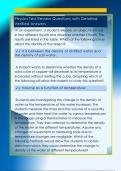
Physics Test Review Questions with Detailed
Verified Answers
In an experiment, a student releases an object from rest
in four different liquids and observes whether it floats. The
results are listed in the table. Which of the following is true
about the density of the object?
✓✓ It is between the density of distilled water and
the density of salt water.
A student wants to determine whether the density of a
solid cube of copper will decrease as its temperature is
increased without melting the cube. Graphing which of
the following will allow the student to study this question?
✓✓ Volume as a function of temperature
Students are investigating the change in the density of
water as the temperature of the water increases. The
students measure the mass and the volume of a quantity
of water and then heat the water to various temperatures
in the range using a thermometer to measure the
temperature. They then attempt to determine the density
of the water at the different temperatures. Assume any
changes of equipment or measuring tools due to
temperature changes are negligible. Which of the
following methods would allow the students to obtain
data from which they could determine the change in
density of the water at different temperatures?
,✓✓ Record the temperature of the water and
precise measurements of the volume of the water.
In an experiment, a student puts each of three objects,
A, B, and C, in four different liquids and observes whether
the objects float. The results are listed in the table. Which
columns contain information that is most useful for
estimating the density of object C?
✓✓ Gasoline and Oil
A physics teacher gives a solid object to each student in
her class. The objects are each made of the same
material but have different shapes and sizes. The teacher
asks the students to measure the mass and volume of their
object and to work together to determine the density of
the material from which the objects are made. Which of
the following methods will give the best estimate of the
material's density?
✓✓ Each student shares the mass and volume of
their object with the class. The class then creates a
graph plotting mass as a function of volume, draws a
best-fit line through the data, and uses the slope of
the best-fit line as the density of the material.
Water is poured into a U-shaped tube and allowed to
come to rest, as shown in the figure. Which of the
following can help explain why the water in the left and
,right sides of the tube reaches the same height? Select
two answers.
✓✓ -The force exerted by the atmosphere on the
surface of the water is the same on both sides.
-The weight of water in the left and right halves of
the tube is the same.
A wooden cube is floating at rest on the surface of a
liquid. Which of the following is an action-reaction pair of
forces that can explain why the force exerted by the
liquid on the bottom of the container is greater with the
floating cube than without it?
✓✓ The liquid exerts a net upward force on the
cube, and the cube exerts a contact force on the
liquid.
A block of weight W is floating in water, and one-third of
the block is above the surface of the water. Which of the
following correctly describes the magnitude F of the force
that the block exerts on the water and explains why F has
that value?
✓✓ F=W. The block is at rest, so the net force on it
must be zero. The water must exert an upward force
of magnitude FF on the block to make this so. The
block then exerts a force of equal magnitude on the
water.
, A cube submerged in a rectangular tank of liquid is at
rest. Which of the following is a Newton's third law pair of
forces in this situation?
✓✓ The force that the liquid exerts on a side of the
tank and the force the side of the tank exerts on the
liquid
The figure shows a block of wood floating in a beaker of
water. Which of the following is true of the force exerted
by the wood on the water?
✓✓ The wood exerts a downward force on the water
that is equal in magnitude to the weight of the
wood.
A block of mass M is floating in a container of liquid and is
partially submerged. The block is then replaced by a
block of mass 2M. Which of the following describes two
forces that are a Newton's-third-law force pair whose
magnitudes are the same for the two situations?
✓✓ The gravitational force Earth exerts on the liquid
and the gravitational force the liquid exerts on Earth
A sphere made of gold is moving downward through
liquid mercury at an increasing speed. The mercury exerts
a net buoyant force in the upward direction on the gold
sphere. Which of the following describes a Newton's-third-
law pair for this force?
Verified Answers
In an experiment, a student releases an object from rest
in four different liquids and observes whether it floats. The
results are listed in the table. Which of the following is true
about the density of the object?
✓✓ It is between the density of distilled water and
the density of salt water.
A student wants to determine whether the density of a
solid cube of copper will decrease as its temperature is
increased without melting the cube. Graphing which of
the following will allow the student to study this question?
✓✓ Volume as a function of temperature
Students are investigating the change in the density of
water as the temperature of the water increases. The
students measure the mass and the volume of a quantity
of water and then heat the water to various temperatures
in the range using a thermometer to measure the
temperature. They then attempt to determine the density
of the water at the different temperatures. Assume any
changes of equipment or measuring tools due to
temperature changes are negligible. Which of the
following methods would allow the students to obtain
data from which they could determine the change in
density of the water at different temperatures?
,✓✓ Record the temperature of the water and
precise measurements of the volume of the water.
In an experiment, a student puts each of three objects,
A, B, and C, in four different liquids and observes whether
the objects float. The results are listed in the table. Which
columns contain information that is most useful for
estimating the density of object C?
✓✓ Gasoline and Oil
A physics teacher gives a solid object to each student in
her class. The objects are each made of the same
material but have different shapes and sizes. The teacher
asks the students to measure the mass and volume of their
object and to work together to determine the density of
the material from which the objects are made. Which of
the following methods will give the best estimate of the
material's density?
✓✓ Each student shares the mass and volume of
their object with the class. The class then creates a
graph plotting mass as a function of volume, draws a
best-fit line through the data, and uses the slope of
the best-fit line as the density of the material.
Water is poured into a U-shaped tube and allowed to
come to rest, as shown in the figure. Which of the
following can help explain why the water in the left and
,right sides of the tube reaches the same height? Select
two answers.
✓✓ -The force exerted by the atmosphere on the
surface of the water is the same on both sides.
-The weight of water in the left and right halves of
the tube is the same.
A wooden cube is floating at rest on the surface of a
liquid. Which of the following is an action-reaction pair of
forces that can explain why the force exerted by the
liquid on the bottom of the container is greater with the
floating cube than without it?
✓✓ The liquid exerts a net upward force on the
cube, and the cube exerts a contact force on the
liquid.
A block of weight W is floating in water, and one-third of
the block is above the surface of the water. Which of the
following correctly describes the magnitude F of the force
that the block exerts on the water and explains why F has
that value?
✓✓ F=W. The block is at rest, so the net force on it
must be zero. The water must exert an upward force
of magnitude FF on the block to make this so. The
block then exerts a force of equal magnitude on the
water.
, A cube submerged in a rectangular tank of liquid is at
rest. Which of the following is a Newton's third law pair of
forces in this situation?
✓✓ The force that the liquid exerts on a side of the
tank and the force the side of the tank exerts on the
liquid
The figure shows a block of wood floating in a beaker of
water. Which of the following is true of the force exerted
by the wood on the water?
✓✓ The wood exerts a downward force on the water
that is equal in magnitude to the weight of the
wood.
A block of mass M is floating in a container of liquid and is
partially submerged. The block is then replaced by a
block of mass 2M. Which of the following describes two
forces that are a Newton's-third-law force pair whose
magnitudes are the same for the two situations?
✓✓ The gravitational force Earth exerts on the liquid
and the gravitational force the liquid exerts on Earth
A sphere made of gold is moving downward through
liquid mercury at an increasing speed. The mercury exerts
a net buoyant force in the upward direction on the gold
sphere. Which of the following describes a Newton's-third-
law pair for this force?