Chapter 19
Government and Market
Failure
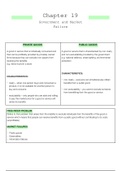
PRIVATE GOODS PUBLIC GOODS
A good or service that is individually consumed and A good or service that is characterised by non-rivalry
that can be profitably provided by privately owned and non-excludability provided by the government.
firms because they can exclude non-payers from e.g. national defence, street lighting, environmental
receiving the benefits. protection
e.g. items found in a store
CHARACTERISTICS:
CHARACTERISTICS:
- non-rivalry – everyone can simultaneously obtain
- rivalry – when one person buys and consumers a benefits from a public good
product, it is not available for another person to
buy and consume - non-excludability – you cannot exclude someone
from benefitting from the good or service
- excludability – only people who are able and willing
to pay the market price for a good or service will
obtain its benefits
FREE-RIDER PROBLEM
Refers to that problem that arises from the inability to exclude individuals from the benefits of the good or
service which means that people can receive benefits from a public good without contributing to its costs
(unprofitable)
MARKET FAILURES
- Public goods
- Externalities
- Information failures
, PUBLIC GOODS
SUPPLY OF PUBLIC GOODS
The government has to try to estimate the demand for a public good through surveys and public votes. The
government can compare marginal benefit (MB) of an added unit of the good against the government’s marginal
cost (MC) of providing it.
Marginal benefit (MB) = Marginal cost (MC)
DEMAND FOR PUBLIC GOODS
COST-BENEFIT ANALYSIS
A cost-benefit analysis is a comparison of the marginal costs of a public good or service with the marginal
benefits to decide whether or not to employ resources in public good or service and to what extent
- If the benefit from the extra public good exceeds the cost that result from having fewer private goods. then
resources should be shifted from the private to the public sector
- If the cost of the forgone private goods is greater than the benefit associated with the extra public goods,
then resources shouldn’t be shifted from the private to the public sector
, EXAMPLE: cost-benefit analysis for a national highway construction project
*choose the one that provides society with the maximum benefit
EXTERNALITIES
Occurs when some of the costs or benefits of a good are spilled over to someone, other than the immediate
buyer or seller
POSITIVE EXTERNALITIES NEGATIVE EXTERNALITIES
Benefits that spill over to a third person or the Costs that spill over to a third party without
community at large. e.g education compensations. e.g environmental pollution
, CORRECTING EXTERNALITIES
PROBLEM RESOURCE ALLOCATION WAYS TO CORRECT
OUTCOME
Negative Externalities Over-allocation of resources 1. Individual bargaining
(spillover costs) 2. Liability rules and lawsuits
3. Tax on products
4. Direct controls
5. Market for externality rights
Positive Externalities Under-allocation of resources 1. Individual bargaining
(spillover benefits) 2. Subsidy to consumers
3. Subsidy to producers
4. Government provision
(1) INDIVIDUAL BARGAINING
The Coase theorem was the idea, first stated by economist Ronald Coase, that externalities can be resolved
through private negotiations with the affected parties.
LIMITATIONS:
Unfortunately, many externalities involve large numbers of affected parties, high bargaining costs and community
property such as air and water. In such situations, private bargaining cannot be used as a remedy.
(2) LIABILITY RULES AND LAWSUITS
The government has come up with a framework of laws that define private property and protect it from damage
done by other parties. Those laws permit parties suffering negative externalities to sue for compensation.
LIMITATIONS:
Large legal fees and major time delays in the court systems are common
(3) GOVERNMENT INTERVENTION
Government interventions may be needed to achieve economic efficiency when externalities affect large
numbers of people or when community interests are at stake.
(1) Direct controls – passing legislation that limits that good or service that produces negative externalities
(2) Specific taxes – the government levies taxes or charges on the related good that produces negative
externalities
(3) Government provision – where positive externalities are extremely large, the government may decide to
provide the product as a public good or service
(4) Subsidies to buyers
(5) Subsidies to producers
Government and Market
Failure
PRIVATE GOODS PUBLIC GOODS
A good or service that is individually consumed and A good or service that is characterised by non-rivalry
that can be profitably provided by privately owned and non-excludability provided by the government.
firms because they can exclude non-payers from e.g. national defence, street lighting, environmental
receiving the benefits. protection
e.g. items found in a store
CHARACTERISTICS:
CHARACTERISTICS:
- non-rivalry – everyone can simultaneously obtain
- rivalry – when one person buys and consumers a benefits from a public good
product, it is not available for another person to
buy and consume - non-excludability – you cannot exclude someone
from benefitting from the good or service
- excludability – only people who are able and willing
to pay the market price for a good or service will
obtain its benefits
FREE-RIDER PROBLEM
Refers to that problem that arises from the inability to exclude individuals from the benefits of the good or
service which means that people can receive benefits from a public good without contributing to its costs
(unprofitable)
MARKET FAILURES
- Public goods
- Externalities
- Information failures
, PUBLIC GOODS
SUPPLY OF PUBLIC GOODS
The government has to try to estimate the demand for a public good through surveys and public votes. The
government can compare marginal benefit (MB) of an added unit of the good against the government’s marginal
cost (MC) of providing it.
Marginal benefit (MB) = Marginal cost (MC)
DEMAND FOR PUBLIC GOODS
COST-BENEFIT ANALYSIS
A cost-benefit analysis is a comparison of the marginal costs of a public good or service with the marginal
benefits to decide whether or not to employ resources in public good or service and to what extent
- If the benefit from the extra public good exceeds the cost that result from having fewer private goods. then
resources should be shifted from the private to the public sector
- If the cost of the forgone private goods is greater than the benefit associated with the extra public goods,
then resources shouldn’t be shifted from the private to the public sector
, EXAMPLE: cost-benefit analysis for a national highway construction project
*choose the one that provides society with the maximum benefit
EXTERNALITIES
Occurs when some of the costs or benefits of a good are spilled over to someone, other than the immediate
buyer or seller
POSITIVE EXTERNALITIES NEGATIVE EXTERNALITIES
Benefits that spill over to a third person or the Costs that spill over to a third party without
community at large. e.g education compensations. e.g environmental pollution
, CORRECTING EXTERNALITIES
PROBLEM RESOURCE ALLOCATION WAYS TO CORRECT
OUTCOME
Negative Externalities Over-allocation of resources 1. Individual bargaining
(spillover costs) 2. Liability rules and lawsuits
3. Tax on products
4. Direct controls
5. Market for externality rights
Positive Externalities Under-allocation of resources 1. Individual bargaining
(spillover benefits) 2. Subsidy to consumers
3. Subsidy to producers
4. Government provision
(1) INDIVIDUAL BARGAINING
The Coase theorem was the idea, first stated by economist Ronald Coase, that externalities can be resolved
through private negotiations with the affected parties.
LIMITATIONS:
Unfortunately, many externalities involve large numbers of affected parties, high bargaining costs and community
property such as air and water. In such situations, private bargaining cannot be used as a remedy.
(2) LIABILITY RULES AND LAWSUITS
The government has come up with a framework of laws that define private property and protect it from damage
done by other parties. Those laws permit parties suffering negative externalities to sue for compensation.
LIMITATIONS:
Large legal fees and major time delays in the court systems are common
(3) GOVERNMENT INTERVENTION
Government interventions may be needed to achieve economic efficiency when externalities affect large
numbers of people or when community interests are at stake.
(1) Direct controls – passing legislation that limits that good or service that produces negative externalities
(2) Specific taxes – the government levies taxes or charges on the related good that produces negative
externalities
(3) Government provision – where positive externalities are extremely large, the government may decide to
provide the product as a public good or service
(4) Subsidies to buyers
(5) Subsidies to producers