FULL NAMES:
STUDENT NUMBER:
UNIQUE NUMBER:
MODULE CODE: ENG2603
MODULE NAME: COLONIAL AND POSTCOLONIAL
AFRICAN LITERATURES
ASSIGNMENT: 01 (QUESTION 1)
YEAR MODULE 2025
DUE DATE: 10 MAY 2025
, Question 1
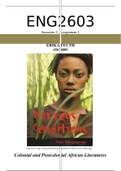
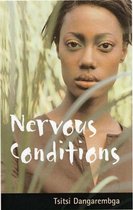
In Nervous Conditions (1988), Tsitsi Dangarembga presents a complex and layered
portrayal of women’s lives in colonial Zimbabwe, exposing how cultural and gender
expectations entrap them and, in some cases, how they attempt to break free.
Tambu, the narrator, introduces the novel with the stark declaration that it is a story
of “escape,” yet that escape is neither complete nor without consequences
(Dangarembga, 1988:1). Within her world, women are defined largely through their
domestic and reproductive roles, with their value measured by how well they serve
others. At the same time, the novel shows that not all women respond to this control
in the same way. Some quietly endure, some rebel subtly, while others revolt openly.
Through the lives of Tambu, Maiguru, Lucia, and Nyasha, the novel uncovers
different forms of entrapment and the unique, sometimes painful, paths toward
escape. Their stories are a reflection of the wider postcolonial landscape, where
freedom from colonial rule does not necessarily translate to personal liberation for
black women. Using close references to the novel and the ENG2603 study guide,
this essay explores how these women experience both psychological and physical
confinement, and how they respond sometimes successfully, sometimes not in their
search for self-determination.
Tambudzai’s journey in Nervous Conditions is a compelling portrait of how patriarchy
structures the experiences of women in colonised Zimbabwe, limiting their potential
and boxing them into roles defined by others. Right from the start, Tambu asserts
her voice through the bold statement: “I was not sorry when my brother died”
(Dangarembga, 1988:1). It is this shocking introduction that sets the tone for her
‘escape’—not from death but from the cultural and gender-based expectations that
shaped her early life. Her brother’s death becomes the catalyst that propels her into
a new world, offering her a chance to access education, something she had always
craved but was denied due to her being a girl. Tambu’s family prioritised Nhamo’s
schooling while she was expected to tend the fields and learn how to become a good
wife. Her fight to grow maize and raise her own school fees was not just about
learning, it was a personal rebellion against the rigid role she was expected to play
(Dangarembga 1988:15). Yet, even as she begins to access the life she dreamed of,
Tambu realises that escape is not so simple. The mission school and later the
Sacred Heart convent do not entirely liberate her but pull her deeper into another
STUDENT NUMBER:
UNIQUE NUMBER:
MODULE CODE: ENG2603
MODULE NAME: COLONIAL AND POSTCOLONIAL
AFRICAN LITERATURES
ASSIGNMENT: 01 (QUESTION 1)
YEAR MODULE 2025
DUE DATE: 10 MAY 2025
, Question 1
In Nervous Conditions (1988), Tsitsi Dangarembga presents a complex and layered
portrayal of women’s lives in colonial Zimbabwe, exposing how cultural and gender
expectations entrap them and, in some cases, how they attempt to break free.
Tambu, the narrator, introduces the novel with the stark declaration that it is a story
of “escape,” yet that escape is neither complete nor without consequences
(Dangarembga, 1988:1). Within her world, women are defined largely through their
domestic and reproductive roles, with their value measured by how well they serve
others. At the same time, the novel shows that not all women respond to this control
in the same way. Some quietly endure, some rebel subtly, while others revolt openly.
Through the lives of Tambu, Maiguru, Lucia, and Nyasha, the novel uncovers
different forms of entrapment and the unique, sometimes painful, paths toward
escape. Their stories are a reflection of the wider postcolonial landscape, where
freedom from colonial rule does not necessarily translate to personal liberation for
black women. Using close references to the novel and the ENG2603 study guide,
this essay explores how these women experience both psychological and physical
confinement, and how they respond sometimes successfully, sometimes not in their
search for self-determination.
Tambudzai’s journey in Nervous Conditions is a compelling portrait of how patriarchy
structures the experiences of women in colonised Zimbabwe, limiting their potential
and boxing them into roles defined by others. Right from the start, Tambu asserts
her voice through the bold statement: “I was not sorry when my brother died”
(Dangarembga, 1988:1). It is this shocking introduction that sets the tone for her
‘escape’—not from death but from the cultural and gender-based expectations that
shaped her early life. Her brother’s death becomes the catalyst that propels her into
a new world, offering her a chance to access education, something she had always
craved but was denied due to her being a girl. Tambu’s family prioritised Nhamo’s
schooling while she was expected to tend the fields and learn how to become a good
wife. Her fight to grow maize and raise her own school fees was not just about
learning, it was a personal rebellion against the rigid role she was expected to play
(Dangarembga 1988:15). Yet, even as she begins to access the life she dreamed of,
Tambu realises that escape is not so simple. The mission school and later the
Sacred Heart convent do not entirely liberate her but pull her deeper into another