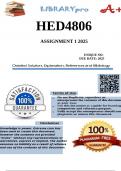
HED4806 Assignment 3 (COMPLETE ANSWERS) 2025 - DUE 2025; 100% correct solutions and explanations
HED4806 Assignment 3 (COMPLETE ANSWERS) 2025 - DUE 2025; 100% correct solutions and explanations. This assignment consists of two sections (A and B). You must answer both. SECTION A Section A is an extract from chapter 14 of the prescribed textbook (Seroto, Davids & Wolhuter, 2020). Read the extract and then answer the questions that follow. Mother tongue as a medium for teaching and learning in multicultural/multilingual societies. Decolonising previously marginalised indigenous languages is, no doubt, one of the most important tasks facing South Africa today. A people’s dignity and self-esteem are restored, and identity and respect maintained, if they speak and use their mother tongue. A people’s language is a heritage bestowed upon them by their ancestors. However, the later generations of our people dumped their languages and embraced the foreign tongue (Sotashe 2017). Wa Thiong’o (1986:4) placed specific emphasis on the use of the relevant local language to decolonise the mind of the African people. In his discussion of the language of African literature, Wa Thiong’o (1986:4) posits that language be put at the centre of people’s definition of themselves, in relation to their natural and social environment and to the world at large. He, further, argues that decolonisation has to start with language. This shows the importance of a person’s language. Wa Thiong’o (1986:4) made an important point about the language of indigenous people’s evening teachings (home teaching), and the language of their immediate and wider community, as well as the language of their field of work. There was harmony in the language used at home, in the community and in their world of work. This harmony was broken by the start of colonial schools. Wa Thiong’o (1986:11) indicates that when schools were still run by Kenyan patriotic nationalists, their medium of teaching and learning was Gĩkũyũ. After the declaration of a state of emergency in Kenya in 1952, the colonial regime took over the administration of all the schools that the nationalists had previously run. English became the language of formal education. To show how the indigenous languages were marginalised in the colonial classroom, Wade (2018) states that the Alliance High School, which Wa Thiong’o attended, used English as a medium of teaching and learning. Children who were found speaking the local Gĩkũyũ language were beaten. On the other hand, any achievement in spoken or written English was highly rewarded. In his own words, Wa Thiong’o (1986:11) says: “One of the most humiliating experiences was to be caught speaking Gĩkũyũ in the vicinity of the school. The culprit was given corporal punishment – three to five strokes of the cane on bare buttocks – or was made to carry a metal plate around the neck with inscriptions such as ‘I am stupid’ or ‘I am a donkey’. Sometimes culprits were fined money they could hardly afford.” This demonstrates that the colonial classroom became an instrument of psychological subjugation of people during the colonial period. English was the language of power, rationality, and intelligence. Gĩkũyũ, which Ngũgĩ would write, was considered backward, and had to be forced out. This is how local languages were suppressed across all colonies (Wade 2018:3). The relevant local language, as suggested by Wa Thiong’o (1986:4), will be referred to as mother tongue in this chapter. UNESCO (2003:15) describes mother tongue as the language that one has learnt first; the language one identifies, with or is identified as a native speaker; the language[s] one knows best, and the language one uses most. In addition, Mizza (2014:101) considers mother tongue as the child’s inborn, or first acquired, language. Mizza (2014:101) considers the term mother tongue as a language that a person learnt as a child at home (usually from their parents). Children growing up in bilingual homes can, according to
Connected book
- 2021
- 9783030642907
- Unknown
Written for
- Institution
- University of South Africa
- Course
- International and Comparative Education - HED4806
Document information
- Uploaded on
- April 3, 2025
- Number of pages
- 19
- Written in
- 2024/2025
- Type
- Exam (elaborations)
- Contains
- Questions & answers
Subjects
-
hed4806 assignment 3 complete answers 2025 due