
Samenvatting EM HC.6
A transmission electron microscope (TEM) provides 2D images
of 3D specimenen, viewed in transmission. But how do you go
from a 2D to a 3D structure?
An electron micrograph is a 2D projection of the 3D object. If
we have 2D projections from all directions, we can reconstruct
the 3D object.
There are 3 techniques to go from 2D to 3D:
Electron crystallography purified objects arranged in an ordered lattice (rooster), i.e.
need crystals, either 2D or small 3D.
Single particle analysis (SPA) purified objects arranged in many different random
orientations. Particles are computationally aligned
Electron tomography (ET) unique biological objects with a unique shape without
symmetry (this can be cells, organelles, viruses etc.)
Electron tomography
The problem with imaging with penetration radiation is that a 2D
image is obtained of a 3D object. In crowded environments structures
can overlap in the final image. This can cause identical 2D projections
for different structures.
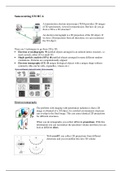
When you do tomography you collect different projections. With this
information you can reconstruct the specimen volume and then you can
look at different slices.
With cryoET you collect 2D projections from different
directions and you recombine this into 3D volume
A transmission electron microscope (TEM) provides 2D images
of 3D specimenen, viewed in transmission. But how do you go
from a 2D to a 3D structure?
An electron micrograph is a 2D projection of the 3D object. If
we have 2D projections from all directions, we can reconstruct
the 3D object.
There are 3 techniques to go from 2D to 3D:
Electron crystallography purified objects arranged in an ordered lattice (rooster), i.e.
need crystals, either 2D or small 3D.
Single particle analysis (SPA) purified objects arranged in many different random
orientations. Particles are computationally aligned
Electron tomography (ET) unique biological objects with a unique shape without
symmetry (this can be cells, organelles, viruses etc.)
Electron tomography
The problem with imaging with penetration radiation is that a 2D
image is obtained of a 3D object. In crowded environments structures
can overlap in the final image. This can cause identical 2D projections
for different structures.
When you do tomography you collect different projections. With this
information you can reconstruct the specimen volume and then you can
look at different slices.
With cryoET you collect 2D projections from different
directions and you recombine this into 3D volume


