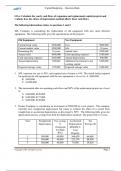
Capital Budgeting – Question Bank
LO.a: Calculate the yearly cash flows of expansion and replacement capital projects and
evaluate how the choice of depreciation method affects those cash flows.
The following information relates to questions 1 and 2.
SZL Company is considering the replacement of old equipment with new more efficient
equipment. The following table gives the specifications of the projects:
Old Equipment New Equipment
Current book value $300,000 Cost $900,000
Current market value $500,000 Life 10 years
Remaining life 10 years Annual sales $550,000
Annual sales $400,000 Cash operating expenses $180,000
Cash operating expenses $160,000 Annual depreciation $90,000
Annual depreciation $30,000 Additional investment in net $100,000
working capital
Expected salvage value $75,000 Expected salvage value $180,000
1. SZL corporate tax rate is 30%, and required rate of return is 10%. The initial outlay required
for replacing the old equipment with the new equipment is closest to: A. $560,000.
B. $500,000.
C. $1,000,000.
2. The incremental after-tax operating cash-flows and NPV of the replacement project are closest
to:
A. $100,000; $120,000.
B. $109,000; $177,000.
C. $109,000; $150,000
3. Domez Company is considering an investment of $500,000 in a new project. The company
currently uses straight-line depreciation but wants to evaluate the effect of a switch from
straight-line to accelerated depreciation on the project’s NPV. The following table gives the
depreciation and tax savings from both the depreciation methods. The project life is 5 years.
Year Straight-line Tax savings Accelerated Tax
Depreciation $ Depreciation Savings ($)
(Corporate MACRS 3-
Tax Rate Year
40%) Property
1 100,000 40,000 166,650 66,660
2 100,000 40,000 222,250 88,900
3 100,000 40,000 74,050 29,620
Copyright © IFT. All rights reserved. Page 1
, Capital Budgeting – Question Bank
4 100,000 40,000 37,050 14,820
5 100,000 40,000 0 0
PV at 10% $151,632 PV at 10%
The change from straight-line to accelerated depreciation would A.
have no effect on the NPV.
B. subtract $14,815 from the NPV.
C. add $14,815 to the NPV.
LO.b: Explain how inflation affects capital budgeting analysis.
4. Which of the following statements is least accurate? If inflation is higher than expected, the
profitability of an investment is lower, because it:
A. shifts wealth from the taxpayer to the government.
B. increases real taxes, by reducing value of the depreciation tax shelter.
C. decreases real taxes, by increasing value of the depreciation tax shelter.
5. Which of the following statements is correct? If inflation is lower than expected for a company
that has issued debt, then
A. real payments to bondholders are higher than expected.
B. real payments to the bondholders are lower than expected.
C. wealth is shifted from bondholders to the issuing company.
LO.c: Evaluate capital projects and determine the optimal capital project in situations of 1)
mutually exclusive projects with unequal lives, using either the least common multiple of
lives approach or the equivalent annual annuity approach, and 2) capital rationing.
6. The most appropriate methods used to evaluate two mutually exclusive projects with unequal
lives that will be replaced repeatedly are:
A. least common multiple of lives approach and EAA approach.
B. NPV and IRR.
C. IRR and payback period.
7. SNoy Company is evaluating two mutually exclusive projects with unequal lives. The
following table gives the projects’ assumptions:
Acoustic Equipment 1 Acoustic Equipment 2
Investment $120,000 $145,000
Annual after-tax operating $54,000 $55,520
cash flows
After-tax salvage value $30,000 $23,000
Life 3-years 4-years
NPV at 10% 36,829
Copyright © IFT. All rights reserved. Page 2
LO.a: Calculate the yearly cash flows of expansion and replacement capital projects and
evaluate how the choice of depreciation method affects those cash flows.
The following information relates to questions 1 and 2.
SZL Company is considering the replacement of old equipment with new more efficient
equipment. The following table gives the specifications of the projects:
Old Equipment New Equipment
Current book value $300,000 Cost $900,000
Current market value $500,000 Life 10 years
Remaining life 10 years Annual sales $550,000
Annual sales $400,000 Cash operating expenses $180,000
Cash operating expenses $160,000 Annual depreciation $90,000
Annual depreciation $30,000 Additional investment in net $100,000
working capital
Expected salvage value $75,000 Expected salvage value $180,000
1. SZL corporate tax rate is 30%, and required rate of return is 10%. The initial outlay required
for replacing the old equipment with the new equipment is closest to: A. $560,000.
B. $500,000.
C. $1,000,000.
2. The incremental after-tax operating cash-flows and NPV of the replacement project are closest
to:
A. $100,000; $120,000.
B. $109,000; $177,000.
C. $109,000; $150,000
3. Domez Company is considering an investment of $500,000 in a new project. The company
currently uses straight-line depreciation but wants to evaluate the effect of a switch from
straight-line to accelerated depreciation on the project’s NPV. The following table gives the
depreciation and tax savings from both the depreciation methods. The project life is 5 years.
Year Straight-line Tax savings Accelerated Tax
Depreciation $ Depreciation Savings ($)
(Corporate MACRS 3-
Tax Rate Year
40%) Property
1 100,000 40,000 166,650 66,660
2 100,000 40,000 222,250 88,900
3 100,000 40,000 74,050 29,620
Copyright © IFT. All rights reserved. Page 1
, Capital Budgeting – Question Bank
4 100,000 40,000 37,050 14,820
5 100,000 40,000 0 0
PV at 10% $151,632 PV at 10%
The change from straight-line to accelerated depreciation would A.
have no effect on the NPV.
B. subtract $14,815 from the NPV.
C. add $14,815 to the NPV.
LO.b: Explain how inflation affects capital budgeting analysis.
4. Which of the following statements is least accurate? If inflation is higher than expected, the
profitability of an investment is lower, because it:
A. shifts wealth from the taxpayer to the government.
B. increases real taxes, by reducing value of the depreciation tax shelter.
C. decreases real taxes, by increasing value of the depreciation tax shelter.
5. Which of the following statements is correct? If inflation is lower than expected for a company
that has issued debt, then
A. real payments to bondholders are higher than expected.
B. real payments to the bondholders are lower than expected.
C. wealth is shifted from bondholders to the issuing company.
LO.c: Evaluate capital projects and determine the optimal capital project in situations of 1)
mutually exclusive projects with unequal lives, using either the least common multiple of
lives approach or the equivalent annual annuity approach, and 2) capital rationing.
6. The most appropriate methods used to evaluate two mutually exclusive projects with unequal
lives that will be replaced repeatedly are:
A. least common multiple of lives approach and EAA approach.
B. NPV and IRR.
C. IRR and payback period.
7. SNoy Company is evaluating two mutually exclusive projects with unequal lives. The
following table gives the projects’ assumptions:
Acoustic Equipment 1 Acoustic Equipment 2
Investment $120,000 $145,000
Annual after-tax operating $54,000 $55,520
cash flows
After-tax salvage value $30,000 $23,000
Life 3-years 4-years
NPV at 10% 36,829
Copyright © IFT. All rights reserved. Page 2