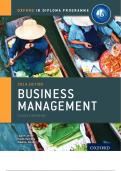
O X F O R D I B D I P L O M A P R O G R A M M E
2 0 1 4 E D I T I O N
B U S IN E S S
M A N A GE M E N T
C O U R S E C O M PA N I O N
Loykie Lominé
Mar tin Muchena
Rober t A. Pierce
, p334: iStock; p338: pick/Shutterstock; p340: bikeriderlondon/
Shutterstock; p344: Jason Mintzer/Shutterstock; p347: iStock;
3
p355: Manufactus.com; p357: Oxford University Press; p364:
Oxford University Press; p366: Mesut Dogan/Shutterstock; p374:
Great Clarendon Street, Oxford, OX2 6DP, United Kingdom
(a) © Frederic Neema/Sygma/Corbis, (b) © Corbis; p376: Oxford
Oxford University Press is a department of the University of
University Press
Oxford. It furthers the University’s objective of excellence in
Artwork by Six Red Marbles and Oxford University Press
research, scholarship, and education by publishing worldwide.
Oxford is a registered trade mark of Oxford University Press in
The authors and the publisher are grateful to the following for
the UK and in certain other countries
permission to reprint the copyright material listed:
© Oxford University Press 2014 The Association of Chartered Certiled Accountants (ACCA)
for the ve fundamental principles from Code of Ethics and Conduct
The moral rights of the authors have been asserted
( January, 2011), www.accaglobal.com.
First published in 2014
Acorn Systems for case study on Coca-Cola Turkey Icecek, from
www.acornsys.com.
All rights reserved. No part of this publication may be reproduced,
stored in a retrieval system, or transmitted, in any form or by
Bennett, Coleman & Co, Ltd (BCCL) for ‘Pepsico targeting
any means, without the prior permission in writing of Oxford
mass marketing, will cater to different segments of consumers:
University Press, or as expressly permitted by law, by licence or
Manu Anand’ by Ratna Bhushan, 6 June 2011, Economic Times,
under terms agreed with the appropriate reprographics rights
Times of India Group, copyright © BCCL 2011. All Rights
organization. Enquiries concerning reproduction outside the scope
Reserved.
of the above should be sent to the Rights Department, Oxford
Pearson Education for ‘The Power Interest Model’, original
University Press, at the address above.
model by A L Mendelow published in the Proceedings of the Second
You must not circulate this work in any other form and you must International Conference on Information Systems, Cambridge MA,
impose this same condition on any acquirer 1991, this version from G Johnson & K Scholes: Exploring Corporate
Strategy (5e, Prentice Hall, 1999).
British Library Cataloguing in Publication Data
UNDP for Summary from ‘Vodafone and Safaricom: Extending
Data available
Financial Services to the Poor in Rural Kenya’ by Winifred
978-0-19-839281-1
N Karugu and Triza Mwendwa, copyright © 2007 United
National Development Programme, published at www.
1 3 5 7 9 10 8 6 4 2
growinginclusivemarkets.org. All rights reserved.
Paper used in the production of this book is a natural, recyclable
Although we have made every effort to trace and contact all
product made from wood grown in sustainable forests.
copyright holders before publication this has not been possible
The manufacturing process conforms to the environmental
in all cases. If notied, the publisher will rectify any errors or
regulations of the country of origin.
omissions at the earliest opportunity.
Printed in Great Britain
Acknowledgements
The publishers would like to thank the following for permissions
to use their photographs:
Cover: MJ Prototype/Shutterstock p1: ChristineGonsalves/
Shutterstock; p5: iStock; p10: iStock; p19: iStock; p23: Ken
Wolter/Shutterstock; p34: iStock; p41: razihusin/Shutterstock;
p45: UIG/Getty Images; p52: iStock; p69: Greg Epperson/
Shutterstock; p72: AFP/Getty Images; p74: iStock; p94:
aerogondo2/Shutterstock; p97: tab62/Shutterstock; p101: iStock;
p111: © Imaginechina/Corbis; p122: iStock; p159: Mazzzur/
Shutterstock; p162: (a) © James Leynse/Corbis, (b) © Michael
S. Yamashita/Corbis; p165: (a) Thomas Mukoya/Reuters, (b)
Bloomberg/Getty Images; p169: Mike Hutchings/Reuters; p173:
(a) © Alex Robinson/JAI/Corbis, (b) © Michael Hanson/National
Geographic Society/Corbis; p174: © Julian Eales/Alamy; p180: ©
Krista Rossow/National Geographic Society/Corbis; p182: Vitaly
Titov & Maria Sidelnikova/Shutterstock; p198: David Becker/
Stringer/Getty Images; p210: M. Unal Ozmen/Shutterstock;
p215: (a) © Rodach, Johannes/the food passionates/Corbis, (b)
© Michele Eve/Splash News/Corbis; p222: © Yuri Arcurs/Tetra
Images/Corbis; p241: (a) © Neil Farrin/JAI/Corbis, (b) © Danny
Lehman/Corbis; p247: Curioso/Shutterstock; p250: iStock;
p252: Gil C/Shutterstock; p253: Bloomberg/Getty Images; p256:
eans/Shutterstock; p267: (a) U. Baumgarten/Getty Images, (b)
Annette Shaff/Shutterstock; p270: Iraidka/Shutterstock; p281:
© Samantha Craddock / Alamy; p300: Bloomberg/Getty Images;
p301: iStock; p311: © Cienpies Design / Alamy; p318: (a) jo
Crebbin/Shutterstock, (b) Richard Kuhlmann/www.qdrum.co.za;
p329: Bocman1973/Shutterstock; p332: Tupungato/Shutterstock;
,Cours book dnition The IB Learner Prole
The IB Diploma Programme course books are The aim of all IB programmes to develop
resource materials designed to support students internationally minded people who work to create
throughout their two-year Diploma Programme a better and more peaceful world. The aim of the
course of study in a particular subject. They will programme is to develop this person through ten
help students gain an understanding of what learner attributes, as described below.
is expected from the study of an IB Diploma
Inquirers: They develop their natural curiosity.
Programme subject while presenting content in a
They acquire the skills necessary to conduct
way that illustrates the purpose and aims of the IB.
inquiry and research and snow independence in
They reect the philosophy and approach of the
learning. They actively enjoy learning and this love
IB and encourage a deep understanding of each
of learning will be sustained throughout their lives.
subject by making connections to wider issues and
Knowledgeable: They explore concepts, ideas,
providing opportunities for critical thinking.
and issues that have local and global signicance.
The books mirror the IB philosophy of viewing the
In so doing, they acquire in-depth knowledge and
curriculum in terms of a whole-course approach;
develop understanding across a broad and balanced
the use of a wide range of resources, international
range of disciplines.
mindedness, the IB learner prole and the IB
Thinkers: They exercise initiative in applying
Diploma Programme core requirements, theory
thinking skills critically and creatively to recognize
of knowledge, the extended essay, and creativity,
and approach complex problems, and make
action, service (CAS).
reasoned, ethical decisions.
Each book can be used in conjunction with other
Communicators: They understand and express
materials and indeed, students of the IB are
ideas and information condently and creatively in
required and encouraged to draw conclusions from
more than one language and in a variety of modes
a variety of resources. Suggestions for additional
of communication. They work effectively and
and further reading are given in each book
willingly in collaboration with others.
and suggestions for how to extend research are
provided.
Principled: They act with integrity and honesty,
with a strong sense of fairness, justice and respect
In addition, the course companions provide advice
for the dignity of the individual, groups and
and guidance on the specic course assessment
communities. They take responsibility for their
requirements and on academic honesty protocol.
own action and the consequences that accompany
They are distinctive and authoritative without
them.
being prescriptive.
Open-minded: They understand and appreciate
their own cultures and personal histories, and are
IB mission statement
open to the perspectives, values and traditions
The International Baccalaureate aims to develop
of other individuals and communities. They are
inquiring, knowledgeable and caring young people
accustomed to seeking and evaluating a range of
who help to create a better and more peaceful
points of view, and are willing to grow from the
world through intercultural understanding and
experience.
respect.
Caring: They show empathy, compassion and
To this end the organization works with schools,
respect towards the needs and feelings of others.
governments and international organizations to
They have a personal commitment to service, and
develop challenging programmes of international
to act to make a positive difference to the lives of
education and rigorous assessment.
others and to the environment.
These programmes encourage students across the
Risk-takers: They approach unfamiliar situations
world to become active, compassionate and lifelong
and uncertainty with courage and forethought,
learners who understand that other people, with
and have the independence of spirit to explore
their differences, can also be right.
new roles, ideas, and strategies. They are brave and
articulate in defending their beliefs.
iii
, Balanced: They understand the importance of
What constitutes malpractice?
intellectual, physical and emotional ballance to
Malpractice is behaviour that results in, or may
achieve personal well-being for themselves and
result in, you or any student gaining an unfair
others.
advantage in one or more assessment component.
Malpractice includes plagiarism and collusion.
Reective: They give thoughtful consideration
to their own learning and experience. They are
Plagiarism is dened as the representation of the
able to assess and understand their strengths and
ideas or work of another person as your own. The
limitations in order to support their learning and
following are some of the ways to avoid plagiarism:
personal development.
●
words and ideas of another person to support
one’s arguments must be acknowledged
A note on academic honesty
●
passages that are quoted verbatim must
It is of vital importance to acknowledge and
be enclosed within quotation marks and
appropriately credit the owners of information
acknowledged
when that information is used in your work.
●
CD-Roms, email messages, web sites on the
After all, owners of ideas (intellectual property)
Internet and any other electronic media must
have property rights. To have an authentic piece
be treated in the same way as books and
of work, it must be based on your individual
journals
and original ideas with the work of others fully
acknowledged. Therefore, all assignments, written
●
the sources of all photographs, maps,
or oral, completed for assessment must use your
illustrations, computer programs, data, graphs,
own language and expression. Where sources are
audio-visual and similar material must be
used or referred to, whether in the form of direct
acknowledged if they are not your own work
quotation or paraphrase, such sources must be
●
works of art, whether music, lm dance,
appropriately acknowledged.
theatre arts or visual arts and where the
How do I acknowledge the work of others? creative use of a part of a work takes place, the
original artist must be acknowledged.
The way that you acknowledge that you have used
the ideas of other people is through the use of
Collusion is dened as supporting malpractice by
footnotes and bibliographies.
another student. This includes:
Footnotes (placed at the bottom of a page) or
●
allowing your work to be copied or submitted
endnotes (placed at the end of a document) are
for assessment by another student
to be provided when you quote or paraphrase
●
duplicating work for different assessment
from another document, or closely summarize the
components and/or diploma requirements.
information provided in another document. You
do not need to provide a footnote for information
Other forms of malpractice include any action
that is part of a ‘body of knowledge’. That is,
that gives you an unfair advantage or affects the
denitions do not need to be footnoted as they are
results of another student. Examples include,
part of the assumed knowledge.
taking unauthorized material into an examination
room, misconduct during an examination and
Bibliographies should include a formal list of the
falsifying a CAS record.
resources that you used in your work. ‘Formal’
means that you should use one of the several
accepted forms of presentation. This usually
involves separating the resources that you use
into different categories (e.g. books, magazines,
newspaper articles, internet-based resources, Cds
and works of art) and providing full information
as to how a reader or viewer of your work can
nd the same information. A bibliography is
compulsory in the Extended Essay.
iv
2 0 1 4 E D I T I O N
B U S IN E S S
M A N A GE M E N T
C O U R S E C O M PA N I O N
Loykie Lominé
Mar tin Muchena
Rober t A. Pierce
, p334: iStock; p338: pick/Shutterstock; p340: bikeriderlondon/
Shutterstock; p344: Jason Mintzer/Shutterstock; p347: iStock;
3
p355: Manufactus.com; p357: Oxford University Press; p364:
Oxford University Press; p366: Mesut Dogan/Shutterstock; p374:
Great Clarendon Street, Oxford, OX2 6DP, United Kingdom
(a) © Frederic Neema/Sygma/Corbis, (b) © Corbis; p376: Oxford
Oxford University Press is a department of the University of
University Press
Oxford. It furthers the University’s objective of excellence in
Artwork by Six Red Marbles and Oxford University Press
research, scholarship, and education by publishing worldwide.
Oxford is a registered trade mark of Oxford University Press in
The authors and the publisher are grateful to the following for
the UK and in certain other countries
permission to reprint the copyright material listed:
© Oxford University Press 2014 The Association of Chartered Certiled Accountants (ACCA)
for the ve fundamental principles from Code of Ethics and Conduct
The moral rights of the authors have been asserted
( January, 2011), www.accaglobal.com.
First published in 2014
Acorn Systems for case study on Coca-Cola Turkey Icecek, from
www.acornsys.com.
All rights reserved. No part of this publication may be reproduced,
stored in a retrieval system, or transmitted, in any form or by
Bennett, Coleman & Co, Ltd (BCCL) for ‘Pepsico targeting
any means, without the prior permission in writing of Oxford
mass marketing, will cater to different segments of consumers:
University Press, or as expressly permitted by law, by licence or
Manu Anand’ by Ratna Bhushan, 6 June 2011, Economic Times,
under terms agreed with the appropriate reprographics rights
Times of India Group, copyright © BCCL 2011. All Rights
organization. Enquiries concerning reproduction outside the scope
Reserved.
of the above should be sent to the Rights Department, Oxford
Pearson Education for ‘The Power Interest Model’, original
University Press, at the address above.
model by A L Mendelow published in the Proceedings of the Second
You must not circulate this work in any other form and you must International Conference on Information Systems, Cambridge MA,
impose this same condition on any acquirer 1991, this version from G Johnson & K Scholes: Exploring Corporate
Strategy (5e, Prentice Hall, 1999).
British Library Cataloguing in Publication Data
UNDP for Summary from ‘Vodafone and Safaricom: Extending
Data available
Financial Services to the Poor in Rural Kenya’ by Winifred
978-0-19-839281-1
N Karugu and Triza Mwendwa, copyright © 2007 United
National Development Programme, published at www.
1 3 5 7 9 10 8 6 4 2
growinginclusivemarkets.org. All rights reserved.
Paper used in the production of this book is a natural, recyclable
Although we have made every effort to trace and contact all
product made from wood grown in sustainable forests.
copyright holders before publication this has not been possible
The manufacturing process conforms to the environmental
in all cases. If notied, the publisher will rectify any errors or
regulations of the country of origin.
omissions at the earliest opportunity.
Printed in Great Britain
Acknowledgements
The publishers would like to thank the following for permissions
to use their photographs:
Cover: MJ Prototype/Shutterstock p1: ChristineGonsalves/
Shutterstock; p5: iStock; p10: iStock; p19: iStock; p23: Ken
Wolter/Shutterstock; p34: iStock; p41: razihusin/Shutterstock;
p45: UIG/Getty Images; p52: iStock; p69: Greg Epperson/
Shutterstock; p72: AFP/Getty Images; p74: iStock; p94:
aerogondo2/Shutterstock; p97: tab62/Shutterstock; p101: iStock;
p111: © Imaginechina/Corbis; p122: iStock; p159: Mazzzur/
Shutterstock; p162: (a) © James Leynse/Corbis, (b) © Michael
S. Yamashita/Corbis; p165: (a) Thomas Mukoya/Reuters, (b)
Bloomberg/Getty Images; p169: Mike Hutchings/Reuters; p173:
(a) © Alex Robinson/JAI/Corbis, (b) © Michael Hanson/National
Geographic Society/Corbis; p174: © Julian Eales/Alamy; p180: ©
Krista Rossow/National Geographic Society/Corbis; p182: Vitaly
Titov & Maria Sidelnikova/Shutterstock; p198: David Becker/
Stringer/Getty Images; p210: M. Unal Ozmen/Shutterstock;
p215: (a) © Rodach, Johannes/the food passionates/Corbis, (b)
© Michele Eve/Splash News/Corbis; p222: © Yuri Arcurs/Tetra
Images/Corbis; p241: (a) © Neil Farrin/JAI/Corbis, (b) © Danny
Lehman/Corbis; p247: Curioso/Shutterstock; p250: iStock;
p252: Gil C/Shutterstock; p253: Bloomberg/Getty Images; p256:
eans/Shutterstock; p267: (a) U. Baumgarten/Getty Images, (b)
Annette Shaff/Shutterstock; p270: Iraidka/Shutterstock; p281:
© Samantha Craddock / Alamy; p300: Bloomberg/Getty Images;
p301: iStock; p311: © Cienpies Design / Alamy; p318: (a) jo
Crebbin/Shutterstock, (b) Richard Kuhlmann/www.qdrum.co.za;
p329: Bocman1973/Shutterstock; p332: Tupungato/Shutterstock;
,Cours book dnition The IB Learner Prole
The IB Diploma Programme course books are The aim of all IB programmes to develop
resource materials designed to support students internationally minded people who work to create
throughout their two-year Diploma Programme a better and more peaceful world. The aim of the
course of study in a particular subject. They will programme is to develop this person through ten
help students gain an understanding of what learner attributes, as described below.
is expected from the study of an IB Diploma
Inquirers: They develop their natural curiosity.
Programme subject while presenting content in a
They acquire the skills necessary to conduct
way that illustrates the purpose and aims of the IB.
inquiry and research and snow independence in
They reect the philosophy and approach of the
learning. They actively enjoy learning and this love
IB and encourage a deep understanding of each
of learning will be sustained throughout their lives.
subject by making connections to wider issues and
Knowledgeable: They explore concepts, ideas,
providing opportunities for critical thinking.
and issues that have local and global signicance.
The books mirror the IB philosophy of viewing the
In so doing, they acquire in-depth knowledge and
curriculum in terms of a whole-course approach;
develop understanding across a broad and balanced
the use of a wide range of resources, international
range of disciplines.
mindedness, the IB learner prole and the IB
Thinkers: They exercise initiative in applying
Diploma Programme core requirements, theory
thinking skills critically and creatively to recognize
of knowledge, the extended essay, and creativity,
and approach complex problems, and make
action, service (CAS).
reasoned, ethical decisions.
Each book can be used in conjunction with other
Communicators: They understand and express
materials and indeed, students of the IB are
ideas and information condently and creatively in
required and encouraged to draw conclusions from
more than one language and in a variety of modes
a variety of resources. Suggestions for additional
of communication. They work effectively and
and further reading are given in each book
willingly in collaboration with others.
and suggestions for how to extend research are
provided.
Principled: They act with integrity and honesty,
with a strong sense of fairness, justice and respect
In addition, the course companions provide advice
for the dignity of the individual, groups and
and guidance on the specic course assessment
communities. They take responsibility for their
requirements and on academic honesty protocol.
own action and the consequences that accompany
They are distinctive and authoritative without
them.
being prescriptive.
Open-minded: They understand and appreciate
their own cultures and personal histories, and are
IB mission statement
open to the perspectives, values and traditions
The International Baccalaureate aims to develop
of other individuals and communities. They are
inquiring, knowledgeable and caring young people
accustomed to seeking and evaluating a range of
who help to create a better and more peaceful
points of view, and are willing to grow from the
world through intercultural understanding and
experience.
respect.
Caring: They show empathy, compassion and
To this end the organization works with schools,
respect towards the needs and feelings of others.
governments and international organizations to
They have a personal commitment to service, and
develop challenging programmes of international
to act to make a positive difference to the lives of
education and rigorous assessment.
others and to the environment.
These programmes encourage students across the
Risk-takers: They approach unfamiliar situations
world to become active, compassionate and lifelong
and uncertainty with courage and forethought,
learners who understand that other people, with
and have the independence of spirit to explore
their differences, can also be right.
new roles, ideas, and strategies. They are brave and
articulate in defending their beliefs.
iii
, Balanced: They understand the importance of
What constitutes malpractice?
intellectual, physical and emotional ballance to
Malpractice is behaviour that results in, or may
achieve personal well-being for themselves and
result in, you or any student gaining an unfair
others.
advantage in one or more assessment component.
Malpractice includes plagiarism and collusion.
Reective: They give thoughtful consideration
to their own learning and experience. They are
Plagiarism is dened as the representation of the
able to assess and understand their strengths and
ideas or work of another person as your own. The
limitations in order to support their learning and
following are some of the ways to avoid plagiarism:
personal development.
●
words and ideas of another person to support
one’s arguments must be acknowledged
A note on academic honesty
●
passages that are quoted verbatim must
It is of vital importance to acknowledge and
be enclosed within quotation marks and
appropriately credit the owners of information
acknowledged
when that information is used in your work.
●
CD-Roms, email messages, web sites on the
After all, owners of ideas (intellectual property)
Internet and any other electronic media must
have property rights. To have an authentic piece
be treated in the same way as books and
of work, it must be based on your individual
journals
and original ideas with the work of others fully
acknowledged. Therefore, all assignments, written
●
the sources of all photographs, maps,
or oral, completed for assessment must use your
illustrations, computer programs, data, graphs,
own language and expression. Where sources are
audio-visual and similar material must be
used or referred to, whether in the form of direct
acknowledged if they are not your own work
quotation or paraphrase, such sources must be
●
works of art, whether music, lm dance,
appropriately acknowledged.
theatre arts or visual arts and where the
How do I acknowledge the work of others? creative use of a part of a work takes place, the
original artist must be acknowledged.
The way that you acknowledge that you have used
the ideas of other people is through the use of
Collusion is dened as supporting malpractice by
footnotes and bibliographies.
another student. This includes:
Footnotes (placed at the bottom of a page) or
●
allowing your work to be copied or submitted
endnotes (placed at the end of a document) are
for assessment by another student
to be provided when you quote or paraphrase
●
duplicating work for different assessment
from another document, or closely summarize the
components and/or diploma requirements.
information provided in another document. You
do not need to provide a footnote for information
Other forms of malpractice include any action
that is part of a ‘body of knowledge’. That is,
that gives you an unfair advantage or affects the
denitions do not need to be footnoted as they are
results of another student. Examples include,
part of the assumed knowledge.
taking unauthorized material into an examination
room, misconduct during an examination and
Bibliographies should include a formal list of the
falsifying a CAS record.
resources that you used in your work. ‘Formal’
means that you should use one of the several
accepted forms of presentation. This usually
involves separating the resources that you use
into different categories (e.g. books, magazines,
newspaper articles, internet-based resources, Cds
and works of art) and providing full information
as to how a reader or viewer of your work can
nd the same information. A bibliography is
compulsory in the Extended Essay.
iv