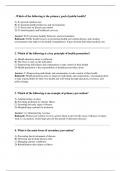
. Which of the following is the primary goal of public health?
A) To provide medical care
B) To promote healthy behaviors and environments
C) To focus only on disease prevention
D) To fund hospitals and healthcare services
Answer: B) To promote healthy behaviors and environments
Rationale: Public health focuses on promoting health, preventing disease, and creating
environments that improve the health of populations. It goes beyond individual medical care.
2. Which of the following is a key principle of health promotion?
A) Health education alone is sufficient
B) The focus is only on the individual
C) Empowering individuals and communities to take control of their health
D) Health promotion is the responsibility of healthcare providers alone
Answer: C) Empowering individuals and communities to take control of their health
Rationale: Health promotion aims to empower individuals and communities, encouraging them
to take responsibility for their own health and well-being through education, resources, and
policy change.
3. Which of the following is an example of primary prevention?
A) Administering vaccines
B) Providing treatment for chronic illness
C) Screening for early signs of disease
D) Hospitalizing a patient for treatment
Answer: A) Administering vaccines
Rationale: Primary prevention involves actions taken to prevent the onset of disease or injury,
such as vaccination, which helps prevent the spread of infectious diseases.
4. What is the main focus of secondary prevention?
A) Preventing the development of disease
B) Detecting and treating disease early
C) Managing chronic conditions
D) Rehabilitation after injury or illness
,Answer: B) Detecting and treating disease early
Rationale: Secondary prevention focuses on early detection and treatment of diseases to reduce
severity or prevent complications, such as screening for cancer or hypertension.
5. Which of the following is an example of tertiary prevention?
A) Health education campaigns
B) Cancer screenings
C) Physical therapy after a stroke
D) Immunizations
Answer: C) Physical therapy after a stroke
Rationale: Tertiary prevention aims to reduce the impact of an existing disease or condition by
improving quality of life and managing symptoms, such as rehabilitation after a stroke.
6. Which of the following is a major determinant of health?
A) Income and social status
B) Access to healthcare only
C) Availability of medical treatments
D) Quality of hospitals
Answer: A) Income and social status
Rationale: Social determinants of health, including income and social status, play a significant
role in overall health outcomes, influencing access to resources, healthcare, and living
conditions.
7. What is the purpose of health impact assessments (HIAs)?
A) To measure individual patient outcomes
B) To assess the potential effects of policies, programs, or projects on community health
C) To track the financial cost of health interventions
D) To determine the health status of a community
Answer: B) To assess the potential effects of policies, programs, or projects on community
health
Rationale: HIAs are used to predict how policies or projects might impact the health of a
community and to ensure that health considerations are part of decision-making.
, 8. Which of the following is a characteristic of the social-ecological model of
health?
A) Health is solely an individual responsibility
B) Focuses on the relationship between individuals and their environments
C) Only focuses on biological factors
D) It does not consider the role of social factors
Answer: B) Focuses on the relationship between individuals and their environments
Rationale: The social-ecological model considers multiple levels of influence, including
individual, interpersonal, community, and societal factors, recognizing that health outcomes are
shaped by various environmental factors.
9. What is the main purpose of the World Health Organization (WHO)?
A) To provide direct healthcare services
B) To promote global health and well-being
C) To regulate national healthcare systems
D) To provide financial aid to hospitals
Answer: B) To promote global health and well-being
Rationale: The WHO's primary role is to lead international efforts to improve health, prevent
diseases, and set global health policies, rather than providing direct medical care.
10. Which of the following is considered a modifiable risk factor for chronic
diseases?
A) Age
B) Family history
C) Smoking
D) Gender
Answer: C) Smoking
Rationale: Modifiable risk factors, like smoking, can be changed or controlled to reduce the risk
of developing chronic diseases. Non-modifiable risk factors, like age and family history, cannot
be altered.
11. Which of the following is a common method of assessing community health
needs?
A) To provide medical care
B) To promote healthy behaviors and environments
C) To focus only on disease prevention
D) To fund hospitals and healthcare services
Answer: B) To promote healthy behaviors and environments
Rationale: Public health focuses on promoting health, preventing disease, and creating
environments that improve the health of populations. It goes beyond individual medical care.
2. Which of the following is a key principle of health promotion?
A) Health education alone is sufficient
B) The focus is only on the individual
C) Empowering individuals and communities to take control of their health
D) Health promotion is the responsibility of healthcare providers alone
Answer: C) Empowering individuals and communities to take control of their health
Rationale: Health promotion aims to empower individuals and communities, encouraging them
to take responsibility for their own health and well-being through education, resources, and
policy change.
3. Which of the following is an example of primary prevention?
A) Administering vaccines
B) Providing treatment for chronic illness
C) Screening for early signs of disease
D) Hospitalizing a patient for treatment
Answer: A) Administering vaccines
Rationale: Primary prevention involves actions taken to prevent the onset of disease or injury,
such as vaccination, which helps prevent the spread of infectious diseases.
4. What is the main focus of secondary prevention?
A) Preventing the development of disease
B) Detecting and treating disease early
C) Managing chronic conditions
D) Rehabilitation after injury or illness
,Answer: B) Detecting and treating disease early
Rationale: Secondary prevention focuses on early detection and treatment of diseases to reduce
severity or prevent complications, such as screening for cancer or hypertension.
5. Which of the following is an example of tertiary prevention?
A) Health education campaigns
B) Cancer screenings
C) Physical therapy after a stroke
D) Immunizations
Answer: C) Physical therapy after a stroke
Rationale: Tertiary prevention aims to reduce the impact of an existing disease or condition by
improving quality of life and managing symptoms, such as rehabilitation after a stroke.
6. Which of the following is a major determinant of health?
A) Income and social status
B) Access to healthcare only
C) Availability of medical treatments
D) Quality of hospitals
Answer: A) Income and social status
Rationale: Social determinants of health, including income and social status, play a significant
role in overall health outcomes, influencing access to resources, healthcare, and living
conditions.
7. What is the purpose of health impact assessments (HIAs)?
A) To measure individual patient outcomes
B) To assess the potential effects of policies, programs, or projects on community health
C) To track the financial cost of health interventions
D) To determine the health status of a community
Answer: B) To assess the potential effects of policies, programs, or projects on community
health
Rationale: HIAs are used to predict how policies or projects might impact the health of a
community and to ensure that health considerations are part of decision-making.
, 8. Which of the following is a characteristic of the social-ecological model of
health?
A) Health is solely an individual responsibility
B) Focuses on the relationship between individuals and their environments
C) Only focuses on biological factors
D) It does not consider the role of social factors
Answer: B) Focuses on the relationship between individuals and their environments
Rationale: The social-ecological model considers multiple levels of influence, including
individual, interpersonal, community, and societal factors, recognizing that health outcomes are
shaped by various environmental factors.
9. What is the main purpose of the World Health Organization (WHO)?
A) To provide direct healthcare services
B) To promote global health and well-being
C) To regulate national healthcare systems
D) To provide financial aid to hospitals
Answer: B) To promote global health and well-being
Rationale: The WHO's primary role is to lead international efforts to improve health, prevent
diseases, and set global health policies, rather than providing direct medical care.
10. Which of the following is considered a modifiable risk factor for chronic
diseases?
A) Age
B) Family history
C) Smoking
D) Gender
Answer: C) Smoking
Rationale: Modifiable risk factors, like smoking, can be changed or controlled to reduce the risk
of developing chronic diseases. Non-modifiable risk factors, like age and family history, cannot
be altered.
11. Which of the following is a common method of assessing community health
needs?