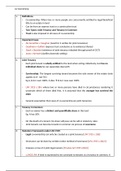
Co-Ownership
a. Definitions
- Co-ownership: When two or more people are concurrently entitled to legal/beneficial
title to an estate in land
- Can be from an express trust or a constructive trust
- Two Types: Joint Tenancy and Tenancy in Common
- Trust is also imposed in all cases of co-ownership
Important Cases
- AG Securities v Vaughan (need for 4 unities for joint tenancies)
- Goodman v Gallant (express trust conclusive as to existence/shares)
- Stack v Dowden (existence of joint tenancy rebutted through proof of CICT)
- Jones v Kernott (clarifies domestic setting)
b. Joint Tenancy
- Each joint tenant is wholly entitled to the land when acting collectively, but has no
individual share he can separately deal with
- Survivorship: The longest surviving tenant becomes the sole owner of the estate (only
applies to JT, not TIC)
Eg A, B & C own 100%. A dies B & C now own 100%
- LPA 1925 s.184: where two or more persons have died in circumstances rendering it
uncertain which of them died first, it is assumed that the younger has survived the
elder
- General assumption that cases of co-ownership are joint tenancies
c. Tenancy in Common
- Each co-owner has a distinct and quantifiable share in the land
Eg. A has 20%
- On the death of a tenant, his share will pass via his will or statutory rules
- Joint tenants can become tenants in common via process of severance
d. Statutory Framework under LPA 1925
- Legal co-ownership can only be created as a joint tenancy [LPA 1925 s.1(6)]
- Severance can be done by written notice method of severance [LPA 1925 s.36(2)]
- Imposes a max of 4 joint legal owners [Trustee Act 1925 s34(2)]
- s.34(2) LPA: If land is expressed to be conveyed to tenants as a tenancy in common, it
a. Definitions
- Co-ownership: When two or more people are concurrently entitled to legal/beneficial
title to an estate in land
- Can be from an express trust or a constructive trust
- Two Types: Joint Tenancy and Tenancy in Common
- Trust is also imposed in all cases of co-ownership
Important Cases
- AG Securities v Vaughan (need for 4 unities for joint tenancies)
- Goodman v Gallant (express trust conclusive as to existence/shares)
- Stack v Dowden (existence of joint tenancy rebutted through proof of CICT)
- Jones v Kernott (clarifies domestic setting)
b. Joint Tenancy
- Each joint tenant is wholly entitled to the land when acting collectively, but has no
individual share he can separately deal with
- Survivorship: The longest surviving tenant becomes the sole owner of the estate (only
applies to JT, not TIC)
Eg A, B & C own 100%. A dies B & C now own 100%
- LPA 1925 s.184: where two or more persons have died in circumstances rendering it
uncertain which of them died first, it is assumed that the younger has survived the
elder
- General assumption that cases of co-ownership are joint tenancies
c. Tenancy in Common
- Each co-owner has a distinct and quantifiable share in the land
Eg. A has 20%
- On the death of a tenant, his share will pass via his will or statutory rules
- Joint tenants can become tenants in common via process of severance
d. Statutory Framework under LPA 1925
- Legal co-ownership can only be created as a joint tenancy [LPA 1925 s.1(6)]
- Severance can be done by written notice method of severance [LPA 1925 s.36(2)]
- Imposes a max of 4 joint legal owners [Trustee Act 1925 s34(2)]
- s.34(2) LPA: If land is expressed to be conveyed to tenants as a tenancy in common, it