Lecture 1: (Date 04/09/24 )
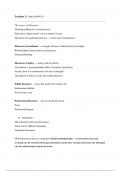
The Layers of Discourse
Meaning-making as a social process.
What does culture mean? Art as a matter of taste
Dynamics of a particular process → causes and consequences
Discourse of academia → concepts, theories, frameworks for example
Relationships between theory and practice
About positioning
Discourse of policy → policy and/or politics
Government / governmentality (Mix of practice and theory)
Society, how is it constructed, how has it changed?
The impact of policy on arts and cultural practice
Public discourse → art in the world, the world in art
Information bubbles
Society that’s you
Professional discourse → the art world, the sector
Peers
Professional jargon
● Integration …
The interaction between discourses
Same source, different meaning
Dominant discourses
(What discourses have in common): Social constructivism → is de theorie dat onze
ervaring van de wereld (deels) geconstrueerd wordt door sociale processen die afhangen
van de maatschappij waarin we leven.
, Principles:
- A critical approach to taken-for-granted knowledge
- Historical and cultural specificity (overtime things might change, you understanding
of a certain phenomena is related to this)
- Link between knowledge and social processes
- Link between knowledge and social action
Discourse constructs the social world in meaning, and that, owing to the fundamental
instability of language, meaning can never be permanently fixed.
“Critical Discourse Analysis”: discourse is just one among many aspects of any social
practice.
Foucault, discourses work in three ways, they enable, they constrain and the constitute.
(ze maken mogelijk, ze beperken en ze vormen).
Language is a discourse: it enables me to speak, it constrains what I can say and it constitutes
me as a speaking subject.
From archaeology to genealogy
→ How is knowledge constructed and maintained? How does a society remember?
● Archaeology: systems of thought and knowledge are governed by rules, beyond those
of grammar and logic, that operate beneath the consciousness of individual subjects
and define a system of conceptual possibilities that determines the boundaries of
thought in a given domain and period.
● Genealogy: this analysis is to show that a given system of thought was the result of
contingent turns of history. → Genealogie of stamboomonderzoek is een discipline
van de geschiedkunde die zich bezighoudt met voorouderlijk onderzoek en de
afstamming van een familie.
Example of discourse:
Cultural Policy → how is culture defined?
What part of culture is captured in or influenced by policy?
Different levels; urban, regional, national, international level.
The Layers of Discourse
Meaning-making as a social process.
What does culture mean? Art as a matter of taste
Dynamics of a particular process → causes and consequences
Discourse of academia → concepts, theories, frameworks for example
Relationships between theory and practice
About positioning
Discourse of policy → policy and/or politics
Government / governmentality (Mix of practice and theory)
Society, how is it constructed, how has it changed?
The impact of policy on arts and cultural practice
Public discourse → art in the world, the world in art
Information bubbles
Society that’s you
Professional discourse → the art world, the sector
Peers
Professional jargon
● Integration …
The interaction between discourses
Same source, different meaning
Dominant discourses
(What discourses have in common): Social constructivism → is de theorie dat onze
ervaring van de wereld (deels) geconstrueerd wordt door sociale processen die afhangen
van de maatschappij waarin we leven.
, Principles:
- A critical approach to taken-for-granted knowledge
- Historical and cultural specificity (overtime things might change, you understanding
of a certain phenomena is related to this)
- Link between knowledge and social processes
- Link between knowledge and social action
Discourse constructs the social world in meaning, and that, owing to the fundamental
instability of language, meaning can never be permanently fixed.
“Critical Discourse Analysis”: discourse is just one among many aspects of any social
practice.
Foucault, discourses work in three ways, they enable, they constrain and the constitute.
(ze maken mogelijk, ze beperken en ze vormen).
Language is a discourse: it enables me to speak, it constrains what I can say and it constitutes
me as a speaking subject.
From archaeology to genealogy
→ How is knowledge constructed and maintained? How does a society remember?
● Archaeology: systems of thought and knowledge are governed by rules, beyond those
of grammar and logic, that operate beneath the consciousness of individual subjects
and define a system of conceptual possibilities that determines the boundaries of
thought in a given domain and period.
● Genealogy: this analysis is to show that a given system of thought was the result of
contingent turns of history. → Genealogie of stamboomonderzoek is een discipline
van de geschiedkunde die zich bezighoudt met voorouderlijk onderzoek en de
afstamming van een familie.
Example of discourse:
Cultural Policy → how is culture defined?
What part of culture is captured in or influenced by policy?
Different levels; urban, regional, national, international level.