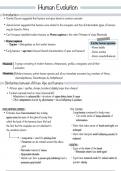
Human Evolution
Introduction
Charles Darwin suggested that humans and apes shared a common ancestor
James burnet suggested that humans were related to the orangutan and that all intermediate types of humans
may be found in Africa
Carl Linnaeus classified modern humans as Homo sapiens in the order Primates of class Mammalia
Homo sapiens
Sapien = distinguishes us from earlier humans Earlier human species
Homo habilis
Early humans = ape men (showed shared characteristics of apes and humans) Homo erectus
Homo neanderthalensis
Hominid A group consisting of modern humans, chimpanzees, gorillas, orangutans and all their
ancestors
Hominins Modern humans, extinct human species and all our immediate ancestors (eg. members of Homo,
Australopithecus, Paranthropus & Ardipithecus)
Similarities between African Ape and humans
African apes = gorillas, chimps, bonobos (slightly larger than chimps)
Earliest mammals lived on trees (arboreal life)
Adaptations to arboreal life = structure of upper limbs, brain & eyes
Other adaptations shared by all primates = no. of offspring & posture
THE UPPER LIMBS: THE BRAIN:
Primates have free movement due to long Large brains compared to body mass
Can make sense of large amounts of
upper arms because of the glenoid cavity (into
information
which the head of the humerus bone fits) and
the fact that the scapulae are not attached to Parts that make sense of touch and sight are
the vertebral column enlarged
Parts that interpret smell (olfactory centre) is
Long arms = used for picking fruit reduced
Forearms can be rotated around the elbow
joint VISION:
Eyes at the front of the head
Flat nails instead of claws
Binocular vision (use both eyes)
Opposable thumbs
Hands can form a power grip (climbing) and a Eyes have cones & rods for colour vision &
precision grip (tools) greater clarity
Introduction
Charles Darwin suggested that humans and apes shared a common ancestor
James burnet suggested that humans were related to the orangutan and that all intermediate types of humans
may be found in Africa
Carl Linnaeus classified modern humans as Homo sapiens in the order Primates of class Mammalia
Homo sapiens
Sapien = distinguishes us from earlier humans Earlier human species
Homo habilis
Early humans = ape men (showed shared characteristics of apes and humans) Homo erectus
Homo neanderthalensis
Hominid A group consisting of modern humans, chimpanzees, gorillas, orangutans and all their
ancestors
Hominins Modern humans, extinct human species and all our immediate ancestors (eg. members of Homo,
Australopithecus, Paranthropus & Ardipithecus)
Similarities between African Ape and humans
African apes = gorillas, chimps, bonobos (slightly larger than chimps)
Earliest mammals lived on trees (arboreal life)
Adaptations to arboreal life = structure of upper limbs, brain & eyes
Other adaptations shared by all primates = no. of offspring & posture
THE UPPER LIMBS: THE BRAIN:
Primates have free movement due to long Large brains compared to body mass
Can make sense of large amounts of
upper arms because of the glenoid cavity (into
information
which the head of the humerus bone fits) and
the fact that the scapulae are not attached to Parts that make sense of touch and sight are
the vertebral column enlarged
Parts that interpret smell (olfactory centre) is
Long arms = used for picking fruit reduced
Forearms can be rotated around the elbow
joint VISION:
Eyes at the front of the head
Flat nails instead of claws
Binocular vision (use both eyes)
Opposable thumbs
Hands can form a power grip (climbing) and a Eyes have cones & rods for colour vision &
precision grip (tools) greater clarity