Managing Business Strategically
Session 1: Value Creation and Value Capture
- Strategy is a concept that has an integrated idea. Strategies develops through a
mission:
Mission: fundamental purpose & values --> Objectives: specific targets --> Strategy:
the central integrated, externally oriented concept of how we ill achieve our objectives
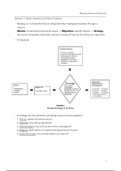
- To illustrate:
- A strategy has five elements, providing answers to five questions:
1. Arenas: where will we be active?
2. Vehicles: how will we get there?
3. Differentiators: how will we win in the marketplace?
4. Staging: what will be our speed and sequence of moves?
5. Economic Logic: how will we obtain our returns?
1
, Managing Business Strategically
- Arenas - i.e. where will we be active? - considers that it is important to be as specific as
possible about the product categories, market segments, geographic areas, and core
technologies, as well as the value-adding stages (e.g. product design, manufacturing,
selling, servicing, distribution) the business intends to take on.
- Vehicles - i.e. how will we get there? - the means for attaining the needed presence in a
particular product category, market segment, geographic area, or value-creation stage
should be the result of deliberate strategic choice:
• Product range: How is the business going to accomplish that; by relying on organic,
internal product development, or are there other vehicles - such as joint ventures or
acquisitions - that offer a better means for achieving a broadened scope?
• International expansion: What should be our primary modes ,or vehicles - greenfield
startups, local acquisitions, licensing, or joint ventures?
- Differentiators - i.e. how will we win in the marketplace? - in a competitive world in the
marketplace, winning is the result of differentiators. They require executives to make
upfront, conscious choices about which weapons will be assembled, honed, and
deployed to beat competitors in the fight for customers, revenues, and profits.
- Staging - i.e what will be our speed and sequence of moves? - the forth element
pertain to staging, or the speed and sequence of major moves to take in order to
heighten the likelihood of success.
- Two ideas of Porter: cost-leadership and diversification. You have to think about the
timing and how you stage yourself.
- General Electrics (GE), for example, started in industrials and staged it by acquiring lots
of firms and divested a lot of firms that weren't core. They decided to grow through
M&A. They focused on renewable first and strengthened on other parts of the business
later onwards.
- Economic Logic - i.e. how will we obtain our returns? - at the heart of a business
strategy must be a clear idea of how profits (above the firm's cost of capital) will be
generated. The economic logics are not fleeting or transitory. They are rooted in the
firms' fundamental and relatively enduring capabilities. Think of Uber/Snapchat, back
when these were start-ups they needed to think of how they could become profitable
with their business models.
2
, Managing Business Strategically
- What is strategy? It is an integrated set of choices consisting of five elements:
- Sensitivity Analysis is a robustness test that you should ask yourself after you have
developed a strategy:
1. Does your strategy fit with what's going on in the environment?
2. Does your strategy exploit your key resources?
3. Will your envisioned differentiators be sustainable?
4. Are the elements of your strategy internally consistent?
5. Do you have enough resources to pursue this strategy?
6. Is your strategy implementable?
- Key takeaways from what is strategy:
• Strategy refers to the central integrated, externally oriented concept of how we will
achieve our objectives.
• A strategy has five elements, each strategy therefore needs to answer five questions
3
, Managing Business Strategically
relating to arena, vehicles, differentiators, staging, and economic logic.
• Perform a sensitivity analysis.
- Value creation in the resource-based view:
Resources have value in relation to their ability to meet customers' needs.
- You use the resource-based view to gain a sustainable competitive advantage. In the
strategic domain, the resource-based view explains why one firm is better than another,
because it has better resource.
- A resource is valuable if it exploits opportunities and/or neutralises threats in a firm's
environments, but also when they enable a firm to conceive of or implement strategies
that improve its efficiency and effectiveness. In short, resources have value in relation to
their ability to meet customers' needs.
- The issue with the resource-based view is that it does not tell us how customers' judge
the extent to which an existing product meets their needs?
- How to assess value? Utility function:
4
Session 1: Value Creation and Value Capture
- Strategy is a concept that has an integrated idea. Strategies develops through a
mission:
Mission: fundamental purpose & values --> Objectives: specific targets --> Strategy:
the central integrated, externally oriented concept of how we ill achieve our objectives
- To illustrate:
- A strategy has five elements, providing answers to five questions:
1. Arenas: where will we be active?
2. Vehicles: how will we get there?
3. Differentiators: how will we win in the marketplace?
4. Staging: what will be our speed and sequence of moves?
5. Economic Logic: how will we obtain our returns?
1
, Managing Business Strategically
- Arenas - i.e. where will we be active? - considers that it is important to be as specific as
possible about the product categories, market segments, geographic areas, and core
technologies, as well as the value-adding stages (e.g. product design, manufacturing,
selling, servicing, distribution) the business intends to take on.
- Vehicles - i.e. how will we get there? - the means for attaining the needed presence in a
particular product category, market segment, geographic area, or value-creation stage
should be the result of deliberate strategic choice:
• Product range: How is the business going to accomplish that; by relying on organic,
internal product development, or are there other vehicles - such as joint ventures or
acquisitions - that offer a better means for achieving a broadened scope?
• International expansion: What should be our primary modes ,or vehicles - greenfield
startups, local acquisitions, licensing, or joint ventures?
- Differentiators - i.e. how will we win in the marketplace? - in a competitive world in the
marketplace, winning is the result of differentiators. They require executives to make
upfront, conscious choices about which weapons will be assembled, honed, and
deployed to beat competitors in the fight for customers, revenues, and profits.
- Staging - i.e what will be our speed and sequence of moves? - the forth element
pertain to staging, or the speed and sequence of major moves to take in order to
heighten the likelihood of success.
- Two ideas of Porter: cost-leadership and diversification. You have to think about the
timing and how you stage yourself.
- General Electrics (GE), for example, started in industrials and staged it by acquiring lots
of firms and divested a lot of firms that weren't core. They decided to grow through
M&A. They focused on renewable first and strengthened on other parts of the business
later onwards.
- Economic Logic - i.e. how will we obtain our returns? - at the heart of a business
strategy must be a clear idea of how profits (above the firm's cost of capital) will be
generated. The economic logics are not fleeting or transitory. They are rooted in the
firms' fundamental and relatively enduring capabilities. Think of Uber/Snapchat, back
when these were start-ups they needed to think of how they could become profitable
with their business models.
2
, Managing Business Strategically
- What is strategy? It is an integrated set of choices consisting of five elements:
- Sensitivity Analysis is a robustness test that you should ask yourself after you have
developed a strategy:
1. Does your strategy fit with what's going on in the environment?
2. Does your strategy exploit your key resources?
3. Will your envisioned differentiators be sustainable?
4. Are the elements of your strategy internally consistent?
5. Do you have enough resources to pursue this strategy?
6. Is your strategy implementable?
- Key takeaways from what is strategy:
• Strategy refers to the central integrated, externally oriented concept of how we will
achieve our objectives.
• A strategy has five elements, each strategy therefore needs to answer five questions
3
, Managing Business Strategically
relating to arena, vehicles, differentiators, staging, and economic logic.
• Perform a sensitivity analysis.
- Value creation in the resource-based view:
Resources have value in relation to their ability to meet customers' needs.
- You use the resource-based view to gain a sustainable competitive advantage. In the
strategic domain, the resource-based view explains why one firm is better than another,
because it has better resource.
- A resource is valuable if it exploits opportunities and/or neutralises threats in a firm's
environments, but also when they enable a firm to conceive of or implement strategies
that improve its efficiency and effectiveness. In short, resources have value in relation to
their ability to meet customers' needs.
- The issue with the resource-based view is that it does not tell us how customers' judge
the extent to which an existing product meets their needs?
- How to assess value? Utility function:
4