

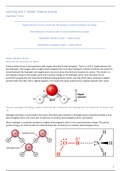
Learning Unit 1: Water, Polarity and pH
Important Terms
Dipole Moment: Occurs in molecules that display an uneven distribution of charge.
Polar Molecule: A molecule with an uneven distribution of charge.
Hydrophilic: Soluble in water – “water-loving”
Hydrophobic: Insoluble in water – “water-hating”
What I Need to Know
Describe the structure of water
A water molecule has a bent geometry with oxygen attached to two hydrogens. There is a 104.3° angle between the
two hydrogens. The oxygen atom is highly electronegative (far more than hydrogen), therefor it attracts the electrons
shared between the hydrogen and oxygen atom more and draws the electrons towards its nucleus. This results in a
net negative charge on the oxygen atom and a positive charge on the hydrogen atom. Since the atom has an
asymmetrical geometry and unevenly distributed charge between atoms, one side of the water molecule is slightly
positive while the other side is slightly negative. This means the water molecule has a dipole moment and is polar.
Discuss hydrogen bonding in water and how this influences the boiling point and density of water and
ice
Hydrogen bonding is a noncovalent interaction that takes place between a hydrogen atom covalently bonded to one
electronegative atom and a lone pair of electrons on another electronegative atom. (see below)
When hydrogen is covalently bonded to a highly electronegative atom, it has a partial positive charge. This partial
positive charge can interact with an unshared (lone) pair of electrons on another electronegative atom.
1
,Each water molecule can form four hydrogen bonds – it has two hydrogens (donors) that can enter into hydrogen bonds
and two lone pair electrons (acceptors) on the oxygen atom to which other water molecules can be hydrogen bonded.
In liquid water, these hydrogen bonds are constantly breaking and reforming, allowing water molecules to “move over”
one another. However, in an ice crystal the hydrogen bonded array is less densely packed than that in liquid water – ice
has a lower density than liquid water due to the orientation of hydrogen bonds results in there being more space
between water molecules. This means that ice is less dense that liquid water and is the reason why ice floats on water.
Although hydrogen bonds are much weaker than covalent bonds, the energy require to overcome this intermolecular
force is still greater than that required to overcome other van der Waals forces. Both the melting and the boiling point
of water are significantly higher than would be predicted for molecules of this size due to the number of hydrogen
bonds that can form between water molecules.
Differentiate between a covale nt and noncovalent interaction
A covalent interaction is one in which there is a sharing of one or more pairs of electrons between atoms.
Noncovalent interactions are weaker than covalent (and ionic) interactions since it does not involve the sharing of
electrons between atoms. These interactions are important in determining stability, structure and functions of
biomolecules.
Compare different types of noncovalent interactions
Hydrophobic interactions are the interactions that occur between nonpolar molecules.
A salt bridge is a noncovalent attraction between two ionised groups of opposite charge.
Van der Waals forces are noncovalent interactions that occur when there is a weak attraction between two dipoles.
These dipoles may be induced dipoles.
Hydrogen bonds are noncovalent attractions between a hydrogen atom covalently bonded to an electronegative atom
and the lone pair of electrons found on another electronegative atom.
Explain what pH means
pH is a measure of hydrogen ion concentration, [H+], in an aqueous (water) solution. The pH scale ranges from 0 to 14.
A low pH value indicates acidity, a pH=7 is neutral, and a high pH value indicates alkalinity.
pH = -log10[H+]
Understand what is meant by Ka and pKa values
Both values describe the degree of ionization of an acid and are true indicators of acid strength because adding water
to a solution will not change the equilibrium constant. Ka is the acid dissociation constant. pKa is simply the -log of this
constant.
Ka = [H+][A-]/ [HA]
pKa = - log Ka
2
,A large Ka value indicates a strong acid because it means the acid is largely dissociated into its ions. A Large Ka value
also means the formation of products in the reaction is favoured. A small Ka value means little of the acid dissociates,
so you have a weak acid.
The pKa gives the same information, just in a different way. The smaller the value of pKa, the stronger the acid. The
pKa value of a weak acid is the pH at which the protonated form, [HA], and its conjugate base, [A-], are present at
equal concentrations.
Explain what a buffer is
A buffer can be defined as something that resists change. Therefor a buffer solution is a solution that tends to resist a
change in pH on addition of moderate amounts of strong acid or strong base. Solutions of weak acids or bases with
their conjugate base or acid, respectively, can act as buffers. They can resist changes in pH because they neutralise
small quantities of added acid or base.
Discuss how buffers are involved in the maintenance of constant pH in biological systems
If you have a solution containing an acid and its conjugate base at equilibrium, it can be represented by the following
equation:
If a strong acid is added to the equilibrium mixture of the weak acid and its conjugate base, the equilibrium will shift to
the left to relieve the stress. This shift in equilibrium occurs in agreement with Le Châtelier’s principle. The hydrogen
ion concentration will therefore not increase by the amount expected for the quantity of acid added. Likewise, if
strong base is added, the hydrogen ion concentration will decrease by less than expected for the quantity of base
added.
Cellular processes are highly sensitive to pH changes because many biological macromolecules will not function if they
are not within an optimal pH range. For this reason, the pH within the cell cytoplasm and extracellular fluid of animals
is carefully regulated.
3
, Learning Unit 2: Introduction to Amino Acids and Peptides
Important Terms
Chiral: Refers to an object that is not superimposable on its mirror image.
Zwitterion: A molecule with two or more functional groups, of which at least one has a positive and
one has a negative electrical charge and the net charge of the entire molecule is zero. They are
electrically neutral molecules with a positive and negative charge.
Isoelectric Point (pI): The pH at which the concentration of the zwitterion is at its maximum and the
concentrations of the anions and cations are equal, i.e. the ion carries no electrical charge. At this
pH amino acids exist in the zwitterion form, which is a neutral form.
What I Need to Know
Draw the basic structure of an amino acid
This is the basic structure of all amino acids. Amino acids differ only in their side chains (R-group).
4
Important Terms
Dipole Moment: Occurs in molecules that display an uneven distribution of charge.
Polar Molecule: A molecule with an uneven distribution of charge.
Hydrophilic: Soluble in water – “water-loving”
Hydrophobic: Insoluble in water – “water-hating”
What I Need to Know
Describe the structure of water
A water molecule has a bent geometry with oxygen attached to two hydrogens. There is a 104.3° angle between the
two hydrogens. The oxygen atom is highly electronegative (far more than hydrogen), therefor it attracts the electrons
shared between the hydrogen and oxygen atom more and draws the electrons towards its nucleus. This results in a
net negative charge on the oxygen atom and a positive charge on the hydrogen atom. Since the atom has an
asymmetrical geometry and unevenly distributed charge between atoms, one side of the water molecule is slightly
positive while the other side is slightly negative. This means the water molecule has a dipole moment and is polar.
Discuss hydrogen bonding in water and how this influences the boiling point and density of water and
ice
Hydrogen bonding is a noncovalent interaction that takes place between a hydrogen atom covalently bonded to one
electronegative atom and a lone pair of electrons on another electronegative atom. (see below)
When hydrogen is covalently bonded to a highly electronegative atom, it has a partial positive charge. This partial
positive charge can interact with an unshared (lone) pair of electrons on another electronegative atom.
1
,Each water molecule can form four hydrogen bonds – it has two hydrogens (donors) that can enter into hydrogen bonds
and two lone pair electrons (acceptors) on the oxygen atom to which other water molecules can be hydrogen bonded.
In liquid water, these hydrogen bonds are constantly breaking and reforming, allowing water molecules to “move over”
one another. However, in an ice crystal the hydrogen bonded array is less densely packed than that in liquid water – ice
has a lower density than liquid water due to the orientation of hydrogen bonds results in there being more space
between water molecules. This means that ice is less dense that liquid water and is the reason why ice floats on water.
Although hydrogen bonds are much weaker than covalent bonds, the energy require to overcome this intermolecular
force is still greater than that required to overcome other van der Waals forces. Both the melting and the boiling point
of water are significantly higher than would be predicted for molecules of this size due to the number of hydrogen
bonds that can form between water molecules.
Differentiate between a covale nt and noncovalent interaction
A covalent interaction is one in which there is a sharing of one or more pairs of electrons between atoms.
Noncovalent interactions are weaker than covalent (and ionic) interactions since it does not involve the sharing of
electrons between atoms. These interactions are important in determining stability, structure and functions of
biomolecules.
Compare different types of noncovalent interactions
Hydrophobic interactions are the interactions that occur between nonpolar molecules.
A salt bridge is a noncovalent attraction between two ionised groups of opposite charge.
Van der Waals forces are noncovalent interactions that occur when there is a weak attraction between two dipoles.
These dipoles may be induced dipoles.
Hydrogen bonds are noncovalent attractions between a hydrogen atom covalently bonded to an electronegative atom
and the lone pair of electrons found on another electronegative atom.
Explain what pH means
pH is a measure of hydrogen ion concentration, [H+], in an aqueous (water) solution. The pH scale ranges from 0 to 14.
A low pH value indicates acidity, a pH=7 is neutral, and a high pH value indicates alkalinity.
pH = -log10[H+]
Understand what is meant by Ka and pKa values
Both values describe the degree of ionization of an acid and are true indicators of acid strength because adding water
to a solution will not change the equilibrium constant. Ka is the acid dissociation constant. pKa is simply the -log of this
constant.
Ka = [H+][A-]/ [HA]
pKa = - log Ka
2
,A large Ka value indicates a strong acid because it means the acid is largely dissociated into its ions. A Large Ka value
also means the formation of products in the reaction is favoured. A small Ka value means little of the acid dissociates,
so you have a weak acid.
The pKa gives the same information, just in a different way. The smaller the value of pKa, the stronger the acid. The
pKa value of a weak acid is the pH at which the protonated form, [HA], and its conjugate base, [A-], are present at
equal concentrations.
Explain what a buffer is
A buffer can be defined as something that resists change. Therefor a buffer solution is a solution that tends to resist a
change in pH on addition of moderate amounts of strong acid or strong base. Solutions of weak acids or bases with
their conjugate base or acid, respectively, can act as buffers. They can resist changes in pH because they neutralise
small quantities of added acid or base.
Discuss how buffers are involved in the maintenance of constant pH in biological systems
If you have a solution containing an acid and its conjugate base at equilibrium, it can be represented by the following
equation:
If a strong acid is added to the equilibrium mixture of the weak acid and its conjugate base, the equilibrium will shift to
the left to relieve the stress. This shift in equilibrium occurs in agreement with Le Châtelier’s principle. The hydrogen
ion concentration will therefore not increase by the amount expected for the quantity of acid added. Likewise, if
strong base is added, the hydrogen ion concentration will decrease by less than expected for the quantity of base
added.
Cellular processes are highly sensitive to pH changes because many biological macromolecules will not function if they
are not within an optimal pH range. For this reason, the pH within the cell cytoplasm and extracellular fluid of animals
is carefully regulated.
3
, Learning Unit 2: Introduction to Amino Acids and Peptides
Important Terms
Chiral: Refers to an object that is not superimposable on its mirror image.
Zwitterion: A molecule with two or more functional groups, of which at least one has a positive and
one has a negative electrical charge and the net charge of the entire molecule is zero. They are
electrically neutral molecules with a positive and negative charge.
Isoelectric Point (pI): The pH at which the concentration of the zwitterion is at its maximum and the
concentrations of the anions and cations are equal, i.e. the ion carries no electrical charge. At this
pH amino acids exist in the zwitterion form, which is a neutral form.
What I Need to Know
Draw the basic structure of an amino acid
This is the basic structure of all amino acids. Amino acids differ only in their side chains (R-group).
4



