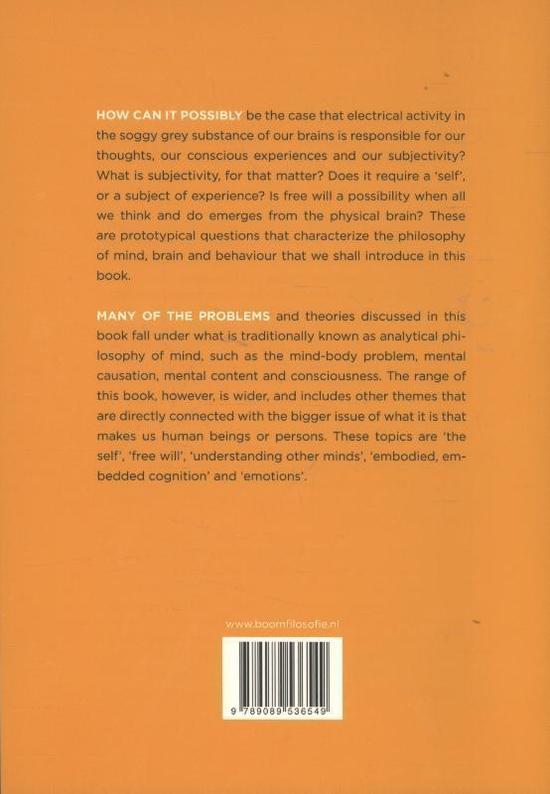
Philosophy of Mind, Brain, and
Behavior
WEEKLY READINGS
Week 1 — WR: Introduction and Dualism 2
Lecture 1 — Introduction & Dualism 5
Week 2 — WR: Behaviorism and Identity Theory 7
Lecture 2 — Behaviorism and Identity Theory 15
Week 3 — WR Functionalism, Consciousness & Eliminativism 18
Lecture 3 — Functionalism, Consciousness & Eliminativism 21
Week 4 — WR Interpretivism & 4E Cognition 26
Lecture 4 — Interpretivism & 4E Cognition 29
Week 5 — WR Philosophy of science: Ideal Science 32
Lecture 5 — Philosophy of science for psychologists 36
Lecture 6 — Philosophy of science: how does science actually develop? 40
Week 7 — WR Free Will 43
Lecture 7 — Free will 46
, Week 1 — WR: Introduction and Dualism
Chapter 1: The mind-body problem
Mental states have a number of properties that make them di cult to understand:
“being about something”
You can think about an in nite number of things, that seem to be completely random. None of
these topics are themselves part of your thoughts. Your thoughts only refer to them.
“experiences”
Such as tasting, seeing, and feeling. You need to have experiences this to be able to know what
it’s like. These experiences are fundamentally subjective.
It’s di cult to explain these phenomena as if they are here in the physical world. Because of this it
may seem that the mind is something non-physical.
All contemporary theories of the mind can be understood as responses to the idea that the mind
resides in an immaterial soul that is distinguishable from the body, this is called dualism.
Section 1.1: Substance dualism
Substance dualism is the theory according to which people consist of two parts:
(1) A material body
(2) An immaterial soul
Descartes believed that the body and soul were two distinct substances that can exist
independently. According to him, the soul does not occupy space. Only material things occupy
space — he thought that this is exactly what de nes matter. The essence of the immaterial
soul is what he called ‘thinking’ (which Descartes referred to when speaking about all conscious
processes such as imaging, perceiving, desiring, believing, doubting, hoping, dreaming, etc…)
Section 1.1.1: Doubt as argument
Descartes’ substance dualism is the product of his quest for the foundations of scienti c
knowledge — he believed that these foundations should consist of knowledge that we cannot
doubt. He searched for any knowledge that could not be doubted and found that the only
thing was: him doubting. Hence: cogito ergo sum
“I think therefore I am”
ffi fi fi ffi fi
, According to Descartes, material objects cannot reason and cannot be conscious. Others,
however, see a direct proof of dualism in his cogito argument:
Leibniz (1646-1716) ‘identity of indiscernible’:
We can only say that x is the same as y, if x and y share all their properties. Even though they are
identical in all their properties — such as shape, color, weight, smoothness — they still di er in
their place in space and time. Only if they would share that property too, they would be one.
Leibniz’ principle can be used to argue that Descartes’ thinking ‘me’ — the soul — cannot be the
same entity as a material body or brain. Descartes argued that we can doubt the existence of our
own bodies and brains, but we cannot doubt our own existence as thinking things. Hence,
these thinking things appear to have a property that our bodies and brains lack.
1.1.2: Two features of Cartesian dualism
The rst feature is “immateriality of the soul”
Descartes’ thinking ‘me’ is his conception of the soul. This entity
interacts with the material body.
The second feature is “separation of the outside world and the inside mind”
Descartes’ thinking ‘me’ is separated from the outside world. It is
connected, but only indirectly through the senses and through behavior.
Knowledge of the world resides in the mind, but consist only of what he
calls ‘ideas’. Ideas exist in the mind but they are often about the world.
Thought is the manipulation of ideas. True knowledge consists of ideas
that correspond with how the world really is.
1.1.3: Problems with arguments for dualism
Descartes’ arguments were based on the idea that material objects or entities cannot think, and
thus were unable to produce or use language, to reason, or have conscious experiences.
In the present day it is easier to comprehend why Descartes was wrong for thinking this,
because we are in a time where it seems more possible that computers can reason and produce/
understand language (not meaning they can do this exactly like humans do). But there are no
reasons to deny that one day they might be able to do so.
The argument from ‘doubt’ remains. We cannot doubt the fact that there is someone who doubts.
So the argument goes that this someone cannot be identical with her brain and body: for in oder
for there to be identity, the shining entity must share all properties with her brain and body.
fi ff
, The relevant distinction here is between ontology and epistemology.
Ontology is the study of ”what really exists”. The idea that the mind
and the body are distinct entities is an ontological conclusion
The distinction between the mind and the body in terms of what we
can doubt is an epistemological distinction. It is not about the mind
and the body as they exist, but between the mind and the body as
we know them.
1.1.4: The interaction problem
The absence of logically inescapable arguments for dualism doesn't negate its validity, but there
are arguments against it, notably the interaction problem. Princess Elisabeth of Bohemia, a
contemporary of Descartes, raised this issue: how can an immaterial soul a ect a material body,
and vice versa? Descartes proposed the pineal gland as the interface for this interaction, but
modern physics challenges this view with the causal closure of the physical realm. This principle
suggests that all physical events have complete physical explanations, leaving no room for
immaterial entities like the soul to in uence physical processes.
fl ff
Behavior
WEEKLY READINGS
Week 1 — WR: Introduction and Dualism 2
Lecture 1 — Introduction & Dualism 5
Week 2 — WR: Behaviorism and Identity Theory 7
Lecture 2 — Behaviorism and Identity Theory 15
Week 3 — WR Functionalism, Consciousness & Eliminativism 18
Lecture 3 — Functionalism, Consciousness & Eliminativism 21
Week 4 — WR Interpretivism & 4E Cognition 26
Lecture 4 — Interpretivism & 4E Cognition 29
Week 5 — WR Philosophy of science: Ideal Science 32
Lecture 5 — Philosophy of science for psychologists 36
Lecture 6 — Philosophy of science: how does science actually develop? 40
Week 7 — WR Free Will 43
Lecture 7 — Free will 46
, Week 1 — WR: Introduction and Dualism
Chapter 1: The mind-body problem
Mental states have a number of properties that make them di cult to understand:
“being about something”
You can think about an in nite number of things, that seem to be completely random. None of
these topics are themselves part of your thoughts. Your thoughts only refer to them.
“experiences”
Such as tasting, seeing, and feeling. You need to have experiences this to be able to know what
it’s like. These experiences are fundamentally subjective.
It’s di cult to explain these phenomena as if they are here in the physical world. Because of this it
may seem that the mind is something non-physical.
All contemporary theories of the mind can be understood as responses to the idea that the mind
resides in an immaterial soul that is distinguishable from the body, this is called dualism.
Section 1.1: Substance dualism
Substance dualism is the theory according to which people consist of two parts:
(1) A material body
(2) An immaterial soul
Descartes believed that the body and soul were two distinct substances that can exist
independently. According to him, the soul does not occupy space. Only material things occupy
space — he thought that this is exactly what de nes matter. The essence of the immaterial
soul is what he called ‘thinking’ (which Descartes referred to when speaking about all conscious
processes such as imaging, perceiving, desiring, believing, doubting, hoping, dreaming, etc…)
Section 1.1.1: Doubt as argument
Descartes’ substance dualism is the product of his quest for the foundations of scienti c
knowledge — he believed that these foundations should consist of knowledge that we cannot
doubt. He searched for any knowledge that could not be doubted and found that the only
thing was: him doubting. Hence: cogito ergo sum
“I think therefore I am”
ffi fi fi ffi fi
, According to Descartes, material objects cannot reason and cannot be conscious. Others,
however, see a direct proof of dualism in his cogito argument:
Leibniz (1646-1716) ‘identity of indiscernible’:
We can only say that x is the same as y, if x and y share all their properties. Even though they are
identical in all their properties — such as shape, color, weight, smoothness — they still di er in
their place in space and time. Only if they would share that property too, they would be one.
Leibniz’ principle can be used to argue that Descartes’ thinking ‘me’ — the soul — cannot be the
same entity as a material body or brain. Descartes argued that we can doubt the existence of our
own bodies and brains, but we cannot doubt our own existence as thinking things. Hence,
these thinking things appear to have a property that our bodies and brains lack.
1.1.2: Two features of Cartesian dualism
The rst feature is “immateriality of the soul”
Descartes’ thinking ‘me’ is his conception of the soul. This entity
interacts with the material body.
The second feature is “separation of the outside world and the inside mind”
Descartes’ thinking ‘me’ is separated from the outside world. It is
connected, but only indirectly through the senses and through behavior.
Knowledge of the world resides in the mind, but consist only of what he
calls ‘ideas’. Ideas exist in the mind but they are often about the world.
Thought is the manipulation of ideas. True knowledge consists of ideas
that correspond with how the world really is.
1.1.3: Problems with arguments for dualism
Descartes’ arguments were based on the idea that material objects or entities cannot think, and
thus were unable to produce or use language, to reason, or have conscious experiences.
In the present day it is easier to comprehend why Descartes was wrong for thinking this,
because we are in a time where it seems more possible that computers can reason and produce/
understand language (not meaning they can do this exactly like humans do). But there are no
reasons to deny that one day they might be able to do so.
The argument from ‘doubt’ remains. We cannot doubt the fact that there is someone who doubts.
So the argument goes that this someone cannot be identical with her brain and body: for in oder
for there to be identity, the shining entity must share all properties with her brain and body.
fi ff
, The relevant distinction here is between ontology and epistemology.
Ontology is the study of ”what really exists”. The idea that the mind
and the body are distinct entities is an ontological conclusion
The distinction between the mind and the body in terms of what we
can doubt is an epistemological distinction. It is not about the mind
and the body as they exist, but between the mind and the body as
we know them.
1.1.4: The interaction problem
The absence of logically inescapable arguments for dualism doesn't negate its validity, but there
are arguments against it, notably the interaction problem. Princess Elisabeth of Bohemia, a
contemporary of Descartes, raised this issue: how can an immaterial soul a ect a material body,
and vice versa? Descartes proposed the pineal gland as the interface for this interaction, but
modern physics challenges this view with the causal closure of the physical realm. This principle
suggests that all physical events have complete physical explanations, leaving no room for
immaterial entities like the soul to in uence physical processes.
fl ff