

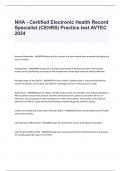
NHA - Certified Electronic Health Record Specialist (CEHRS) Practice test AVTEC 2024
Accounts Receivable - ANSWERSPatient bills for services that have already been provided that legally are due to a facility. Autopsy Rates - ANSWERSThe percent of autopsies performed on patients who die in the hospital; reasons for not performing an autopsy in the hospital may include legal inquiry or family preference. Average Length of Stay (ALOS) - ANSWERSThe total number of patient days in a period divided by the number of patients; for example, the ALOS for cardiology services in February was 6.1 days. Benchmarks - ANSWERSGoals or metrics a facility wants to meet; for example, if the industry standard is 90% of patients should have advance directives entered into their patient record within 24 hour of admission, and a hospital was only meeting this for 45% of the patients, they would use the external benchmark of 90% as a goal and track performance toward that goal by month or quarter. Centers for Disease and Control and Prevention (CDC) - ANSWERSA division of the Department of Health and Human Services. Chief Executive Officer (CEO) - ANSWERSLeader of a facility who reports to the Board of Directors. Chief Financial Officer (CFO) - ANSWERSLeader who oversees all financial and fiscal decisions and issues for a facility; generally reports to the CEO. Commercial Insurers - ANSWERSPrivate, non-government insurers; these are often the insurance options available through employers. Comorbidity - ANSWERSDisease that exists at the same time as a primary disease that a patient is being treated for at the time; for example, a patient who has cancer is receiving cancer specific treatment and is also a diabetic - diabetes mellitus would be considered the comorbid condition. Complications - ANSWERSUnexpected events or circumstances that happen to a patient during the course of his care; hospital-acquired infections, such as those involving MRSA, are considered to be complications, as are reactions to medications or an adverse response to any treatment. Copayment - ANSWERSMoney the patient must pay toward the bill as contracted between the insurer and provider; amounts range from $5 to $50, and $75 for emergency room and specialist visits; provider's office visits are often in the $10 to $35 range. Daily Census - ANSWERSThe count of how many patients are in beds by patient care unit for an inpatient facility. Department of Health and Human Services (HHS) - ANSWERSPrinciple agency for protecting Americans' Health Institute of Medicine (IOM) - ANSWERSNon-governmental, independent, and nonprofit organization that provides unbiased, expert advice to governmental and private decision-makers, as well as the public. Morbidity - ANSWERSRefers to disease Mortality (death) Rate - ANSWERSThe percentage of all discharged patients who are discharged due to death within a prescribed period; for example, if a hospital has discharged 30 patients in a month, and of those 5 were deaths, the mortality rate for the month would be expressed as 5/30 or 16.7%. National Ambulatory Medical Care Survey (NAMCS) - ANSWERSCollects data on ambulatory medical care provided in the U.S.; the data is collected from visits to office based providers who provide direct patient care. National Center for Health Statistics (NCHS) - ANSWERSNation's primary statistics organization; it works to compile, analyze, and disseminate information on the nation's health to influence and guide health policy and practice in a manner that best serves the population. National Health Inpatient Quality Measures - ANSWERSA set of specific data that hospitals must collect and report to CMS and the Joint Commission to document quality patient care. Occupancy Rate - ANSWERSThe percentage of licensed beds in a hospital that have a patient assigned to them, and thus are generating revenue. Patient Care Unit (PCU) - ANSWERSFor the purpose of census data, a PCU has a defined number of beds and is staff assigned; also called floors, units, or wards. Prospective Payment System (PPS) - ANSWERSSystem initially implemented by Medicare in the early 1980's that replaced fee-for-service payments for the provision of health services with predetermined payments based on the principal diagnosis of the patient. Service Lines - ANSWERSGroups of patient services by specialty; hospitals define these individually, and they vary by facility with some similarities, such as obstetrics; examples include cardiology, neurology, thoracic surgery, general surgery, and the gynecology; some facilities choose to combine similar or related lines, such as obstetrics and neonatology, obstetrics and gynecology, and cardio-thoracic surgery; they are useful for compiling financial, compliance, and other in-house reports. Total Inpatient Service Days - ANSWERSThe number of inpatients receiving care each day summed for the days in the period under study; for example, if you are reviewing the total inpatient service days for the month of September, which has 30 days, add the patients for Sept 1 (125), Sept 2 (119), and so on; the total is the sum of all patients per day. az Which of the following describes the impact on legacy systems when implementing an EHR system? - ANSWERSThey were not built to work with other health information technology solutions. CPOE - ANSWERSAllows a provider to order medications, diagnostic testing, rehabilitation, and other services for inpatients. ePrescribing - ANSWERSIs the tool providers use in the outpatient setting to send prescriptions to the patient's pharmacy. It replaces the paper prescription pad. eFax - ANSWERSIs a software application that allows EHR specialists to send a document from the computer to a fax machine. HIS - ANSWERSRefers to the sum total of all information systems that support operations in a facility. CCHIT - ANSWERSApproves and certifies EHR technology and is the required standard for facilities and providers wanting to participate in the Meaningful Use incentive program.
Document information
- Uploaded on
- May 24, 2024
- Number of pages
- 15
- Written in
- 2023/2024
- Type
- Exam (elaborations)
- Contains
- Questions & answers


