NREMT Advanced-EMT
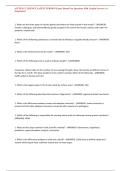
NREMT Advanced-EMT Study Guide
Exam Containing 494 Questions with
Definitive Solutions 2024-2025.
Initial Assessment: B-SMNAC - Answer: - BSI (body substance isolation);
- Scene Safety;
- Mechanism of Injury (MOI)/Nature of Illness (NOI);
- Number of Patients;
- Assistance (additional units, Fire, Police, etc.);
1
, NREMT Advanced-EMT
- C-spine (and/or C-collar)
Initial Assessment: G-CAAT - Answer: - General Impression;
- Chief Complaints, Life Threats (hemorrhage);
- AVPU;
- ABC's (airway, breathing, circulation);
- Transport Decision (Load and Go or Stay and Play)
Components of General Impression - Answer: ASSS-FLOP-VD:
- Apparent state of health;
- Skin color, obvious lesions;
- Signs of distress;
- Sexual development;
- Facial expressions;
- Level of consciousness;
- Odors;
- Posture, Motor, Gait;
- Vital statistics;
- Dress, Grooming, Hygiene
Components of AVPU - Answer: - Alert;
- responds to Verbal stimuli;
- responds to Painful stimuli;
- Unresponsive
2
, NREMT Advanced-EMT
Secondary Assessment: OPQRST-I - Answer: especially for Respiratory and Cardiac
patients:
- Onset;
- Provocation/Palliation;
- Quality;
- Radiation;
- Scale/Severity;
- Time;
- Interventions
What is OPQRST? - Answer: a mnemonic for remembering the questions to ask
when assessing the patient's chief complaint or major symptoms
Onset - Answer: - When and how did the symptom begin?
- Ask the patient if the onset was sudden or gradual.
- Also determine if the onset was associated with a particular activity.
Provocation/palliation: - Answer: - What makes the symptom worse?
- What makes the symptom better?
Quality - Answer: How would you describe the pain?
Radiation - Answer: - Where do you feel the pain?;
- Where does the pain go?
3
, NREMT Advanced-EMT
Scale/Severity - Answer: - On a scale from 0 to 10, with 10 being the worst.
- How bad is the symptom?
Time - Answer: - Determine if the symptom has been present for minutes, hours,
days, weeks, months, or years;
- The length of time the symptoms are present is important to document
Secondary Assessment: SAMPLE - Answer: - Signs and Symptoms (history of
present issues);
- Allergies;
- Medications;
- Past Medical History, Pertinent Negatives;
- Last Oral Intake;
- Events (leading to present: trauma or medical)
Secondary Assessment: V-FITD - Answer: - Vital Signs, baseline (VS);
- Focused Physical Exam (performed);
- Interventions (RX's per medical direction, etc.);
- Transport (re-evaluate decision);
- Detailed Physical Exam (verbalized);
Order of Initial Assessment - Answer: - B-SMNAC;
- G-CAAT;
Order of Secondary Assessment - Answer: - OPQRST-I;
4
NREMT Advanced-EMT Study Guide
Exam Containing 494 Questions with
Definitive Solutions 2024-2025.
Initial Assessment: B-SMNAC - Answer: - BSI (body substance isolation);
- Scene Safety;
- Mechanism of Injury (MOI)/Nature of Illness (NOI);
- Number of Patients;
- Assistance (additional units, Fire, Police, etc.);
1
, NREMT Advanced-EMT
- C-spine (and/or C-collar)
Initial Assessment: G-CAAT - Answer: - General Impression;
- Chief Complaints, Life Threats (hemorrhage);
- AVPU;
- ABC's (airway, breathing, circulation);
- Transport Decision (Load and Go or Stay and Play)
Components of General Impression - Answer: ASSS-FLOP-VD:
- Apparent state of health;
- Skin color, obvious lesions;
- Signs of distress;
- Sexual development;
- Facial expressions;
- Level of consciousness;
- Odors;
- Posture, Motor, Gait;
- Vital statistics;
- Dress, Grooming, Hygiene
Components of AVPU - Answer: - Alert;
- responds to Verbal stimuli;
- responds to Painful stimuli;
- Unresponsive
2
, NREMT Advanced-EMT
Secondary Assessment: OPQRST-I - Answer: especially for Respiratory and Cardiac
patients:
- Onset;
- Provocation/Palliation;
- Quality;
- Radiation;
- Scale/Severity;
- Time;
- Interventions
What is OPQRST? - Answer: a mnemonic for remembering the questions to ask
when assessing the patient's chief complaint or major symptoms
Onset - Answer: - When and how did the symptom begin?
- Ask the patient if the onset was sudden or gradual.
- Also determine if the onset was associated with a particular activity.
Provocation/palliation: - Answer: - What makes the symptom worse?
- What makes the symptom better?
Quality - Answer: How would you describe the pain?
Radiation - Answer: - Where do you feel the pain?;
- Where does the pain go?
3
, NREMT Advanced-EMT
Scale/Severity - Answer: - On a scale from 0 to 10, with 10 being the worst.
- How bad is the symptom?
Time - Answer: - Determine if the symptom has been present for minutes, hours,
days, weeks, months, or years;
- The length of time the symptoms are present is important to document
Secondary Assessment: SAMPLE - Answer: - Signs and Symptoms (history of
present issues);
- Allergies;
- Medications;
- Past Medical History, Pertinent Negatives;
- Last Oral Intake;
- Events (leading to present: trauma or medical)
Secondary Assessment: V-FITD - Answer: - Vital Signs, baseline (VS);
- Focused Physical Exam (performed);
- Interventions (RX's per medical direction, etc.);
- Transport (re-evaluate decision);
- Detailed Physical Exam (verbalized);
Order of Initial Assessment - Answer: - B-SMNAC;
- G-CAAT;
Order of Secondary Assessment - Answer: - OPQRST-I;
4