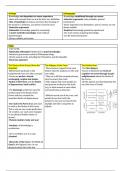
A Priori A Posteriori
-Knowledge not dependent on sense experience -Knowledge established through our senses
-Ideas and concepts that are true by their very definition -Inductive arguments (only probable, general
-Idea of tautology (as long as you know the meaning of conclusions)
the words in a sentence, you know it must be true) -Sense experience has limitations, and our senses are not
-Deductive arguments always reliable
-Rationalist (knowledge gained by reasoning) -Empirical (knowledge gained by experience)
-A priori synthetic knowledge: truth without -Our main means of gaining knowledge
experiencing it -Can be tested and proven
-Always reliable and certain
Plato
-430-347 BC
-Rationalist philosopher (believed in a priori knowledge)
-Wanted a government ruled by Philosopher Kings
-Wrote several works, including the Theaetetus and the Republic
-Slave boy argument
The Theory of the Forms (from the The Allegory of the Cave: The Divided Line:
Republic): -The prisoners trapped in the cave -The first allegory
-Behind each particular is the believe that the shadows on the wall -Serves to illustrate the levels of
fundamental Form of it (the concept) are reality. cognition we travel through to gain
-Forms are perfect, eternal, -They try to kill the escaped prisoner enlightenment about the Realm of
unchanging, original and simple. who has learnt the truth. the Forms.
-Realm of the Forms and the Realm -Plato argues that most people are -All the aspects are illuminated by the
of Appearances (dual reality!) too ignorant to discover the truth sun (the Form of Good)
(e.g. to look around at each other)
-The Demiurge wanted to copy the and would stay as prisoners.
truths found in the Realm of the
Forms and thus created the -Difficult ascent out of the cave, and
imperfect Realm of Appearances. painful to see the truth (the
prisoner's eyes are not used to the
-Our soul is the Form of us and used daylight and take a long time to
to exist in the Realm of the Forms. adjust).
This is why we can create particulars.
-At creation, our souls were trapped
in our physical bodies (body is a
prison).
-Platonic dualism: body and soul
-Innatism: all knowledge is
recollection.
-Art is worthless as it is a copy
(shadow)
-Hierarchy of the Forms: The Form of
Good is the highest Form. In our
physical world, this is the Sun
,Aristotle
-Born in 384 BC
-Empiricist (believed in a posteriori knowledge)
-Per genus et differentia (classifies material things by their types and differences)
-Needs evidence to believe something, and therefore rejected Plato’s Theory of the Forms
-Refutes the idea of innatism (all learning is recollection)
-Assumes that nature is purposive (teleological theory)
-Cats and milk argument (Prime Mover=milk)
The Category Theory: Aristotle’s Four Causes: Aristotle’s Prime Mover/Uncaused
-Categorise knowledge off what we -Builds off the Category Theory cause:
see -An argument using motion, causality
-Early approach similar to scientific -Material Cause: the substance a and the Four Causes
methods of understanding thing a made from
-However, Aristotle did not fully -Formal Cause: its design that shapes -God began the process of the
explain how he came up with the the formal concept (e.g. architect’s creation of the universe by just
theory. drawings) existing.
-Efficient Cause: its maker or builder -He acts like a pull on the universe,
-Final Cause: its purpose or function causing motion
-His perfection attracts our
existence, as we all desire what is
good and perfect (qualities he holds).
-The Prime Mover is unaware of
anything other than itself, as it
cannot contemplate things that are
not perfect.
-The Prime Mover is the final and
efficient cause of the universe.
-Aristotle’s God is perfect, eternal,
atemporal, immutable, impassive,
disinterested and transcendent.
Dualism Monism
-The view that we have both a body and a soul -The view that we do not have a soul
-There could be a strictly mental substance that subverts -Physicalism/Materialism
the rules (the soul) -One fundamental, ultimate essence
-Substance dualism (Descartes) -Links to Ockham’s Razor
-Property dualism -E.g., ‘I am a body’
Plato on the soul
-Platonic dualist
-References it in both the Republic and the Phaedo
-Posits the first idea of reincarnation
-Influenced by the death of his teacher Socrates (ideas never die)
-Our soul is deformed through its association with our body
Plato and the qualities of our soul The Chariot Allegory: Plato and Christianity:
, and body: -Symbolic representation of our -Overall, Plato’s view of the soul is
-Our soul is the Form of us psyche not a Christian one.
-It is distinct and separate from the -He posits that the soul has no
body -Our soul is like a chariot beginning and is eternal
-It is simple, eternal, immortal and -Reason guides the chariot -Additionally, he puts forward the
unchanging. -Our Appetites and Virtues try to first idea of reincarnation.
-The soul had a pre-existence in the change the direction of the chariot -Chrisitan teaching opposes all the
world of the Forms, and therefore -Appetites (desires): mortal horse- above
we are capable of understanding and dark part of the sou;
recognising the Forms -Virtues (morals): immortal horse- -On the other hand, Plato’s Realm of
-It enables us to have knowledge positive part of the soul the Forms is rather like the Christian
heaven, and Christians also believe
-The body is less important than the -’Angel vs demon’ (no middle ground) that the soul outlives the body
soul (though not in the way of
-It is part of the empirical world and -Tripartite (3-fold) nature of the soul reincarnation).
therefore subject to constant change.
-(For Plato) the body and senses are
not a reliable guide to the truth
-”The body is a prism and the soul is
released upon its death”
-Psyche: Greek term used
interchangeably for mind/soul
Aristotle on the soul
-Wrote about it in Deanima
-A dualist in a different way to Plato (Aristotle does not completely separate types)
-The soul is the formal cause (see Four Causes)
Aristotle and the qualities of the soul, and the hierarchy of the souls
-For Aristotle, the soul is the principle of life
-When we die, the soul does not live on, and we just become a lump of matter again
-The soul has three elements and form part of a hierarchy
- ‘Vegetative soul’: lowest form of a soul which is shared with all living things (e.g., plants)
- ‘Appetitive soul’: beings which are directed by basic needs such as hunger and desires (e.g., cats)
- ‘Intellectual soul’: the highest form of a soul which is rational and directive (e.g., humans). In imago dei
“If the eye represents the body, the soul is its ability to see”
Wax and seal analogy: When heated wax is imprinted with someone’s seal or stamp, it is impossible to separate the
imprint of the seal from the wax.
St Thomas Aquinas on the soul
-Was influenced by previous philosophers such as Aristotle
-Argues that the soul is the principle of life
Aquinas and the qualities of the soul
-Directly correlates the soul with intellect and the mind
-Knowledge not dependent on sense experience -Knowledge established through our senses
-Ideas and concepts that are true by their very definition -Inductive arguments (only probable, general
-Idea of tautology (as long as you know the meaning of conclusions)
the words in a sentence, you know it must be true) -Sense experience has limitations, and our senses are not
-Deductive arguments always reliable
-Rationalist (knowledge gained by reasoning) -Empirical (knowledge gained by experience)
-A priori synthetic knowledge: truth without -Our main means of gaining knowledge
experiencing it -Can be tested and proven
-Always reliable and certain
Plato
-430-347 BC
-Rationalist philosopher (believed in a priori knowledge)
-Wanted a government ruled by Philosopher Kings
-Wrote several works, including the Theaetetus and the Republic
-Slave boy argument
The Theory of the Forms (from the The Allegory of the Cave: The Divided Line:
Republic): -The prisoners trapped in the cave -The first allegory
-Behind each particular is the believe that the shadows on the wall -Serves to illustrate the levels of
fundamental Form of it (the concept) are reality. cognition we travel through to gain
-Forms are perfect, eternal, -They try to kill the escaped prisoner enlightenment about the Realm of
unchanging, original and simple. who has learnt the truth. the Forms.
-Realm of the Forms and the Realm -Plato argues that most people are -All the aspects are illuminated by the
of Appearances (dual reality!) too ignorant to discover the truth sun (the Form of Good)
(e.g. to look around at each other)
-The Demiurge wanted to copy the and would stay as prisoners.
truths found in the Realm of the
Forms and thus created the -Difficult ascent out of the cave, and
imperfect Realm of Appearances. painful to see the truth (the
prisoner's eyes are not used to the
-Our soul is the Form of us and used daylight and take a long time to
to exist in the Realm of the Forms. adjust).
This is why we can create particulars.
-At creation, our souls were trapped
in our physical bodies (body is a
prison).
-Platonic dualism: body and soul
-Innatism: all knowledge is
recollection.
-Art is worthless as it is a copy
(shadow)
-Hierarchy of the Forms: The Form of
Good is the highest Form. In our
physical world, this is the Sun
,Aristotle
-Born in 384 BC
-Empiricist (believed in a posteriori knowledge)
-Per genus et differentia (classifies material things by their types and differences)
-Needs evidence to believe something, and therefore rejected Plato’s Theory of the Forms
-Refutes the idea of innatism (all learning is recollection)
-Assumes that nature is purposive (teleological theory)
-Cats and milk argument (Prime Mover=milk)
The Category Theory: Aristotle’s Four Causes: Aristotle’s Prime Mover/Uncaused
-Categorise knowledge off what we -Builds off the Category Theory cause:
see -An argument using motion, causality
-Early approach similar to scientific -Material Cause: the substance a and the Four Causes
methods of understanding thing a made from
-However, Aristotle did not fully -Formal Cause: its design that shapes -God began the process of the
explain how he came up with the the formal concept (e.g. architect’s creation of the universe by just
theory. drawings) existing.
-Efficient Cause: its maker or builder -He acts like a pull on the universe,
-Final Cause: its purpose or function causing motion
-His perfection attracts our
existence, as we all desire what is
good and perfect (qualities he holds).
-The Prime Mover is unaware of
anything other than itself, as it
cannot contemplate things that are
not perfect.
-The Prime Mover is the final and
efficient cause of the universe.
-Aristotle’s God is perfect, eternal,
atemporal, immutable, impassive,
disinterested and transcendent.
Dualism Monism
-The view that we have both a body and a soul -The view that we do not have a soul
-There could be a strictly mental substance that subverts -Physicalism/Materialism
the rules (the soul) -One fundamental, ultimate essence
-Substance dualism (Descartes) -Links to Ockham’s Razor
-Property dualism -E.g., ‘I am a body’
Plato on the soul
-Platonic dualist
-References it in both the Republic and the Phaedo
-Posits the first idea of reincarnation
-Influenced by the death of his teacher Socrates (ideas never die)
-Our soul is deformed through its association with our body
Plato and the qualities of our soul The Chariot Allegory: Plato and Christianity:
, and body: -Symbolic representation of our -Overall, Plato’s view of the soul is
-Our soul is the Form of us psyche not a Christian one.
-It is distinct and separate from the -He posits that the soul has no
body -Our soul is like a chariot beginning and is eternal
-It is simple, eternal, immortal and -Reason guides the chariot -Additionally, he puts forward the
unchanging. -Our Appetites and Virtues try to first idea of reincarnation.
-The soul had a pre-existence in the change the direction of the chariot -Chrisitan teaching opposes all the
world of the Forms, and therefore -Appetites (desires): mortal horse- above
we are capable of understanding and dark part of the sou;
recognising the Forms -Virtues (morals): immortal horse- -On the other hand, Plato’s Realm of
-It enables us to have knowledge positive part of the soul the Forms is rather like the Christian
heaven, and Christians also believe
-The body is less important than the -’Angel vs demon’ (no middle ground) that the soul outlives the body
soul (though not in the way of
-It is part of the empirical world and -Tripartite (3-fold) nature of the soul reincarnation).
therefore subject to constant change.
-(For Plato) the body and senses are
not a reliable guide to the truth
-”The body is a prism and the soul is
released upon its death”
-Psyche: Greek term used
interchangeably for mind/soul
Aristotle on the soul
-Wrote about it in Deanima
-A dualist in a different way to Plato (Aristotle does not completely separate types)
-The soul is the formal cause (see Four Causes)
Aristotle and the qualities of the soul, and the hierarchy of the souls
-For Aristotle, the soul is the principle of life
-When we die, the soul does not live on, and we just become a lump of matter again
-The soul has three elements and form part of a hierarchy
- ‘Vegetative soul’: lowest form of a soul which is shared with all living things (e.g., plants)
- ‘Appetitive soul’: beings which are directed by basic needs such as hunger and desires (e.g., cats)
- ‘Intellectual soul’: the highest form of a soul which is rational and directive (e.g., humans). In imago dei
“If the eye represents the body, the soul is its ability to see”
Wax and seal analogy: When heated wax is imprinted with someone’s seal or stamp, it is impossible to separate the
imprint of the seal from the wax.
St Thomas Aquinas on the soul
-Was influenced by previous philosophers such as Aristotle
-Argues that the soul is the principle of life
Aquinas and the qualities of the soul
-Directly correlates the soul with intellect and the mind