
PHARMACOKINETICS
BASICS
Pharmacology = pharmacokinetics + pharmacodynamics
Pharmacokinetics (PK) is the effect of the body on the drug (ADME),
and pharmacodynamics (PD) is the effect of the drug on the body.
Effect of drug in pharmacokinetics: binding → activation → effect.
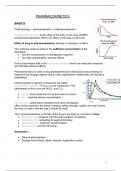
The medicine needs to achieve the sufficient concentration at the
right place.
• Too low concentration: no therapeutic response
• Too high concentration: adverse effects
If the concentration falls in the therapeutic window, there is an adequate response
and tolerable adverse effects.
Pharmacokinetics is used in drug development (pre-clinical and clinical testing) to
determine the dosage regimen and do dose adjustments. Additionally, the toxicity is
established.
Clinical studies on generic compounds are called
bioequivalence studies → Cplasma curve comparison. The
parameters on this curve are AUC0-t and Cmax.
• AUC0-t: Area-Under-the-Curve from time 0 to time t.
• Cmax: maximal plasma concentration
Generic drug: same active ingredient and same therapeutic
effect as the originator; the same in dosing, safety, strength, quality, the way it works,
the way it is taken, and the way it should be used.
Thus, pharmacokinetics is the fate of the drug in the body as a function of time.
• Absorption (A): entrance into the body (systemic circulation)
• Distribution (D): spreading throughout the body.
• Metabolism (M): chemical “transformation”.
• Excretion (E): exit from the body.
Absorption –
• Sites of administration
• Dosage forms (liquid, tablet, capsule, suppository, patch)
1
, • Administration routes
When a drug is administered through extravascular routes, such as oral (by mouth),
subcutaneous (under the skin), or intramuscular (into muscle), it undergoes
absorption to reach the systemic circulation. After oral administration, a significant
portion of the drug may be lost before it reaches the systemic circulation due to first-
pass metabolism (first-pass loss). First-pass loss occurs in three main areas: the gut
lumen, gut wall, and liver.
Some drugs are administered in an inactive form and undergo
conversion into their active form through metabolic processes.
These are called pro-drugs. Pro-drugs are designed to minimize
first-pass metabolism and improve absorption.
Additionally, during absorption, the drug has to pass barriers (e.g.
cell membrane)!
Distribution –
After arriving the systemic circulation, different drugs
are distributed differently in the body, e.g. lipophilic
drugs can accumulate in the fatty tissue.
Drugs not only distribute in the bloodstream, but
they can also distribute into tissue.
The enterohepatic circulation is a physiological
process that involves the recycling of drugs and other substances between the liver
and the small intestine. When drugs are in the liver, they may undergo metabolism,
where they can be modified into metabolites. The liver secretes bile, which contains
various substances, including drugs and their metabolites. Bile is then released into
the small intestine. Some drugs and their metabolites that are present in the bile
can be reabsorbed from the small intestine back into the bloodstream. The drugs
are transported back to the liver via the portal vein. Once in the liver, they may
undergo further metabolism or be excreted.
The enterohepatic circulation can extend the duration of drug action by recycling the
drug multiple times between the liver and the small intestine. This recycling can lead
to a prolonged presence of the drug in the body.
2
,Elimination –
Elimination = metabolism + excretion
The liver is a central organ in drug metabolism. It plays a crucial role in
biotransforming drugs into metabolites, often to facilitate their excretion. The kidneys
are vital for the excretion of drugs and their metabolites. After undergoing metabolism
in the liver, many drug metabolites are water-soluble and can be eliminated through
the urine.
Other organs:
• Gastrointestinal Tract (GI) - some drugs and their metabolites may undergo
excretion through the feces.
• Lungs - certain volatile substances can be eliminated through the respiratory
system.
• Blood
We study pharmacokinetics and ADME through various sampling sites. The main
sites are blood, urine and faeces.
Blood and related fluids –
Blood: ~ 5 - 6 L
• Plasma (including plasma proteins)
• Cells (red blood cells, white blood cells, platelets)
Plasma: ~ 3 L (around 55% of blood)
• Water (90%) + ions + lipids + plasma proteins; no cells.
Serum
• Plasma (including plasma proteins) but without clotting.
• Factors (fibrinogen/fibrin)
Serum is the liquid that remains after clotting. Fibrinogen and fibrin
are proteins that play crucial roles in the process of blood clotting, a vital mechanism
for wound healing and preventing excessive bleeding.
Without clotting, but with fibrinogen and fibrin?
Drug plasma concentration vs time curve after different administration routes –
3
, An intravenous (IV) bolus dose refers to the administration of a relatively large and
concentrated amount of a medication directly into the bloodstream over a short
period. This method allows for a rapid and immediate effect of the drug.
Extravascular administration refers to the administration of a drug outside of the
systemic circulation. Absorption has to occur, therefore, there is a decrease in the
drug plasma concentration.
The dose-effect relationship: quantification and modelling of the drug (and
metabolite) concentration in the body as a function of time.
• In order to design an appropriate dosage regimen
• For optimum therapeutic response and avoidance of adverse effects
Dose-effect relationship via:
• Physiological models - describe the interaction
between a drug and the physiological processes
of the body, e.g. organ function, blood flow, and
receptor dynamics.
• Compartment models - one-compartment model (left) &
two-compartment model (right).
• Mathematical models – involves equations.
Pharmacokinetics and pharmacodynamics must be
combined (PK/PD) to predict effect VS time:
4
BASICS
Pharmacology = pharmacokinetics + pharmacodynamics
Pharmacokinetics (PK) is the effect of the body on the drug (ADME),
and pharmacodynamics (PD) is the effect of the drug on the body.
Effect of drug in pharmacokinetics: binding → activation → effect.
The medicine needs to achieve the sufficient concentration at the
right place.
• Too low concentration: no therapeutic response
• Too high concentration: adverse effects
If the concentration falls in the therapeutic window, there is an adequate response
and tolerable adverse effects.
Pharmacokinetics is used in drug development (pre-clinical and clinical testing) to
determine the dosage regimen and do dose adjustments. Additionally, the toxicity is
established.
Clinical studies on generic compounds are called
bioequivalence studies → Cplasma curve comparison. The
parameters on this curve are AUC0-t and Cmax.
• AUC0-t: Area-Under-the-Curve from time 0 to time t.
• Cmax: maximal plasma concentration
Generic drug: same active ingredient and same therapeutic
effect as the originator; the same in dosing, safety, strength, quality, the way it works,
the way it is taken, and the way it should be used.
Thus, pharmacokinetics is the fate of the drug in the body as a function of time.
• Absorption (A): entrance into the body (systemic circulation)
• Distribution (D): spreading throughout the body.
• Metabolism (M): chemical “transformation”.
• Excretion (E): exit from the body.
Absorption –
• Sites of administration
• Dosage forms (liquid, tablet, capsule, suppository, patch)
1
, • Administration routes
When a drug is administered through extravascular routes, such as oral (by mouth),
subcutaneous (under the skin), or intramuscular (into muscle), it undergoes
absorption to reach the systemic circulation. After oral administration, a significant
portion of the drug may be lost before it reaches the systemic circulation due to first-
pass metabolism (first-pass loss). First-pass loss occurs in three main areas: the gut
lumen, gut wall, and liver.
Some drugs are administered in an inactive form and undergo
conversion into their active form through metabolic processes.
These are called pro-drugs. Pro-drugs are designed to minimize
first-pass metabolism and improve absorption.
Additionally, during absorption, the drug has to pass barriers (e.g.
cell membrane)!
Distribution –
After arriving the systemic circulation, different drugs
are distributed differently in the body, e.g. lipophilic
drugs can accumulate in the fatty tissue.
Drugs not only distribute in the bloodstream, but
they can also distribute into tissue.
The enterohepatic circulation is a physiological
process that involves the recycling of drugs and other substances between the liver
and the small intestine. When drugs are in the liver, they may undergo metabolism,
where they can be modified into metabolites. The liver secretes bile, which contains
various substances, including drugs and their metabolites. Bile is then released into
the small intestine. Some drugs and their metabolites that are present in the bile
can be reabsorbed from the small intestine back into the bloodstream. The drugs
are transported back to the liver via the portal vein. Once in the liver, they may
undergo further metabolism or be excreted.
The enterohepatic circulation can extend the duration of drug action by recycling the
drug multiple times between the liver and the small intestine. This recycling can lead
to a prolonged presence of the drug in the body.
2
,Elimination –
Elimination = metabolism + excretion
The liver is a central organ in drug metabolism. It plays a crucial role in
biotransforming drugs into metabolites, often to facilitate their excretion. The kidneys
are vital for the excretion of drugs and their metabolites. After undergoing metabolism
in the liver, many drug metabolites are water-soluble and can be eliminated through
the urine.
Other organs:
• Gastrointestinal Tract (GI) - some drugs and their metabolites may undergo
excretion through the feces.
• Lungs - certain volatile substances can be eliminated through the respiratory
system.
• Blood
We study pharmacokinetics and ADME through various sampling sites. The main
sites are blood, urine and faeces.
Blood and related fluids –
Blood: ~ 5 - 6 L
• Plasma (including plasma proteins)
• Cells (red blood cells, white blood cells, platelets)
Plasma: ~ 3 L (around 55% of blood)
• Water (90%) + ions + lipids + plasma proteins; no cells.
Serum
• Plasma (including plasma proteins) but without clotting.
• Factors (fibrinogen/fibrin)
Serum is the liquid that remains after clotting. Fibrinogen and fibrin
are proteins that play crucial roles in the process of blood clotting, a vital mechanism
for wound healing and preventing excessive bleeding.
Without clotting, but with fibrinogen and fibrin?
Drug plasma concentration vs time curve after different administration routes –
3
, An intravenous (IV) bolus dose refers to the administration of a relatively large and
concentrated amount of a medication directly into the bloodstream over a short
period. This method allows for a rapid and immediate effect of the drug.
Extravascular administration refers to the administration of a drug outside of the
systemic circulation. Absorption has to occur, therefore, there is a decrease in the
drug plasma concentration.
The dose-effect relationship: quantification and modelling of the drug (and
metabolite) concentration in the body as a function of time.
• In order to design an appropriate dosage regimen
• For optimum therapeutic response and avoidance of adverse effects
Dose-effect relationship via:
• Physiological models - describe the interaction
between a drug and the physiological processes
of the body, e.g. organ function, blood flow, and
receptor dynamics.
• Compartment models - one-compartment model (left) &
two-compartment model (right).
• Mathematical models – involves equations.
Pharmacokinetics and pharmacodynamics must be
combined (PK/PD) to predict effect VS time:
4


