
Cognitive neuro
Basis of neural signals
-neurons, with cell bodies in grey matter of cerebral cortex and subcortical structures;
white matter contains axons.
-Without input (at rest), cell membrane of a neuron has an
electrical potential difference between in- and outside
of -70 mV
-Post-synaptic potential is determined by integrating input of
many synapses at the dendrites.
Neural communiction
Input neurons (through neurotransmitters):
action potentials over time
àMembrane potential of post-synaptic
neuron depolarizes or hyperpolarizes
Over time, membrane potential of post-synaptic
neuron changes in function of input it receives
= signal
summary of level of input, relative degree excitatory/inhibitory input, when
action potential is triggered
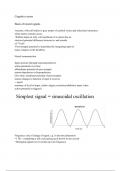
Frequency: rate of change of signal, e.g. in the time dimension
• 1 Hz = completing a full cycle (going up & down) in one second
• Biological signals never contain just one frequency
,(happens in artificial signals, e.g. pure tone)
Complex signals can be decomposed into frequency components
• Each has a particular frequency (e.g., 1 Hz, 2 Hz, 3 Hz, …)
• Amplitude: how much it goes up and down
• Phase: when it goes up and down
Frequency spectrum: measured range of frequencies
• Highest frequency
• Limited by sampling frequency
• ½ * sampling frequency (Nyquist sampling theorem)
• Lowest frequency
• Limited by how long the signal is measured
• 1 / number of seconds measured
Filtering: attenuating or excluding certain part of
measured frequency spectrum
(low-pass, high-pass or band-pass)
Electrophysiological changes are connected to other kind of changes...
At a smaller scale: movement of chemical substances and molecules
• E.g. depolarization: influx of Na+; repolarization: outward current of K+
• E.g. calcium concentration high in electrically active neurons à two-photon calcium imaging
At a larger scale: hemodynamics
• Blood supply is adjusted to current energy needs
Energy consumption
Electrophysiological events require energy
Amplitude of potential changes not necessarily best predictor of energy consumption
• Action potential = passive chain of events that does not consume much energy
Restoring resting potential requires energy à energy consumption of neuron could
correlate with number of action potentials
Pre- and post-synaptic factors (e.g., neurotransmitter release) also require energy
Exact energy distribution to different processes can vary
(species, neuron type)
Clustering
Noninvasive methods cannot achieve single neuron resolution
• Methods with highest spatial resolution still average signal from many neurons
Neurons of similar functional properties are clustered together
,• The more clustering, the more the averaged signal from many neurons
corresponds to the signal of the individual neurons
à Sensitivity of a noninvasive imaging technique depends upon amount
of clustering present
• Clustering on different spatial scales
Orientation columns (containing neurons with
similar preference for line orientation):
not in all species
3 dimensiosn
• Temporal resolution: the smallest unit of time that can be differentiated by a method
• Spatial resolution: the smallest unit of space which can be resolved
• Invasiveness: majority of methods are either fully invasive (skull needs to be
penetrated) or not invasive at all
• Changes in blood and tissue oxygenation, blood flow, and blood volume
• Temporal resolution of hemodynamic imaging is poorer compared to electrical
imaging due to slowness of hemodynamic events
• Spatial resolution varies strongly (but range smaller than for electrical signals):
• (invasive) optical imaging: columnar structure visible
• (non-invasive) fNIRS: several cm
• Spatial resolution, affected by
• Distance electrode and source of the signal
• Intermediate tissue (e.g. skull)
• Noninvasiveness: highest frequencies cannot be picked up
Different frequency bands contain very different information!
Pitcher et al. (2011): EEG study
• Signal of EEG-electrodes on back of the head,
averaged across many trials of viewing faces (red)
or chairs (blue)
• Amplitude of N170 & P1 is stronger for faces
versus chairs
• Due to low spatial resolution of EEG these
components do not differentiate between
Aniston, Pitt, ..., and anatomical localization
is poor
, Peripheral measures
-skin comduction
-pupil size
-heart activity/ heart rate variability
-muscle activity
Lecture 2-Electrophysiological neuroimagining
-excitatory neurotranbmitter is realeased atthe apical dendrites of a pyramidal cell leads to a flow
of positively charged ions intothe dendrites creating a negative net oytisede the dendrites
-to complete the circuit there is anet positivity near the cell body
For brain electrical activity
to be detectable through skull,
must be strong signal summed
over many neurons
- All behaving similarly at same time
- All oriented in same way
- So negative and positive don’t cancel
each other out when summed
Basis of neural signals
-neurons, with cell bodies in grey matter of cerebral cortex and subcortical structures;
white matter contains axons.
-Without input (at rest), cell membrane of a neuron has an
electrical potential difference between in- and outside
of -70 mV
-Post-synaptic potential is determined by integrating input of
many synapses at the dendrites.
Neural communiction
Input neurons (through neurotransmitters):
action potentials over time
àMembrane potential of post-synaptic
neuron depolarizes or hyperpolarizes
Over time, membrane potential of post-synaptic
neuron changes in function of input it receives
= signal
summary of level of input, relative degree excitatory/inhibitory input, when
action potential is triggered
Frequency: rate of change of signal, e.g. in the time dimension
• 1 Hz = completing a full cycle (going up & down) in one second
• Biological signals never contain just one frequency
,(happens in artificial signals, e.g. pure tone)
Complex signals can be decomposed into frequency components
• Each has a particular frequency (e.g., 1 Hz, 2 Hz, 3 Hz, …)
• Amplitude: how much it goes up and down
• Phase: when it goes up and down
Frequency spectrum: measured range of frequencies
• Highest frequency
• Limited by sampling frequency
• ½ * sampling frequency (Nyquist sampling theorem)
• Lowest frequency
• Limited by how long the signal is measured
• 1 / number of seconds measured
Filtering: attenuating or excluding certain part of
measured frequency spectrum
(low-pass, high-pass or band-pass)
Electrophysiological changes are connected to other kind of changes...
At a smaller scale: movement of chemical substances and molecules
• E.g. depolarization: influx of Na+; repolarization: outward current of K+
• E.g. calcium concentration high in electrically active neurons à two-photon calcium imaging
At a larger scale: hemodynamics
• Blood supply is adjusted to current energy needs
Energy consumption
Electrophysiological events require energy
Amplitude of potential changes not necessarily best predictor of energy consumption
• Action potential = passive chain of events that does not consume much energy
Restoring resting potential requires energy à energy consumption of neuron could
correlate with number of action potentials
Pre- and post-synaptic factors (e.g., neurotransmitter release) also require energy
Exact energy distribution to different processes can vary
(species, neuron type)
Clustering
Noninvasive methods cannot achieve single neuron resolution
• Methods with highest spatial resolution still average signal from many neurons
Neurons of similar functional properties are clustered together
,• The more clustering, the more the averaged signal from many neurons
corresponds to the signal of the individual neurons
à Sensitivity of a noninvasive imaging technique depends upon amount
of clustering present
• Clustering on different spatial scales
Orientation columns (containing neurons with
similar preference for line orientation):
not in all species
3 dimensiosn
• Temporal resolution: the smallest unit of time that can be differentiated by a method
• Spatial resolution: the smallest unit of space which can be resolved
• Invasiveness: majority of methods are either fully invasive (skull needs to be
penetrated) or not invasive at all
• Changes in blood and tissue oxygenation, blood flow, and blood volume
• Temporal resolution of hemodynamic imaging is poorer compared to electrical
imaging due to slowness of hemodynamic events
• Spatial resolution varies strongly (but range smaller than for electrical signals):
• (invasive) optical imaging: columnar structure visible
• (non-invasive) fNIRS: several cm
• Spatial resolution, affected by
• Distance electrode and source of the signal
• Intermediate tissue (e.g. skull)
• Noninvasiveness: highest frequencies cannot be picked up
Different frequency bands contain very different information!
Pitcher et al. (2011): EEG study
• Signal of EEG-electrodes on back of the head,
averaged across many trials of viewing faces (red)
or chairs (blue)
• Amplitude of N170 & P1 is stronger for faces
versus chairs
• Due to low spatial resolution of EEG these
components do not differentiate between
Aniston, Pitt, ..., and anatomical localization
is poor
, Peripheral measures
-skin comduction
-pupil size
-heart activity/ heart rate variability
-muscle activity
Lecture 2-Electrophysiological neuroimagining
-excitatory neurotranbmitter is realeased atthe apical dendrites of a pyramidal cell leads to a flow
of positively charged ions intothe dendrites creating a negative net oytisede the dendrites
-to complete the circuit there is anet positivity near the cell body
For brain electrical activity
to be detectable through skull,
must be strong signal summed
over many neurons
- All behaving similarly at same time
- All oriented in same way
- So negative and positive don’t cancel
each other out when summed


