Tropical Cyclones
Definitions: Tropical Cyclone Hazards:
Different types:
Tropical Cyclones: large, rotating High winds (119-250 km/hr)
Hurricanes Landslides
storms that form over the ocean in
tropical areas (Atlantic or eastern pacific near Intense rainfall
the USA and Caribbean) River flooding
Formation: the initial development Storm surges
of the tropical cyclone Typhoons
Source Area: a location where the (western pacific near Japan and
tropical cyclone is formed the Philippines) Categories:
Track: the route that the tropical Cyclones
cyclone takes
(Indian and south pacific near
Immaturity: when a tropical cyclone India, Bangladesh, Australia)
has developed but not reached full
strength Response:
Maturity: when a tropical cyclone is Search and rescue
fully developed and reached full Emergency supplies
strength and wind speed Repair and reconstruction
Decay: when a tropical cyclone
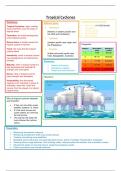
loses strength and dissipates Structure:
Vulnerability: the diminished
capacity of an individual or group to
anticipate, cope with, resist and
recover from the impact of a natural
hazard event
Why do tropical cyclones dissipate
and intensify?
If they run into other ocean
weather systems i.e. winds
If it hits land/ moves into
cooler waters as it will lose
its heat source
The warmer the water the
more intense the cyclone
will be
Preparation:
Measuring atmospheric pressure
Monitoring development (USA uses hunter planes)
Tracking (monitoring using satellites)
Modelling (mimic behaviour and generates likely tracks, points of landfall, intensification, dissipation
Planning (storm surge defences, strict building codes, response plans like shelters and evacuation routes)
Educate the public on securing homes, preparing emergency packs
Order evacuations and activate defences
Definitions: Tropical Cyclone Hazards:
Different types:
Tropical Cyclones: large, rotating High winds (119-250 km/hr)
Hurricanes Landslides
storms that form over the ocean in
tropical areas (Atlantic or eastern pacific near Intense rainfall
the USA and Caribbean) River flooding
Formation: the initial development Storm surges
of the tropical cyclone Typhoons
Source Area: a location where the (western pacific near Japan and
tropical cyclone is formed the Philippines) Categories:
Track: the route that the tropical Cyclones
cyclone takes
(Indian and south pacific near
Immaturity: when a tropical cyclone India, Bangladesh, Australia)
has developed but not reached full
strength Response:
Maturity: when a tropical cyclone is Search and rescue
fully developed and reached full Emergency supplies
strength and wind speed Repair and reconstruction
Decay: when a tropical cyclone
loses strength and dissipates Structure:
Vulnerability: the diminished
capacity of an individual or group to
anticipate, cope with, resist and
recover from the impact of a natural
hazard event
Why do tropical cyclones dissipate
and intensify?
If they run into other ocean
weather systems i.e. winds
If it hits land/ moves into
cooler waters as it will lose
its heat source
The warmer the water the
more intense the cyclone
will be
Preparation:
Measuring atmospheric pressure
Monitoring development (USA uses hunter planes)
Tracking (monitoring using satellites)
Modelling (mimic behaviour and generates likely tracks, points of landfall, intensification, dissipation
Planning (storm surge defences, strict building codes, response plans like shelters and evacuation routes)
Educate the public on securing homes, preparing emergency packs
Order evacuations and activate defences