EPMS Corporate Financial Management - Case CAPM
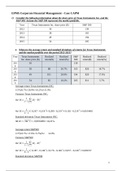
1) Consider the following information about the share price of Texas Instruments Inc. and the
S&P 500. Assume the S&P 500 represents the market portfolio.
Year Texas Instruments Inc. share price ($) S&P 500
2012 30 139
2013 38 165
2014 49 194
2015 54 205
a. What are the average return and standard deviations of returns for Texas Instruments
and the market portfolio over the period 2012-2015?
Year Texas Instruments Realized Realized S&P Realized Realized
Inc. share price ($) return($) return(%) 500 return($) return(%)
201 30 139
2
201 38 $8 26.7% 165 $26 18.7%
3
201 49 $11 28.9% 194 $29 17.6%
4
201 54 $5 10.2% 205 $11 5.7%
5
Average return Texas Instruments INC:
1/3*(26.7%+28.9%+10.2%)=21.9%
Variance Texas Instruments INC:
T
1
Var ( R )= ∑ ( R −Ŕ)2
t−1 t=1 t
1
Var ( R )= ∗( ( 0,267−0,219 )2+ ( 0,289−0,219 )2 + ( 0,102−0,219 )2 )=0,0104465
3−1
Standard deviation Texas Instruments INC:
SR ( R )=√ Var ( r )=√ 0,0104465=10,22 %
Average return S&P500
1/3*(18.7%+17.6%+5.7%)%= 14.0%
Variance S&P500
T
1
Var ( R )= ∑
t−1 t=1
( R t −Ŕ)2
1
Var ( R )= ∗( ( 0,187−0,140 )2+ ( 0,176−0,140 )2+ ( 0,057−0,140 )2) =0,005197
3−1
Standard deviation S&P500
1
, SD ( R )=√ Var ( r ) =√ 0,005197=7,21 %
b. Assume the current risk-free rate is 2% and Texas Instruments has a beta of 1.2 with the
market portfolio. Assume a market risk premium of 5%. What is the expected share price
for Texas Instruments in 2016?
E ( r i ) =r f + βi∗( E [ r ] −r f ) =2+1.2∗(5 %)=8 %
m
Expected share price of Texas Instruments in 2016
$54*1.08=$58.32
c. Suppose that in 2016, the demand for calculators drops as scientific research
unexpectedly shifts away from quantitative research methods. As a consequence, the
share price for Texas Instruments turned out to be $45.50. What is Texas Instruments’
alpha in 2016?
45,50
R s= −1=−15,74 %
54
α s=R s−E [ R s ] =−0.157−0.08=−0,2374
d. Can we calculate expected future returns using the estimated alpha from question (c)?
Why (not)?
In our opinion the basis of information is too rigid to know I this alpha would give a realistic
indication for the future returns. The drop in 2016 could have been an incident but it could
also be that in 2017 or later the demand recovers or drops either further.
2) Consider Texas Instruments Inc. from question (1). The company considers expanding its
product range by offering data storage services. Texas Instruments estimates that the facilities
will require an investment of $800 million today. It estimates that the new service will
generate a free cash flow of $100 million next year that will grow by 1% annually forever.
Assume the risk-free rate is 2% and the market risk premium is 5% as before. Assume further
that the firm is fully equity financed.
a. What is the internal rate of return of the data storage project? Would you accept the
project on this outcome?
CF 100
PV i= =800=
r−g r−0.01
100
r= +0.01=13,5 %
800
The internal rate of return is 13,5%, this is higher than the CAPM of 8% which we have
calculated in question 1. On this basis we should accept the project, but there is no
information about the risk of the project so this needs to be examined to.
b. Assume Texas Instruments estimates the risk of the new project to be in line with its
existing business, so that the beta is 1.2. What is the NPV of expanding into the data
storage business? Should Texas Instruments expand its business?
2
1) Consider the following information about the share price of Texas Instruments Inc. and the
S&P 500. Assume the S&P 500 represents the market portfolio.
Year Texas Instruments Inc. share price ($) S&P 500
2012 30 139
2013 38 165
2014 49 194
2015 54 205
a. What are the average return and standard deviations of returns for Texas Instruments
and the market portfolio over the period 2012-2015?
Year Texas Instruments Realized Realized S&P Realized Realized
Inc. share price ($) return($) return(%) 500 return($) return(%)
201 30 139
2
201 38 $8 26.7% 165 $26 18.7%
3
201 49 $11 28.9% 194 $29 17.6%
4
201 54 $5 10.2% 205 $11 5.7%
5
Average return Texas Instruments INC:
1/3*(26.7%+28.9%+10.2%)=21.9%
Variance Texas Instruments INC:
T
1
Var ( R )= ∑ ( R −Ŕ)2
t−1 t=1 t
1
Var ( R )= ∗( ( 0,267−0,219 )2+ ( 0,289−0,219 )2 + ( 0,102−0,219 )2 )=0,0104465
3−1
Standard deviation Texas Instruments INC:
SR ( R )=√ Var ( r )=√ 0,0104465=10,22 %
Average return S&P500
1/3*(18.7%+17.6%+5.7%)%= 14.0%
Variance S&P500
T
1
Var ( R )= ∑
t−1 t=1
( R t −Ŕ)2
1
Var ( R )= ∗( ( 0,187−0,140 )2+ ( 0,176−0,140 )2+ ( 0,057−0,140 )2) =0,005197
3−1
Standard deviation S&P500
1
, SD ( R )=√ Var ( r ) =√ 0,005197=7,21 %
b. Assume the current risk-free rate is 2% and Texas Instruments has a beta of 1.2 with the
market portfolio. Assume a market risk premium of 5%. What is the expected share price
for Texas Instruments in 2016?
E ( r i ) =r f + βi∗( E [ r ] −r f ) =2+1.2∗(5 %)=8 %
m
Expected share price of Texas Instruments in 2016
$54*1.08=$58.32
c. Suppose that in 2016, the demand for calculators drops as scientific research
unexpectedly shifts away from quantitative research methods. As a consequence, the
share price for Texas Instruments turned out to be $45.50. What is Texas Instruments’
alpha in 2016?
45,50
R s= −1=−15,74 %
54
α s=R s−E [ R s ] =−0.157−0.08=−0,2374
d. Can we calculate expected future returns using the estimated alpha from question (c)?
Why (not)?
In our opinion the basis of information is too rigid to know I this alpha would give a realistic
indication for the future returns. The drop in 2016 could have been an incident but it could
also be that in 2017 or later the demand recovers or drops either further.
2) Consider Texas Instruments Inc. from question (1). The company considers expanding its
product range by offering data storage services. Texas Instruments estimates that the facilities
will require an investment of $800 million today. It estimates that the new service will
generate a free cash flow of $100 million next year that will grow by 1% annually forever.
Assume the risk-free rate is 2% and the market risk premium is 5% as before. Assume further
that the firm is fully equity financed.
a. What is the internal rate of return of the data storage project? Would you accept the
project on this outcome?
CF 100
PV i= =800=
r−g r−0.01
100
r= +0.01=13,5 %
800
The internal rate of return is 13,5%, this is higher than the CAPM of 8% which we have
calculated in question 1. On this basis we should accept the project, but there is no
information about the risk of the project so this needs to be examined to.
b. Assume Texas Instruments estimates the risk of the new project to be in line with its
existing business, so that the beta is 1.2. What is the NPV of expanding into the data
storage business? Should Texas Instruments expand its business?
2