

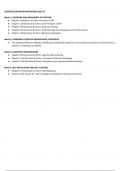
COGNITIVE BEHAVIOR INTERVIEWS 2023-24
Week 1: EXPOSURE AND BEHAVIORAL ACTIVATION
● Chapter 1 (Wright et al): Basic Principles of CBT
● Chapter 1 (O’Donohue & Fisher): Core Principles of CBT
● Chapter 4 (O’Donohue & Fisher): Exposure Therapy
● Chapter 2 (O’Donohue & Fisher): Understanding the contingencies of reinforcement
● Chapter 9 (O’Donohue & Fisher): Behavioral Activation
Week 2: COMBINED COGNITIVE-BEHAVIOURAL STRATEGIES
● The Cognitive Behavioral Model of Medically unexplained symptoms: A theoretical and empirical review (Deary, V.,
Chalder, T., & Sharpe, M. (2007))
Week 3: COGNITIVE INTERVENTIONS
● Chapter 6 (O’Donohue & Fisher): Cognitive Restructuring
● Chapter 13 (O’Donohue & Fisher): Principles of Positive Psychology
● Chapter 14 (O’Donohue & Fisher): Acceptance and cognitive-behavior therapy
Week 4: SELF-REGULATION AND SELF-CONTROL
● Chapter 8 (O’Donohue & Fisher): Self-Regulation
● Chapter 26 (G. Martin & J. Pear): Helping an individual to develop self-control
, hapter 1: Basic Principles of CBT (Wright et al)
C
CBT IS BASED ON TWO CENTRAL BELIEFS
● Ourcognitionshave a controlling influence on our emotions and behavior
○ Aaron T. Beck (1960):First person to develop theories/methods for using cognitive & behavioral interventions
■ Based on his ideas on the psychoanalytic concepts + several post-Freudian analysts (focused on distorted
self-images)
○ Beck’s negative cognitive triad:Cognitive conceptualization of depression
■ Symptoms related to a negative thinking style:self, world, and the future
■ Later, it applied to other disorders
● How weact or behavecan strongly affect our thought patterns and emotions
○ Behavioral components:Pavlov, Skinner, and other experimental behaviorists
○ Focus: Shaping measurable behavior with reinforcers and extinguishing fearful responses with exposure protocols
○ Meichenbaum & Lewinsohn: incorporated cognitive theories/ strategies into their treatment programs
○ Barlow & Clark: combined cognitive techniques (to modify fearful cognitions) + behavioral methods (breathing
training, exposure therapy) = efficient
COGNITIVE BEHAVIORAL MODEL
● Cognitive processing => central role in this model
● Interacting parts => Cognitions, Emotions, Behaviors
● Strongly recommended: gather full information regarding cognitive-behavioral, biological, social, and interpersonal
LEVELS OF COGNITIVE PROCESSING - BECK ET AL
● CONSCIOUSNESS
○ Highest level of cognition
○ State of awareness in which decisions can be made on a rational basis (e.g.: problem-solving)
○ Allows us:
■ Monitor and assess interactions with the environment
■ Link memories with present experiences
■ Control and plan future actions
● AUTOMATIC THOUGHTS (PRECONSCIOUS)
○ Cognitions that stream rapidly => might be occurring in the presence of strong emotions
○ Depression or anxiety disorders => increase distorted automatic thinking
○ Beckstated that people with emotional disorders =>Cognitive errors
■ E.g.: All or nothing thinking / Personalization
● SCHEMAS
○ Core beliefs that act as basic templates or underlying rules for information processing
○ Function in allowing humans toscreen, filter, and assign meaning to informationfrom the environment
○ Shaped in early childhood: parental teaching and modeling, trauma or education
○ Need schemas to manage large amounts of information and make decisions
○ Main groups:
■ Simple schemas: rules about the physical nature of the environment, management of activities (little to no
effect on psychopathology)
■ Intermediary beliefs and assumptions: if-then statements that influence self-esteem and emotional
regulation
■ Core beliefs about the self: global and absolute rules for interpreting environmental information related to
self-esteem
○ Stress-diathesis hypothesis:
■ In psychiatric conditions maladaptive schemas may remain dominant until a stressful life event occurs that
activates the core beliefs => themaladaptive schemais then strengthened to the point that it stimulates and
drives the most superficial stream ofnegative automatic thoughts
,CBT vs PSYCHODYNAMIC ORIENTED THERAPY
● Does not believe that specific structures/defenses block thoughts from awareness
● Emphasizes techniques designed to help patientsdetect and modify their inner thoughts
● Teaches patients tothink about their thinking
THERAPY METHODS
● Therapist develops anindividualized conceptualizationthat ties CB theories with the patient’s unique psychological makeup
and their presenting problem
● Problem-oriented focus
● Collaborative empirical therapeutic relationship
● Socratic questioning
● Use of structuring, psychoeducation, and rehearsal to enhance learning
● Eliciting and modifying automatic thoughts etc
THERAPY
● Short-term format (5-20 sessions, 45 minutes)
● Case conceptualization: bring together information from the diagnostic assessment, observations on the unique background of
the patient, and CBT in the detailed treatment plan
● Therapeutic relationship: understanding, kindness and empathy, collaborative, action-oriented intervention
● Socratic questioning:stimulate curiosity and inquisitiveness
● Cognitive restructuring:help patients recognize and change maladaptive automatic thoughts and schemas
● Behavioral methods
○ Break patterns of avoidance or helplessness
○ Gradually face feared situations
○ Build coping skills
○ Reduce painful emotions or autonomic arousal
Chapter 1: Core Principles of CBT (O’Donohue & Fisher)
COGNITIVE BEHAVIORAL THERAPY:Viewed as the only paradigm in psychotherapy
ADVANTAGES DISADVANTAGES
● any disorders can be treated
M F idelity problem: having the therapy be executed with other
● Often quicker therapists, in other settings with other clients
● Cheaper
● Scaled, constructs are easier to define, measure and Solution: Core principles
teach other therapists ● Functional analysis and contingency management
● Skills training
● Exposure
● Relaxation
● Cognitive restructuring
● Problem-solving
● Self-regulation
● Behavioral activation
● Social skills
● Emotional regulation
● Communication
● Positive psychology
● Acceptance
, Lecture 1: Exposure and Behavioral Activation
hapter 4 (Fisher): Exposure Therapy
C
Chapter 9 (Fisher): Behavioral Activation
WAVES OF BEHAVIOR THERAPY
● FIRST WAVE: BEHAVIORISM
○ School of Behaviorism (1930-40s):Reaction to psychoanalysis(dominant paradigm in psychology for a long time)
■ Key concept =>unconscious
● The concept that is not observable and not knowable
● People become frustrated =>Focus on the observable, measurable behaviors
● Can only help people by focusing on observable behavior
○ People learn through interaction with the environment
○ Focus on observable behaviors, ignore internal states(response to psycho-analysis)
○ Based onconditioning paradigms(classical and operant)
■ Pavlo: Classical conditioning
■ Skinner: Operant conditioning
■ Therapies that stem from them: only focus on modifying behavior by directly targeting the environment
(rewards or punishments)
○ Led todissatisfaction
■ Important toinclude cognitive processes=> how people process information
● SECOND WAVE: COGNITIVE BEHAVIORAL THERAPY
○ Cognitive revolution: more researchers theorized that they needed tobring back mental and cognitive processesto
understand how people learn and behave
○ “Mental unobservable processes play a role in learning” =>Integrate the role of cognitive processes
○ Also acknowledging the role of behavioral processes
○ Influential figures
■ AaronT. Beck
■ AlbertEllis
○ It wasnot a rejection from the first wave
■ Still acknowledged that these behavioral processes (classical and operant) are very fundamental to
understanding people
■ They build upon the first wave => Combination of those
COGNITIVE BEHAVIORAL THERAPY
● Family ofpsychological interventionsthat are based oncognitive and/or behavioral principles
● Goal:identify and increase adaptive schemaswhilemodifying and reducingthe influence ofmaladaptive schemas
● Psychological problems are based on:
○ Faulty or unhelpful ways of thinking
○ Learned patterns of unhelpful behaviors
● Aims toreduce emotional problemsbyfocusing on thinking and behavior
○ By engaging in new behavior => one might also start thinking differently
EXPOSURE THERAPY
● Purposefully generates anxiety byexposing(instead of avoiding) an individualrepeatedly to fear(CR)provoking stimuli(CS)
○ In the absence of presented aversive outcomes (UCS) (safe environment)
○ Leads toextinction to fear (CR), and peopleno longer feel the need for avoidance
○ Reduce pathological fear and related emotions
● Types: In vivo (real life); In vitro (imaginal); Interoceptive exposure
○ Gradual exposure =>Systematic desensitization(briefarousing)
○ Flooding techniques: more highly feared stimuli
Week 1: EXPOSURE AND BEHAVIORAL ACTIVATION
● Chapter 1 (Wright et al): Basic Principles of CBT
● Chapter 1 (O’Donohue & Fisher): Core Principles of CBT
● Chapter 4 (O’Donohue & Fisher): Exposure Therapy
● Chapter 2 (O’Donohue & Fisher): Understanding the contingencies of reinforcement
● Chapter 9 (O’Donohue & Fisher): Behavioral Activation
Week 2: COMBINED COGNITIVE-BEHAVIOURAL STRATEGIES
● The Cognitive Behavioral Model of Medically unexplained symptoms: A theoretical and empirical review (Deary, V.,
Chalder, T., & Sharpe, M. (2007))
Week 3: COGNITIVE INTERVENTIONS
● Chapter 6 (O’Donohue & Fisher): Cognitive Restructuring
● Chapter 13 (O’Donohue & Fisher): Principles of Positive Psychology
● Chapter 14 (O’Donohue & Fisher): Acceptance and cognitive-behavior therapy
Week 4: SELF-REGULATION AND SELF-CONTROL
● Chapter 8 (O’Donohue & Fisher): Self-Regulation
● Chapter 26 (G. Martin & J. Pear): Helping an individual to develop self-control
, hapter 1: Basic Principles of CBT (Wright et al)
C
CBT IS BASED ON TWO CENTRAL BELIEFS
● Ourcognitionshave a controlling influence on our emotions and behavior
○ Aaron T. Beck (1960):First person to develop theories/methods for using cognitive & behavioral interventions
■ Based on his ideas on the psychoanalytic concepts + several post-Freudian analysts (focused on distorted
self-images)
○ Beck’s negative cognitive triad:Cognitive conceptualization of depression
■ Symptoms related to a negative thinking style:self, world, and the future
■ Later, it applied to other disorders
● How weact or behavecan strongly affect our thought patterns and emotions
○ Behavioral components:Pavlov, Skinner, and other experimental behaviorists
○ Focus: Shaping measurable behavior with reinforcers and extinguishing fearful responses with exposure protocols
○ Meichenbaum & Lewinsohn: incorporated cognitive theories/ strategies into their treatment programs
○ Barlow & Clark: combined cognitive techniques (to modify fearful cognitions) + behavioral methods (breathing
training, exposure therapy) = efficient
COGNITIVE BEHAVIORAL MODEL
● Cognitive processing => central role in this model
● Interacting parts => Cognitions, Emotions, Behaviors
● Strongly recommended: gather full information regarding cognitive-behavioral, biological, social, and interpersonal
LEVELS OF COGNITIVE PROCESSING - BECK ET AL
● CONSCIOUSNESS
○ Highest level of cognition
○ State of awareness in which decisions can be made on a rational basis (e.g.: problem-solving)
○ Allows us:
■ Monitor and assess interactions with the environment
■ Link memories with present experiences
■ Control and plan future actions
● AUTOMATIC THOUGHTS (PRECONSCIOUS)
○ Cognitions that stream rapidly => might be occurring in the presence of strong emotions
○ Depression or anxiety disorders => increase distorted automatic thinking
○ Beckstated that people with emotional disorders =>Cognitive errors
■ E.g.: All or nothing thinking / Personalization
● SCHEMAS
○ Core beliefs that act as basic templates or underlying rules for information processing
○ Function in allowing humans toscreen, filter, and assign meaning to informationfrom the environment
○ Shaped in early childhood: parental teaching and modeling, trauma or education
○ Need schemas to manage large amounts of information and make decisions
○ Main groups:
■ Simple schemas: rules about the physical nature of the environment, management of activities (little to no
effect on psychopathology)
■ Intermediary beliefs and assumptions: if-then statements that influence self-esteem and emotional
regulation
■ Core beliefs about the self: global and absolute rules for interpreting environmental information related to
self-esteem
○ Stress-diathesis hypothesis:
■ In psychiatric conditions maladaptive schemas may remain dominant until a stressful life event occurs that
activates the core beliefs => themaladaptive schemais then strengthened to the point that it stimulates and
drives the most superficial stream ofnegative automatic thoughts
,CBT vs PSYCHODYNAMIC ORIENTED THERAPY
● Does not believe that specific structures/defenses block thoughts from awareness
● Emphasizes techniques designed to help patientsdetect and modify their inner thoughts
● Teaches patients tothink about their thinking
THERAPY METHODS
● Therapist develops anindividualized conceptualizationthat ties CB theories with the patient’s unique psychological makeup
and their presenting problem
● Problem-oriented focus
● Collaborative empirical therapeutic relationship
● Socratic questioning
● Use of structuring, psychoeducation, and rehearsal to enhance learning
● Eliciting and modifying automatic thoughts etc
THERAPY
● Short-term format (5-20 sessions, 45 minutes)
● Case conceptualization: bring together information from the diagnostic assessment, observations on the unique background of
the patient, and CBT in the detailed treatment plan
● Therapeutic relationship: understanding, kindness and empathy, collaborative, action-oriented intervention
● Socratic questioning:stimulate curiosity and inquisitiveness
● Cognitive restructuring:help patients recognize and change maladaptive automatic thoughts and schemas
● Behavioral methods
○ Break patterns of avoidance or helplessness
○ Gradually face feared situations
○ Build coping skills
○ Reduce painful emotions or autonomic arousal
Chapter 1: Core Principles of CBT (O’Donohue & Fisher)
COGNITIVE BEHAVIORAL THERAPY:Viewed as the only paradigm in psychotherapy
ADVANTAGES DISADVANTAGES
● any disorders can be treated
M F idelity problem: having the therapy be executed with other
● Often quicker therapists, in other settings with other clients
● Cheaper
● Scaled, constructs are easier to define, measure and Solution: Core principles
teach other therapists ● Functional analysis and contingency management
● Skills training
● Exposure
● Relaxation
● Cognitive restructuring
● Problem-solving
● Self-regulation
● Behavioral activation
● Social skills
● Emotional regulation
● Communication
● Positive psychology
● Acceptance
, Lecture 1: Exposure and Behavioral Activation
hapter 4 (Fisher): Exposure Therapy
C
Chapter 9 (Fisher): Behavioral Activation
WAVES OF BEHAVIOR THERAPY
● FIRST WAVE: BEHAVIORISM
○ School of Behaviorism (1930-40s):Reaction to psychoanalysis(dominant paradigm in psychology for a long time)
■ Key concept =>unconscious
● The concept that is not observable and not knowable
● People become frustrated =>Focus on the observable, measurable behaviors
● Can only help people by focusing on observable behavior
○ People learn through interaction with the environment
○ Focus on observable behaviors, ignore internal states(response to psycho-analysis)
○ Based onconditioning paradigms(classical and operant)
■ Pavlo: Classical conditioning
■ Skinner: Operant conditioning
■ Therapies that stem from them: only focus on modifying behavior by directly targeting the environment
(rewards or punishments)
○ Led todissatisfaction
■ Important toinclude cognitive processes=> how people process information
● SECOND WAVE: COGNITIVE BEHAVIORAL THERAPY
○ Cognitive revolution: more researchers theorized that they needed tobring back mental and cognitive processesto
understand how people learn and behave
○ “Mental unobservable processes play a role in learning” =>Integrate the role of cognitive processes
○ Also acknowledging the role of behavioral processes
○ Influential figures
■ AaronT. Beck
■ AlbertEllis
○ It wasnot a rejection from the first wave
■ Still acknowledged that these behavioral processes (classical and operant) are very fundamental to
understanding people
■ They build upon the first wave => Combination of those
COGNITIVE BEHAVIORAL THERAPY
● Family ofpsychological interventionsthat are based oncognitive and/or behavioral principles
● Goal:identify and increase adaptive schemaswhilemodifying and reducingthe influence ofmaladaptive schemas
● Psychological problems are based on:
○ Faulty or unhelpful ways of thinking
○ Learned patterns of unhelpful behaviors
● Aims toreduce emotional problemsbyfocusing on thinking and behavior
○ By engaging in new behavior => one might also start thinking differently
EXPOSURE THERAPY
● Purposefully generates anxiety byexposing(instead of avoiding) an individualrepeatedly to fear(CR)provoking stimuli(CS)
○ In the absence of presented aversive outcomes (UCS) (safe environment)
○ Leads toextinction to fear (CR), and peopleno longer feel the need for avoidance
○ Reduce pathological fear and related emotions
● Types: In vivo (real life); In vitro (imaginal); Interoceptive exposure
○ Gradual exposure =>Systematic desensitization(briefarousing)
○ Flooding techniques: more highly feared stimuli





