BRM II - Literature
Patton (2002) - Design Sampling
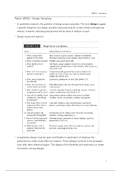
- In qualitative research, the problem of design poses a paradox. The term design suggest
a specific blueprint, but design actually means planning for certain broad contingencies
without, however, indicating exactly what will be done in relation to each.
- Design issues and options:
- A qualitative design must be open and flexible to exploration of whatever the
phenomenon under study offers for research. These designs continue to be emergent
even after data collective begins. The degree of this flexibility and openness is a matter
of variation among designs.
!1
, BRM II - Literature
- Different methods produce different findings. Here, the challenge is which design and
methods are best appropriate, productive, and useful in a given situation.
- Evaluators using qualitative methods think that because the sample sizes they can study
will be too small to permit generalisations, it doesn't matter how cases are picked, so
they might as well pick ones that are easy to access and inexpensive to study.
- While, convenience and cost are real considerations, they should be the last factors to be
taken into account after strategically deliberating on how to get the most information of
greatest utility from the limited number of cases to be sampled. Purposeful, strategic
sampling can yield crucial information about critical cases. Convenience sampling is
neither purposeful nor strategic.
- There are 15 purposeful sampling strategies (plus a 16th approach, which is a
combination/mixed purposeful sampling):
!2
Patton (2002) - Design Sampling
- In qualitative research, the problem of design poses a paradox. The term design suggest
a specific blueprint, but design actually means planning for certain broad contingencies
without, however, indicating exactly what will be done in relation to each.
- Design issues and options:
- A qualitative design must be open and flexible to exploration of whatever the
phenomenon under study offers for research. These designs continue to be emergent
even after data collective begins. The degree of this flexibility and openness is a matter
of variation among designs.
!1
, BRM II - Literature
- Different methods produce different findings. Here, the challenge is which design and
methods are best appropriate, productive, and useful in a given situation.
- Evaluators using qualitative methods think that because the sample sizes they can study
will be too small to permit generalisations, it doesn't matter how cases are picked, so
they might as well pick ones that are easy to access and inexpensive to study.
- While, convenience and cost are real considerations, they should be the last factors to be
taken into account after strategically deliberating on how to get the most information of
greatest utility from the limited number of cases to be sampled. Purposeful, strategic
sampling can yield crucial information about critical cases. Convenience sampling is
neither purposeful nor strategic.
- There are 15 purposeful sampling strategies (plus a 16th approach, which is a
combination/mixed purposeful sampling):
!2