AICP Exam Prep – Law Questions With Complete Solutions
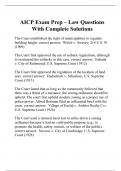
The Court established the right of municipalities to regulate building height. correct answer: Welch v. Swasey; 214 U.S. 91 (1909) The Court first approved the use of setback regulations, although it overturned the setbacks in this case. correct answer: Eubank v. City of Richmond; U.S. Supreme Court (1912) The Court first approved the regulation of the location of land uses. correct answer: Hadacheck v. Sebastian; U.S. Supreme Court (1915) The Court found that as long as the community believed that there was a threat of a nuisance, the zoning ordinance should be upheld. The court first upheld modern zoning as a proper use of police power. Alfred Bettman filed an influential brief with the court. correct answer: Village of Euclid v. Ambler Realty Co.; U.S. Supreme Court (1926) The Court used a rational basis test to strike down a zoning ordinance because it had no valid public purpose (e.g., to promote the health, safety, morals, or welfare of the public). correct answer: Nectow v. City of Cambridge; U.S. Supreme Court (1928) The court upheld a growth management system that awarded points to development proposals based on the availability of public utilities, drainage facilities, parks, road access, and firehouses. A proposal would only be approved upon reaching a certain point level. Developers could increase their point total by providing the involved facilities themselves. correct answer: Golden v. Planning Board of the Town of Ramapo; New York State Court of Appeals (1972) the Court upheld quotas on the annual number of building permits issued. correct answer: Construction Industry of Sonoma County v. City of Petaluma; U.S. Court of Appeals for the 4th Circuit (1975) The Court upheld temporary moratoriums on building permits. correct answer: Associated Home Builders of Greater East Bay v. City of Livermore; California Supreme Court (1976) The Court held that the EPA must provide a reasonable justification for why they would not regulate greenhouse gases. correct answer: Massachusetts v. EPA, Inc.; U.S. Supreme Court (2006) The Court found that the Army Corp of Engineers must determine whether there is a significant nexus between a wetland and a navigable waterway. correct answer: Rapanos v. United States; U.S. Supreme Court (2006) The Court found that hydroelectric dams are subject to Section 401 of the Clean Water Act. correct answer: SD Warren v. Maine Board of Environmental Protection; U.S. Supreme Court (2006) In this case the Supreme Court was asked to evaluate whether disparate impact is the appropriate standard in whi
Written for
- Institution
- AICP
- Course
- AICP
Document information
- Uploaded on
- September 14, 2023
- Number of pages
- 16
- Written in
- 2023/2024
- Type
- Exam (elaborations)
- Contains
- Questions & answers
Subjects
-
aicp exam prep law questions with complete solut

Also available in package deal