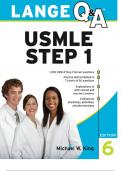
USMLE STEP 1 L AN G E Q &A™ SIXTH EDITIONMichael W. King, PhD Professor Department of Biochemistry and Molecular Biology Center for Regenerative Biology and Medicine Indiana University School of Medicine Terre Haute, Indiana USMLE STEP 1 L AN G E Q &A™ SI
USMLE STEP 1 L AN G E Q &A™ SIXTH EDITIONMichael W. King, PhD Professor Department of Biochemistry and Molecular Biology Center for Regenerative Biology and Medicine Indiana University School of Medicine Terre Haute, Indiana USMLE STEP 1 L AN G E Q &A™ SIXTH EDITION New York Chicago San Francisco Lisbon London Madrid Mexico City Milan New Delhi San Juan Seoul Singapore Sydney Toronto Copyright © 2008 by The McGraw-Hill Companies, Inc. All rights reserved. Manufactured in the United States of America. Except as permitted under the United States Copyright Act of 1976, no part of this publication may be reproduced or distributed in any form or by any means, or stored in a database or retrieval system, without the prior written permission of the publisher. 0-07--1 The material in this eBook also appears in the print version of this title: 0-07--4. All trademarks are trademarks of their respective owners. Rather than put a trademark symbol after every occurrence of a trademarked name, we use names in an editorial fashion only, and to the benefit of the trademark owner, with no intention of infringement of the trademark. Where such designations appear in this book, they have been printed with initial caps. McGraw-Hill eBooks are available at special quantity discounts to use as premiums and sales promotions, or for use in corporate training programs. For more information, please contact George Hoare, Special Sales, at or (212) 904-4069. TERMS OF USE This is a copyrighted work and The McGraw-Hill Companies, Inc. (“McGraw-Hill”) and its licensors reserve all rights in and to the work. Use of this work is subject to these terms. Except as permitted under the Copyright Act of 1976 and the right to store and retrieve one copy of the work, you may not decompile, disassemble, reverse engineer, reproduce, modify, create derivative works based upon, transmit, distribute, disseminate, sell, publish or sublicense the work or any part of it without McGraw-Hill’s prior consent. You may use the work for your own noncommercial and personal use; any other use of the work is strictly prohibited. Your right to use the work may be terminated if you fail to comply with these terms. THE WORK IS PROVIDED “AS IS.” McGRAW-HILL AND ITS LICENSORS MAKE NO GUARANTEES OR WARRANTIES AS TO THE ACCURACY, ADEQUACY OR COMPLETENESS OF OR RESULTS TO BE OBTAINED FROM USING THE WORK, INCLUDING ANY INFORMATION THAT CAN BE ACCESSED THROUGH THE WORK VIA HYPERLINK OR OTHERWISE, AND EXPRESSLY DISCLAIM ANY WARRANTY, EXPRESS OR IMPLIED, INCLUDING BUT NOT LIMITED TO IMPLIED WARRANTIES OF MERCHANTABILITY OR FITNESS FOR A PARTICULAR PURPOSE. McGraw-Hill and its licensors do not warrant or guarantee that the functions contained in the work will meet your requirements or that its operation will be uninterrupted or error free. Neither McGraw-Hill nor its licensors shall be liable to you or anyone else for any inaccuracy, error or omission, regardless of cause, in the work or for any damages resulting therefrom. McGraw-Hill has no responsibility for the content of any information accessed through the work. Under no circumstances shall McGraw-Hill and/or its licensors be liable for any indirect, incidental, special, punitive, consequential or similar damages that result from the use of or inability to use the work, even if any of them has been advised of the possibility of such damages. This limitation of liability shall apply to any claim or cause whatsoever whether such claim or cause arises in contract, tort or otherwise. DOI: 10.1036/4 We hope you enjoy this McGraw-Hill eBook! If you’d like more information about this book, its author, or related books and websites, please click here. Professional Want to learn more? iii Contents Contributors ........................................................................................................................................................... v Preface .................................................................................................................................................................. vii Review Preparation Guide ................................................................................................................................ ix Standard Abbreviations ................................................................................................................................... xiii USMLE Step 1 Common Laboratory Values ................................................................................................. xv 1. Anatomy ........................................................................................................................................................... 1 TAIHUNG DUONG, PHD Questions .......................................................................................................................................................... 1 Answers and Explanations .......................................................................................................................... 30 Bibliography ................................................................................................................................................... 55 2. Physiology ..................................................................................................................................................... 57 GABI NINDL WAITE, PHD, BRIAN G. KENNEDY, PHD, AND STEPHEN ECHTENKAMP, PHD Questions ......................................................................................................................................................... 57 Answers and Explanations ........................................................................................................................... 82 Bibliography .................................................................................................................................................. 108 3. Biochemistry ............................................................................................................................................... 109 MICHAEL W. KING, PHD Questions ....................................................................................................................................................... 109 Answers and Explanations ......................................................................................................................... 132 Bibliography .................................................................................................................................................. 174 4. Microbiology ............................................................................................................................................... 175 JAMES D. KETTERING, PHD Questions ....................................................................................................................................................... 175 Answers and Explanations ......................................................................................................................... 198 Bibliography .................................................................................................................................................. 228 5. Pathology ..................................................................................................................................................... 229 KAREN D. TSOULAS, MD, EDD Questions ....................................................................................................................................................... 229 Answers and Explanations ......................................................................................................................... 256 Bibliography .................................................................................................................................................. 288 For more information about this title, click here 6. Pharmacology............................................................................................................................................... 289 BERTRAM G. KATZUNG, MD, PHD Questions ....................................................................................................................................................... 289 Answers and Explanations ......................................................................................................................... 307 Bibliography .................................................................................................................................................. 333 7. Behavioral Sciences .................................................................................................................................... 335 HOYLE LEIGH, MD Questions ....................................................................................................................................................... 335 Answers and Explanations ......................................................................................................................... 342 Bibliography .................................................................................................................................................. 348 8. Practice Test 1............................................................................................................................................... 349 Questions ....................................................................................................................................................... 349 Answers and Explanations ......................................................................................................................... 359 Bibliography .................................................................................................................................................. 371 9. Practice Test 2............................................................................................................................................... 373 Questions ....................................................................................................................................................... 373 Answers and Explanations ......................................................................................................................... 382 10. Practice Test 3............................................................................................................................................... 395 Questions ....................................................................................................................................................... 395 Answers and Explanations ......................................................................................................................... 404 11. Practice Test 4 ............................................................................................................................................... 417 Questions ....................................................................................................................................................... 417 Answers and Explanations ......................................................................................................................... 426 12. Practice Test 5............................................................................................................................................... 439 Questions ....................................................................................................................................................... 439 Answers and Explanations ......................................................................................................................... 449 13. Practice Test 6............................................................................................................................................... 461 Questions ....................................................................................................................................................... 461 Answers and Explanations ......................................................................................................................... 470 14. Practice Test 7............................................................................................................................................... 481 Questions ....................................................................................................................................................... 481 Answers and Explanations ......................................................................................................................... 491 Index ..................................................................................................................................................................... 503 Color insert appears after the Index. iv Contents Taihung Duong, PhD Associate Professor Department of Anatomy and Cell Biology Indiana University School of Medicine-Terre Haute Terre Haute, Indiana Stephen Echtenkamp, PhD Associate Professor Department of Cellular and Integrative Physiology Indiana University School of Medicine-Northwest Gary, Indiana Bertram G. Katzung, MD, PhD Professor Emeritus Department of Cellular and Molecular Pharmacology University of California, San Francisco San Francisco, California Brian G. Kennedy, PhD Associate Professor Department of Cellular and Integrative Physiology Indiana University School of Medicine-Northwest Gary, Indiana James D. Kettering, PhD Professor Emeritus Department of Biochemistry and Microbiology Loma Linda University School of Medicine Loma Linda, California Hoyle Leigh, MD Professor Department of Psychiatry University of California, San Francisco Fresno, California Karen D. Tsoulas, MD, EdD Assistant Professor Department of Pathology and Laboratory Medicine Keck School of Medicine University of Southern California Los Angeles, California Gabi Nindl Waite, PhD Associate Professor Department of Cellular and Integrative Physiology Indiana University School of Medicine-Terre Haute Terre Haute, Indiana Contributors v Copyright © 2008 by The McGraw-Hill Companies, Inc. Click here for terms of use. This page intentionally left blank Success on the United States Medical Licensing Examination (USMLE) Step 1 requires a thorough understanding of the basic sciences covered in the first and second years of medical education. To offer the most complete and accurate review book, we assembled a team of authors and editors from around the country who are engaged in various specialties and involved in both academic and clinical settings. The author team was asked to research and write test questions using the parameters set forth by the National Board of Medical Examiners (NBME). All the subjects, types of questions, and techniques that will be encountered on the USMLE Step 1 are presented in this book. Lange Q&A: USMLE Step 1 is designed to provide you with a comprehensive review of the basic sciences as well as a valuable self-assessment tool for exam preparation. A total of 1200 questions are included in this edition. Key Features and Use • Approximately 150 questions are covered in each of the basic sciences: Anatomy, Physiology, Biochemistry, Microbiology, Pathology, Pharmacology, and Behavioral Sciences. • Questions are followed by a section with answers and detailed explanations referenced to the most current and popular resources available. • Seven practice tests simulating the USMLE Step 1 are included at the end of this text. • We believe that you will find the questions, explanations, and format of Lange Q&A: USMLE Step 1 to be of great assistance to you during your review. We wish you luck on the USMLE Step 1. The Editor and the Publisher Preface vii Copyright © 2008 by The McGraw-Hill Companies, Inc. Click here for terms of use. This page intentionally left blank If you are planning to prepare for the USMLE Step 1, then this book is designed for you. Here, in one package, is a comprehensive review resource with 1200 examination-type basic science, multiplechoice questions with referenced, paragraph-length explanations of each answer. In addition, the last section of the book offers seven comprehensive practice tests for self-assessment purposes. This introduction provides specific information on the USMLE Step 1, information on question types, question-answering strategies, and various ways to use this review. The USMLE Step 1 The USMLE Step 1 has approximately 350 multiplechoice test items, divided into seven blocks of 50 questions, which are administered via computer. Students are allotted 1 hour to complete each question block. The exam is designed to test knowledge of Anatomy, Physiology, Biochemistry, Microbiology, Pathology, Pharmacology, and Behavioral Sciences. The questions have been proffered by senior academic faculty to test comprehension of basic science concepts that they feel are relevant to the future successful practice of medicine. To correctly answer these test questions, examinees may be required to recall memorized facts, to use deductive reasoning, or both. A minority of the questions will employ graphs, photographs, or line drawings that require interpretation. The application materials you receive for the USMLE Step 1 will more fully discuss the exam procedure, rules of test administration, types of questions asked, and the scope of material you may be tested on. Organization of this Book This book is organized to cover sequentially each of the basic science areas specified by the National Board of Medical Examiners. There are seven sections, one for each of the basic sciences, plus three integrated practice tests at the end of the review. The sections are as follows: 1. Anatomy (including gross and microscopic anatomy, neuroanatomy, and development and control mechanisms). 2. Physiology (including general and cellular functions, major body system physiology, energy balance, and fluid and electrolyte balance). 3. Biochemistry (including energy metabolism, major metabolic pathways of small molecules, major tissue and cellular structures, properties, and functions, biochemical aspects of cellular and molecular biology, and special biochemistry of tissues). 4. Microbiology (including microbial structure and composition, cellular metabolism, physiology, and regulation, microbial and molecular genetics, immunology, bacterial pathogens, virology, and medical mycology and parasitology). 5. Pathology (including general and systemic pathology and pathology of syndromes and complex reactions). 6. Pharmacology (including general principles, major body system agents, vitamins, chemotherapeutic agents, and poisoning and therapy of intoxication). 7. Behavioral Sciences (including behavioral biology, individual, interpersonal, and social behavior, and culture and society). Review Preparation Guide ix Copyright © 2008 by The McGraw-Hill Companies, Inc. Click here for terms of use. 8. Practice Tests (each includes 50 questions from all seven basic sciences, presented in an integrated format). Each of the chapters is organized in the following order: Questions, Answers and Explanations, and Bibliography. These sections and how you might use them are discussed below. Question Formats The style and presentation of the questions have been fully revised to conform to the USMLE Step 1. This will enable you to familiarize yourself with the types of questions to be expected, and provide practice in recalling your knowledge in each format. Following the answers in each chapter is a list of suggested references for additional consultation. Each of the seven basic science chapters contains multiple choice questions composed in the Single Best Answer query format (example question 1). This is the most frequently encountered format in the USMLE Step 1. It generally contains a brief statement, followed by five options of which only one is entirely correct. The answer options on the USMLE are lettered A, B, C, D, and E. Although the format for this question type is straightforward, the questions can be difficult because some of the distractors in the answer list are partially correct. An example of this question format follows: DIRECTIONS (Question 1): Each of the numbered items or incomplete statements in this section is followed by answers or by completions of the statement. Select the one lettered answer or completion that is best in each case. 1. Liquefaction necrosis is the characteristic result of infarcts in the (A) brain (B) heart (C) kidney (D) spleen (E) small intestine The correct answer is (A). There are two ways to attack this style of question. If after reading the query an answer immediately comes to mind, then look for it in the answer list. Alternatively, if no answer immediately comes to mind, or if the answer you thought was obvious is not a choice, then you will need to spend time examining all of the answer options to find the correct one. In this case, anything you can do to eliminate an answer option will increase your odds of choosing the correct answer. With this in mind, scan all of the possible answers. Eliminate any that are clearly wrong and all that are only partially right. Even if you can eliminate one or two of the answer choices by this method you will have significantly increased your chance of guessing the right answer from the remaining choices. Always answer every question, even if you have to guess among all five answer choices, because there is no penalty for a wrong answer. Your test score is dependent only on the number of correct answers obtained. Strategies for Answering Single Best Answer Questions 1. Remember that only one choice can be the correct answer. 2. Read the question carefully to be sure that you understand what is being asked. 3. If you immediately know the answer, look for it in the answer choices. 4. If no answer is immediately obvious, quickly scan all the five answer choices for familiarity. 5. Eliminate any answer that is completely wrong or only partially correct. This increases your odds of picking the correct answer from a lesser number of remaining answer choices. 6. If two of the remaining choices are mutually exclusive, the correct answer is probably one of them. 7. Always answer every question even if you have to guess. 8. Don’t spend too much time with any one question. To finish each 60-minute session you will need to answer a question about every 70 seconds. Practice Tests The seven 50-question practice tests at the end of the book consist of questions from each of the seven basic sciences. This format mimics the actual exam and enables you to test your skill at answering questions in all of the basic sciences under simulated examination conditions. x Review Preparation Guide The practice test section is organized in a similar format as the seven earlier sections: Questions, Answers and Explanations, and a Subject List. The Bibliogrpahy for the practice tests is at the end of Chapter 14. How to Use this Book There are two logical ways to get the most value from this book. We will call them Plan A and Plan B. In Plan A, you go straight to the Practice Tests and complete them according to the instructions. This will be a good indicator of your initial knowledge of the subject and will help you identify specific areas for preparation and review. You can now use the first seven chapters of the book to help you improve your relative weak points. In Plan B, you go through Chapters 1 through 7 checking off your answers and then comparing your choices with the answers and discussions in the book. Once you have completed this process, you can take the Practice Tests and see how well prepared you are. If you still have a major weakness, it should be apparent in time for you to take remedial action. In Plan A, by taking the Practice Tests first, you get quick feedback regarding your initial areas of strength and weakness. You may find that you have a good command of the material, indicating that perhaps only a cursory review of the seven chapters is necessary. This, of course, would be good to know early on in your exam preparation. On the other hand, you may find that you have many areas of weakness. In this case, you could then focus on these areas in your review not just with this book, but also with the cited references and with your current textbooks. It is, however, unlikely that you will not do some studying prior to taking the USMLE (especially since you have this book). Therefore, it may be more realistic to take the Practice Tests after you have reviewed the first seven chapters (as in Plan B). This will probably give you a more realistic type of testing situation since very few of us just sit down to a test without studying. In this case, you will have done some reviewing (from superficial to in-depth), and your Practice Tests will reflect this studying time. If, after reviewing the first seven chapters and taking the Practice Tests, you still have some weaknesses, you can then go back to the first seven chapters and supplement your review with your texts. Specific Information on the Step 1 Examination The official source of all information with respect to the United States Medical Licensing Examination Step 1 is the National Board of Medical Examiners (NBME), 3930 Chestnut Street, Philadelphia, PA 19104 (). Established in 1915, the NBME is a voluntary, nonprofit, independent organization whose sole function is the design, implementation, distribution, and processing of a vast bank of question items, certifying examinations, and evaluative services in the professional medical field. You should contact the NBME directly for information regarding eligibility to sit for the USMLE, or visit the USMLE web site at . Scoring Because there is no deduction for wrong answers, you should answer every question. Your test is scored in the following way: 1. The number of questions answered correctly is totaled. This is called the raw score. 2. The raw score is converted statistically to a “standard” score on a scale of 200–800, with the mean set at 500. Each 100 points away from 500 is one standard deviation. 3. Your score is compared statistically with the criteria set by the scores of the second-year medical school candidates for certification in the June administration during the prior 4 years. This is what is meant by the term, “criterion referenced test.” 4. A score of 500 places you around the 50th percentile. A score of 380 is the minimum passing score for Step 1; this probably represents about the 12th to 15th percentile. If you answer 50 percent or so of the questions correctly, you will probably receive a passing score. Remember: You do not have to pass all seven basic science components, although you will receive Review Preparation Guide xi a standard score in each of them. A score of less than 400 (about the 15th percentile) on any particular area is a real cause for concern as it will certainly drag down your overall score. Likewise, a 600 or better (85th percentile) is an area of great relative strength. (You can use the practice test included in this book to help determine your areas of strength and weakness well in advance of the actual examination.) Physical Conditions The NBME is very concerned that all their exams be administered under uniform conditions in the numerous centers that are used. Since 1999, the USMLE examination has been administered electronically. Please visit for details, or contact your local Prometric center for scheduling and further information. xii Review Preparation Guide ACTH: adrenocorticotropic hormone ADH: antidiuretic hormone ADP: adenosine diphosphate AFP: alpha-fetoprotein AMP: adenosine monophosphate ATP: adenosine triphosphate ATPase: adenosine triphosphatase bid: two times a day BP: blood pressure BUN: blood urea nitrogen CT: computed tomography CBC: complete blood count CCU: coronary care unit CNS: central nervous system CPK: creatine phosphokinase CSF: cerebrospinal fluid DNA: deoxyribonucleic acid DNAse: deoxyribonuclease ECG: electrocardiogram EDTA: ethylenediaminetetraacetate EEG: electroencephalogram ER: emergency room FAD: flavin adenine dinucleotide FSH: follicle-stimulating hormone GI: gastrointestinal GU: genitourinary Hb: hemoglobin hCG: human chorionic gonadotropin HDL: high-density lipoprotein Hct: hematocrit IgA, etc.: immunoglobulin A, etc. IM: intramuscular(ly) IQ: intelligence quotient IU: international unit IV: intravenous(ly) KUB: kidney, ureter, and bladder LDH: lactic dehydrogenase LDL: low-density lipoprotein LH: luteinizing hormone LSD: lysergic acid diethylamide mRNA: messenger RNA NAD: nicotinamide adenine dinucleotide NADP: nicotinamide adenine dinucleotide phosphate PO: oral(ly) prn: as needed RBC: red blood cell RNA: ribonucleic acid RNAse: ribonuclease rRNA: ribosomal RNA SC: subcutaneous(ly) SGOT: serum glutamic oxaloacetic transaminase SGPT: serum glutamic pyruvic transaminase TB: Tuberculosis tRNA: transfer RNA TSH: thyroid-stimulating hormone WBC: white blood cell Standard Abbreviations xiii Copyright © 2008 by The McGraw-Hill Companies, Inc. Click here for terms of use. This page intentionally left blank REFERENCE RANGE SI REFERENCE INTERVALS BLOOD, PLASMA, SERUM * Alanine aminotransferase (ALT, GPT at 30 EC) 8–20 U/L 8–20 U/L Alpha-fetoprotein Adult: 40 ng/mL 40 μg/L Amylase, serum 25–125 U/L 25–125 U/L * Aspartate aminotransferase (AST, GOT at 30 EC) 8–20 U/L 8–20 U/L Bilirubin, serum (adult) Total // Direct 0.1–1.0 mg/dL // 0.0–0.3 mg/dL 2–17 μmol/L // 0–5 μmol/L * Calcium, serum (Ca2+) 8.4–10.2 mg/dL 2.1–2.8 mmol/L * Cholesterol, serum Rec:200 mg/dL 5.2 mmol/L * Cortisol, serum 0800 h: 5–23 μg/dL // 1600 h: 3–15 μg/dL 138–635 nmol/L // 82–413 nmol/L 2000 h: ≤50% of 0800 h Fraction of 0800 h:≤0.50 * Creatine kinase, serum Male: 25–90 U/L 25–90 U/L Female: 10–70 U/L 10–70 U/L * Creatinine, serum 0.6–1.2 mg/dL 53–106 μmol/L Electrolytes, serum Sodium (Na+) 136–145 meq/L 136–145 mmol/L Chloride (Cl–) 95–105 meq/L 95–105 mmol/L * Potassium (K+) 3.5–5.0 meq/L 3.5–5.0 mmol/L Bicarbonate (HCO3 −) 22–28 meq/L 22–28 mmol/L Magnesium (Mg2+) 1.5–2.0 meq/L 0.75–1.0 mmol/L Estriol, total, serum (in pregnancy) 24–28 weeks // 32–36 weeks 30–170 ng/mL // 60–280 ng/mL 104–590 // 208–970 nmol/L 28–32 weeks // 36–40 weeks 40–220 ng/mL // 80–350 ng/mL 140–760 // 280–1210 nmol/L Ferritin, serum Male: 15–200 ng/mL 15–200 μg/L Female: 12–150 ng/mL 12–150 μg/L Follicle-stimulating hormone, serum/plasma Male: 4–25 mIU/mL 4–25 U/L Female: Premenopause 4–30 mIU/mL 4–30 U/L Midcycle peak 10–90 mIU/mL 10–90 U/L Postmenopause 40–250 mIU/mL 40–250 U/L Gases, arterial blood (room air) pH 7.35–7.45 [H+] 36–44 nmol/L PCO2 33–45 mmHg 4.4–5.9 kPa PO2 75–105 mmHG 10.0–14.0 kPa * Glucose, serum Fasting: 70–110 mg/dL 3.8–6.1 mmol/L 2-h postprandial: 120 mg/dL 6.6 mmol/L Growth hormone—arginine stimulation Fasting: 5 ng/mL 5 μg/L provocative stimuli: 7 ng/mL 7 μg/L Immunoglobulins, serum IgA 76–390 mg/dL 0.76–3.90 g/L IgE 0–380 IU/mL 0–380 kIU/L IgG 650–1500 mg/dL 6.5–15 g/L IgM 40–345 mg/dL 0.4–3.45 g/L Iron 50–170 μg/dL 9–30 μmol/L Lactate dehydrogenase, serum 45–90 U/L 45–90 U/L Luteinizing hormone, serum/plasma Male: 6–23 mIU/mL 6–23 U/L Female: Follicular phase 5–30 mIU/mL 5–30 U/L Midcycle 75–150 mIU/mL 75–150 U/L Postmenopause 30–200 mIU/mL 30–200 U/L Osmolality, serum 275–295 mOsmol/kg 275–295 mOsmol/kg Parathyroid hormone, serum, N-terminal 230–630 pg/mL 230–630 ng/L * Phosphatase (alkaline), serum (P-NPP at 30 EC) 20–70 U/L 20–70 U/L * Phosphorus (inorganic), serum 3.0–4.5 mg/dL 1.0–1.5 mmol/L Prolactin, serum (hPRL) 20 ng/mL 20 μg/L * Proteins, serum Total (recumbent) 6.0–7.8 g/dL 60–78 g/L Albumin 3.5–5.5 g/dL 35–55 g/L Globulin 2.3–3.5 g/dL 23–35 g/L Thyroid-stimulating hormone, serum or plasma 0.5–5.0 μU/mL 0.5–5.0 mU/L Thyroidal iodine (123I) uptake 8–30% of administered does/24 h 0.08–0.30/24 h Thyroxine (T4), serum 5–12 μg/dL 64–155 nmol/L Triglycerides, serum 35–160 mg/L 0.4–1.81 mmol/L (Continued) USMLE STEP 1 COMMON LABORATORY VALUES xv Copyright © 2008 by The McGraw-Hill Companies, Inc. Click here for terms of use. xvi USMLE Step 1 Common Laboratory Values REFERENCE RANGE SI REFERENCE INTERVALS Triiodothyronine (T3), serum (RIA) 115–190 ng/dL 1.8–2.9 nmol/L Triiodothyronine (T3) resin uptake 25–35% 0.25–0.35 * Urea nitrogen, serum (BUN) 7–18 mg/dL 1.2–3.0 mmol urea/L * Uric acid, serum 3.0–8.2 mg/dL 0.18–0.48 mmol/L BODY MASS INDEX (BMI) Body mass index Adult: 19–25 kg/m2 CEREBROSPINAL FLUID Cell count 0–5 cells/mm3 0–5 × 10⁶/L Chloride 118–132 meq/L 118–132 mmol/L Gamma globulin 3–12% total proteins 0.03–0.12 Glucose 40–70 mg/dL 2.2–3.9 mmol/L Pressure 70–180 mm H2O 70–180 mm H2O Proteins, total 40 mg/dL 0.40 g/L HEMATOLOGIC Bleeding time (template) 2–7 min 2–7 min Erythrocyte count Male: 4.3–5.9 million/mm3 4.3–5.9 × 10¹²/L Female: 3.5–5.5 million/mm3 3.5–5.5 × 10¹²/L Erythrocyte sedimentation rate (Westergren) Male: 0–15 mm/h 0–15 mm/h Female: 0–20 mm/h 0–20 mm/h Hematocrit Male: 41–53% 0.41–0.53 Female: 36–46% 0.36–0.46 Hemoglobin A1C ≤6% ≤0.06% Hemoglobin, blood Male: 13.5–17.5 g/dL 2.09–2.71 mmol/L Female: 12.0–16.0 g/dL 1.86–2.48 mmol/L Hemoglobin, plasma 1–4 mg/dL 0.16–0.62 mmol/L Leukocyte count and differential Leukocyte count 4500–11,000/mm3 4.5–11.0 × 10⁹/L Segmented neutrophils 54–62% 0.54–0.62 Bands 3–5% 0.03–0.05 Eosinophils 1–3% 0.01–0.03 Basophils 0–0.75% 0–0.0075 Lymphocytes 25–33% 0.25–0.33 Monocytes 3–7% 0.03–0.07 Mean corpuscular hemoglobin 25.4–34.6 pg./cell 0.39–0.54 fmol/cell Mean corpuscular hemoglobin concentration 31–36% Hb/cell 4.81–5.58 mmol Hb/L Mean corpuscular volume 80–100 μm3 80–100 fL Partial thromboplastin time (activated) 25–40 s 25–40 s Platelet count 150,000–400,000/mm3 150–400 × 109/L Prothrombin time 11–15 s 11–15 s Reticulocyte count 0.5–1.5% of red cells 0.005–0.015 Thrombin time 2 s deviation from control 2 s deviation from control Volume Plasma Male: 25–43 mL/kg 0.025–0.043 L/kg Female: 28–45 mL/kg 0.028–0.045 L/kg Red cell Male: 20–36 mL/kg 0.020–0.036 L/kg Female: 19–31 mL/kg 0.019–0.031 L/kg SWEAT Chloride 0.35 mmol/L 0–35 mmol/L URINE Calcium 100–300 mg/24 h 2.5–7.5 mmol/24 h Chloride Varies with intake Varies with intake Creatinine clearance Male: 97–137 mL/min Female: 88–128 mL/min Estriol, total (in pregnancy) 30 weeks 6–18 mg/24 h 21–62 μmol/24 h 35 weeks 9–28 mg/24 h 31–97 μmol/24 h 40 weeks 13–42 mg/24 h 45–146 μmol/24 h 17-Hydroxycorticosteroids Male: 3.0–10.0 mg/24 h 8.2–27.6 μmol/24 h Female: 2.0–8.0 mg/24 h 5.5–22 μmol/24 h 17-Ketosteroids, total Male: 8–20 mg/24 h 28–70 μmol/24 h Female: 6–15 mg/24 h 21–52 μmol/24 h Osmolality 50–1400 mOsmol/kg Oxalate 8–40 μg/mL 90–445 μmol/L Potassium Varies with diet Varies with diet Proteins, total 150 mg/24 h 0.15 g/24 h Sodium Varies with diet Varies with diet Uric acid Varies with diet Varies with diet * Included in the Biochemical Profile (SMA-12) 1 1. A 2-year-old male patient develops progressive generalized weakness and muscle atrophy. The impairment first began with the muscles of the hips, and then progressed to the pelvic area, thigh, and shoulder muscles. The patient is diagnosed with Duchenne’s muscular dystrophy, a congenital disorder where the protein dystrophin is deficient. Which of the following describes the role of dystrophin in muscle tissue? (A) anchors actin to the sarcolemma (B) endows the myosin filaments with elastic recoil properties (C) extends from Z disk to Zdisk, forming a supportive network (D) inhibits the binding of myosin to actin (E) protects desmin filaments from stressinduced damage 2. An 8-year-old boy is referred to a neurologist by his family physician because he has developed progressive slow and clumsy walking. On examination, the patient has difficulty with standing and running. While standing, he adopts a wide-based gait with constant shifting of position to maintain his balance. Sitting or standing, he also displays a constant tremor of the head and trunk. When asked to walk, his feet strike the ground in an uneven and irregular rhythm; if he attempts to correct his imbalance, he displays wild and abrupt movements. A magnetic resonance image (MRI) reveals demyelination in the dorsal columns, corticospinal and spinocerebellar tracts. The child is diagnosed with Friedreich’s ataxia, an autosomal recessive neurological disorder resulting from mutation of a gene locus on chromosome 9. Second-order neurons of the dorsal (posterior) spinocerebellar tracts are located in which of the following? (A) deep cerebellar nuclei (B) dorsal root ganglion (C) nucleus cuneatus (D) nucleus dorsalis (Clarke’s column) (E) Rexed’s lamina IX of the spinal cord 3. The third week of development is characterized by the appearance of the branchial apparatus, the embryonic primordium from which head and neck structures will be derived. The apparatus consists of five branchial arches, numbered 1, 2, 3, 4 and 6. Second arch anomalies represent 95% of all branchial anomalies and are classified into four types with types I–III being the most common. The anomalies manifest as cysts or fistulae in the lateral neck, located anterior and deep to the sternocleidomastoid muscle. Which of the following structures develop from the second branchial arch? (A) anterior digastric muscle (B) posterior cricoarytenoideus muscle (C) posterior digastric muscle (D) stylopharyngeus muscle (E) superior constrictor muscle CHAPTER 1 Anatomy Taihung Duong, PhD Questions Copyright © 2008 by The McGraw-Hill Companies, Inc. Click here for terms of use. 4. A 10-year boy is examined because his parents noticed that “his eyes never seem to look in the right direction.” On examination, the left eye of the child is unable to move laterally (abduction) and when asked to look toward the nose (adduction), the eyeball retracts into the socket and the eye opening narrows. Sometimes, the eye also moves superiorly. The child is diagnosed with Duane syndrome, a congenital ocular motility disorder characterized by limited abduction of the affected eye. This is due to absence of the abducens (fifth cranial) nerve with aberrant innervation by the oculomotor (third cranial) nerve. Which of the following muscles is normally innervated by the abducens nerve? (A) inferior oblique (B) lateral rectus (C) medial rectus (D) superior oblique (E) superior rectus 5. Retinitis pigmentosa is a hereditary disorder, which affects the photoreceptors (the rods and the cones) in the retina. These photoreceptors are located in which of the numbered layers in Fig. 1-1? (A) 1 (B) 2 (C) 3 (D) 4 (E) 5 6. The structure indicated by arrow 1 in Fig. 1-2 is which of the following vessels? (A) brachiocephalic artery (B) left brachiocephalic vein (C) left common carotid artery (D) right brachiocephalic vein (E) superior vena cava 7. A 4-month-old male infant is brought to the clinic because of excessive noisy respiration. On examination, the infant is within the normal range of growth, appears healthy, and does not show respiratory distress. Phonation is normal, along with head and neck examination findings. However, the child displays stridor (highpitched breathing sound) on inspiration, accentuated in the supine position. The parents report that the same stridor is heard during feeding or when the child is agitated. The attending physician places the child in the prone position and the stridor is relieved. To confirm, she holds the child in a neck extended position, which also relieves the stridor. An endoscopic laryngeal examination reveals bulky arytenoids cartilages and the diagnosis of laryngomalacia is established. During development, the arytenoids cartilages arise from which of the following? (A) first pharyngeal arch (B) second pharyngeal arch (C) third pharyngeal arch (D) fifth pharyngeal arch (E) sixth pharyngeal arch 2 1: Anatomy FIG. 1-1 (Also see color insert.) FIG. 1-2 8. An 8-year-old male patient is brought to a rural hospital with a history of recurrent infection. The patient has a characteristic facies with a high, broad nasal bridge, long face, narrow palpebral fissures, and an abnormally small mandible. The patient also has a cleft palate. The patient is diagnosed with DiGeorge syndrome, an inherited immunodeficiency disease due to a chromosome 22q11.2 deletion. In this syndrome, the production of which of the following cells is affected in the thymus? (A) B cells (B) endothelial cells (C) macrophages (D) neutrophils (E) T cells 9. A newborn infant suffers from cyanotic heart disease caused by transposition of the great arteries (TGA). In this situation, the aorta arises from which of the following structures? (A) ductus arteriosus (B) left atrium (C) left ventricle (D) right atrium (E) right ventricle 10. About 75% of the blood supply of the spinal cord is derived from the anterior spinal artery. This artery arises from which of the following? (A) artery of Adamkiewicz (B) basilar artery (C) internal carotid artery (D) posterior inferior cerebellar artery (E) vertebral artery 11. Clinical edema results when lymphatic vessels are blocked or when the volume of extracellular fluid exceeds the drainage capacity of the lymphatic vessels. Which of the following numbered structures in Fig. 1-3 is a lymphatic vessel? (A) 1 (B) 2 (C) 3 (D) 4 (E) 5 12. The histological structure marked by the asterisk in Fig. 1-4 is which of the following structures from the integumentary system? (A) aprocrine sweat gland (B) dermal papilla (C) eccrine sweat gland (D) hair follicle (E) sebaceous gland Questions: 4–12 3 FIG. 1-3 (Also see color insert.) FIG. 1-4 (Also see color insert.) 13. Occlusion of which of the following vessels affects the entire dorsolateral part of the rostral medulla (level of the restiform body) and produces the lateral medullary (Wallenberg) syndrome? (A) anterior inferior cerebellar artery (B) anterior spinal artery (C) posterior inferior cerebellar artery (D) posterior spinal artery (E) superior cerebellar artery 14. A third-year medical student is asked to review the computerized tomographic (CT) results of a patient with a possible abdominal aortic aneurysm. Which of the following arrows in Fig. 1-5 points to the abdominal aorta? (A) 1 (B) 2 (C) 3 (D) 4 (E) 5 15. The chief or peptic (zymogenic) cells of the gastric glands secrete pepsinogen. The latter is converted to pepsin, a 35-kilodalton (kDa) proteolytic enzyme, when the pH in the stomach falls below 5.0. In Fig. 1-6, which of the following arrows point to the location of chief or peptic (zymogenic) cells? (A) 1 (B) 2 (C) 3 (D) 4 (E) 5 16. A 62-year-old patient diagnosed with prostate carcinoma complains of a right-sided headache worsening over 4 days and displays a drooping right upper eyelid. Examination reveals a right third nerve palsy. An MRI reveals a single metastasis of the prostatic carcinoma in the right side of the midbrain, causing Benedikt’s syndrome. Which of the following signs would also be seen in this patient? (A) complete paralysis of facial expression musculature on the left side (B) deviation of the tongue to the right (C) intention tremor in the left upper and lower extremity (D) ipsilateral hemiplegia (E) vertical gaze palsy
Written for
- Institution
- SIXTH EDITION USMLE STEP 1 L AN G E Q &A™ S
- Course
- SIXTH EDITION USMLE STEP 1 L AN G E Q &A™ S
Document information
- Uploaded on
- August 9, 2023
- Number of pages
- 546
- Written in
- 2023/2024
- Type
- Exam (elaborations)
- Contains
- Questions & answers
Subjects
- usmle step 1
-
usmle step 1 l an g e q ampa™ sixth editionmichael w
-
l an g e q ampa™ sixth editionmichael w
-
l an g e q ampa™ sixth edition
Also available in package deal