
LEARNING UNIT 6
Urban Dynamics and the Residential Mosaic
6.1 INTRODUCTION
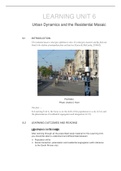
The residential mosaic is what gives definition to cities. It is what gives character and life, flesh and
blood to the skeleton of metropolitan form and land use (Knox & McCarthy, 2014:63).
POZNAN.
Photo: André C Horn
Our focus …
In Learning Unit 6, the focus is on the shift of the population in a city (6.3.1) and
the phenomenon of residential segregation and integration (6.3.2).
6.2 LEARNING OUTCOMES AND READING
LEARNING OUTCOMES
After working through all the prescribed study material for this Learning Unit,
you should be able to understand and differentiate between:
• Population shifts
• Social interaction, polarisation and residential segregation (with reference
to the South African city)
, LEARNING UNIT 6: Urban Dynamics and the Residential Mosaic
READING
• In order to achieve the above outcomes you are required to read recommended
reading material.
• NB: The information contained in the Study Guide alone will not be sufficient to
pass the examination
for this module.
• You can also do further searches on the internet to enrich your knowledge.
6.3 LEARNING CONTENT
6.3.1 Urbanisation: processes and population shifts
• Urbanisation: processes and population shifts
Learning Unit 6 focuses on some of the processes and outcomes that were
mentioned in the graph that provided a broad overview of the module. Within
cities, there are forces of centralisation and decentralisation resulting in structural and
population concentrations and de-concentrations. The above finds expression in
various population movements:
◦ Urbanisation, as already explained, is a shift of the population to cities
from rural areas
◦ Suburbanisation – a shift of certain (more affluent) populations from inner-
city areas to suburbs within the range of the streetcar, buses, rail transport
and motor vehicles, but not necessarily at the overall loss of population
in the inner-city areas
◦ Ex-urbanisation refers to a great extent of suburbanisation and is also
referred to as extended suburbanisation – the commuter-belt grows at the
expense of the urban core
◦ Peripheral urbanisation is typical of cities in less-developed countries and
indicate that a large portion of the urban population resides in peripheral
areas or the outskirts of cities (typical of South African cities)
◦ Counter-urbanisation is a general outflow of urban citizens from inner-city
areas, resulting in a shift in the balance of the urban population from the
core to outer areas
◦ Over-urbanisation refers to the over concentration of a country’s urban
population in primate cities (see the discussion on the rank-size rule in
Learning Unit 4)
◦ Exo-urbanisation refers to a concentration of people working in the labour-
intensive assembly-manufacturing industries with an export focus located
in smaller cities and towns and the even the countryside, in an attempt to
counter the high cost of land in bigger cities (see reference to the bid-rent
curve)
◦ Re-urbanisation – city centres gaining in population at the loss of certain
suburbs
Urban Dynamics and the Residential Mosaic
6.1 INTRODUCTION
The residential mosaic is what gives definition to cities. It is what gives character and life, flesh and
blood to the skeleton of metropolitan form and land use (Knox & McCarthy, 2014:63).
POZNAN.
Photo: André C Horn
Our focus …
In Learning Unit 6, the focus is on the shift of the population in a city (6.3.1) and
the phenomenon of residential segregation and integration (6.3.2).
6.2 LEARNING OUTCOMES AND READING
LEARNING OUTCOMES
After working through all the prescribed study material for this Learning Unit,
you should be able to understand and differentiate between:
• Population shifts
• Social interaction, polarisation and residential segregation (with reference
to the South African city)
, LEARNING UNIT 6: Urban Dynamics and the Residential Mosaic
READING
• In order to achieve the above outcomes you are required to read recommended
reading material.
• NB: The information contained in the Study Guide alone will not be sufficient to
pass the examination
for this module.
• You can also do further searches on the internet to enrich your knowledge.
6.3 LEARNING CONTENT
6.3.1 Urbanisation: processes and population shifts
• Urbanisation: processes and population shifts
Learning Unit 6 focuses on some of the processes and outcomes that were
mentioned in the graph that provided a broad overview of the module. Within
cities, there are forces of centralisation and decentralisation resulting in structural and
population concentrations and de-concentrations. The above finds expression in
various population movements:
◦ Urbanisation, as already explained, is a shift of the population to cities
from rural areas
◦ Suburbanisation – a shift of certain (more affluent) populations from inner-
city areas to suburbs within the range of the streetcar, buses, rail transport
and motor vehicles, but not necessarily at the overall loss of population
in the inner-city areas
◦ Ex-urbanisation refers to a great extent of suburbanisation and is also
referred to as extended suburbanisation – the commuter-belt grows at the
expense of the urban core
◦ Peripheral urbanisation is typical of cities in less-developed countries and
indicate that a large portion of the urban population resides in peripheral
areas or the outskirts of cities (typical of South African cities)
◦ Counter-urbanisation is a general outflow of urban citizens from inner-city
areas, resulting in a shift in the balance of the urban population from the
core to outer areas
◦ Over-urbanisation refers to the over concentration of a country’s urban
population in primate cities (see the discussion on the rank-size rule in
Learning Unit 4)
◦ Exo-urbanisation refers to a concentration of people working in the labour-
intensive assembly-manufacturing industries with an export focus located
in smaller cities and towns and the even the countryside, in an attempt to
counter the high cost of land in bigger cities (see reference to the bid-rent
curve)
◦ Re-urbanisation – city centres gaining in population at the loss of certain
suburbs


