

👓
Bone Physiology
Calcium Reserve and
Metabolism
Calcium is the most abundant
mineral in the body
99% is in the skeleton as calcium
phosphate
Calcium binds proteins, to do so is
required in
the plasma
– Eg. Hypothyroidism and
osteoporosis
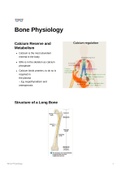
Structure of a Long Bone
Bone Physiology 1
, Diaphysis
The shaft
A heavy wall of compact bone, or dense bone
A central space called medullary (marrow) cavity
Epiphysis
Wide part at each end
Articulation with other bones
Mostly spongy (cancellous/trabecular) bone
Covered with compact bone (cortex)
Metaphysis
Where diaphysis and epiphysis meet
Bone (Osseous) Tissue:
Dense supportive connective tissue
Bone Matrix
Strong (calcified calcium salt deposits = solid matrix)
Resists shattering (flexible collagen fibers)
Bone Cells
Osteoblasts
Osteocytes
Osteoprogenitor cells
Osteoclasts
Periosteum and Endosteum
Covers bones surfaces
Fibrous layer
Cellular layer
Bone Physiology 2
Bone Physiology
Calcium Reserve and
Metabolism
Calcium is the most abundant
mineral in the body
99% is in the skeleton as calcium
phosphate
Calcium binds proteins, to do so is
required in
the plasma
– Eg. Hypothyroidism and
osteoporosis
Structure of a Long Bone
Bone Physiology 1
, Diaphysis
The shaft
A heavy wall of compact bone, or dense bone
A central space called medullary (marrow) cavity
Epiphysis
Wide part at each end
Articulation with other bones
Mostly spongy (cancellous/trabecular) bone
Covered with compact bone (cortex)
Metaphysis
Where diaphysis and epiphysis meet
Bone (Osseous) Tissue:
Dense supportive connective tissue
Bone Matrix
Strong (calcified calcium salt deposits = solid matrix)
Resists shattering (flexible collagen fibers)
Bone Cells
Osteoblasts
Osteocytes
Osteoprogenitor cells
Osteoclasts
Periosteum and Endosteum
Covers bones surfaces
Fibrous layer
Cellular layer
Bone Physiology 2


