MFH-1 systeemtheoretische modellen
The eHealth Enhanced Chronic Care Model (eCCM)
Kijk colleges hiervan engels
The eHealth Enhanced Chronic Care Model (eCCM)
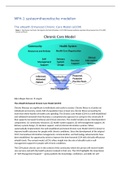
Chronic illnesses are significant to individuals and costly to society. Chronic illness is a burden on
individuals and society; nearly half of population have at least one chronic illness accounting for
more than three-fourths of health care spending. The Chronic Care Model (CCM) is a well-established
and validated framework that illustrates a comprehensive approach to caring for the chronically ill
that supports increased functional and clinical outcomes. The model includes six key interdependent
components: (1) community resources, (2) health system support, (3) self-management support, (4)
delivery system design, (5) decision support, and (6) clinical information systems. When
systematically implemented, the well-established and tested Chronic Care Model (CCM) is shown to
improve health outcomes for people with chronic conditions. Since the development of the original
CCM, tremendous information management, communication, and technology advancements have
been established. An opportunity exists to improve the time-honored CCM with clinically efficacious
eHealth tools. The revised model, eCCM, offers insight into the role of eHealth tools in self-
management support for people with chronic conditions.
The CCM places chronic care in the context of the community where the person will receive health
care services and with the health systems involved in that care. The CCM highlights the importance
of “Self-Management Support”—giving patients the knowledge, confidence, and skills for self-
, management of their condition. “Delivery System Design” is also important to promote a patient-
centered interdisciplinary team approach to care. “Decision Support” is needed to assure providers
and patients have access to the most current and relevant evidenced-based guidelines for care,
Finally, the model emphasizes the role of “Clinical Information Systems” to provide access to data,
information, and knowledge needed to improve health. Effective and productive patient and provider
interactions are the heart of the CCM and the key to improving outcomes.
The CCM has proven to be a useful framework for patient empowerment, self-management support,
and improving clinical and behavioral outcomes. The purpose of this e-lecture is to update the CCM
with emerging eHealth technologies.
The eHealth Enhanced Chronic Care Model (eCCM)
eHealth for Chronic Illness Leaders and policy makers on a global scale are strongly encouraging the
use of eHealth technologies. Australia, Europe, South Korea, and the United States all have strong
eHealth initiatives that are developing policy for using information technology to improve health and
health care systems. The Washington think tank “eHealth Initiative” (promoting policy focused on
research and education in eHealth), the Institute of Medicine (IOM), and the Agency for Healthcare
Research and Quality (AHRQ) also recommend the use of eHealth as a tool to support self-
management in chronic illness.
Large systematic reviews determined that eHealth tools can improve patient engagement and health
outcomes.
Despite the strong push for eHealth, there is no standard definition. Overall, the literature describes
the definition of eHealth to be very broad and encompassing. In the literature, the components of
eHealth typically consist of use of the Internet, telemedicine, and communication. The definition of
eHealth for chronic illness self-management in this lecture is: To promote positive health outcomes
by using a new frame of mind that incorporates information and communication technologies in the
presence of a complete feedback loop and enables the use of data and information, to generate
health management knowledge and wisdom. Including use of the Internet for health information,
social networking, telehealth, mHealth (including wearable devices), electronic health records, and
electronic personal health records/patient portals.
Use of the Internet for Self-Management Support
The Internet serves as a conduit for self-management support, connecting providers and consumers
to secure portals, health applications, social networks, and large databases. Roughly 80% of adults
have sought health information on the Internet, including 62% of adults with a chronic illness; of
those, 75% of the chronically ill surveyed stated their most recent Internet encounter affected
decisions about the self-management of their condition. The Internet is also the vehicle used by
many adults for access to social networking sites.
Social Networking or eHealth Communities
Social networking or virtual communities are newer components of eHealth. To date, most research
on the impact of social networks has been descriptive but there are a few studies that have shown
improved health outcomes; no studies to date have shown adverse effects on consumers/patients.
One randomized controlled trial (RCT) followed overweight and sedentary adults and found that the
use of an online community helped maintain adherence to the program and that the participants had
lower attrition from the study. In recent descriptive studies, virtual community members with
diabetes and heart disease found that the environment was useful for asking questions, reporting
The eHealth Enhanced Chronic Care Model (eCCM)
Kijk colleges hiervan engels
The eHealth Enhanced Chronic Care Model (eCCM)
Chronic illnesses are significant to individuals and costly to society. Chronic illness is a burden on
individuals and society; nearly half of population have at least one chronic illness accounting for
more than three-fourths of health care spending. The Chronic Care Model (CCM) is a well-established
and validated framework that illustrates a comprehensive approach to caring for the chronically ill
that supports increased functional and clinical outcomes. The model includes six key interdependent
components: (1) community resources, (2) health system support, (3) self-management support, (4)
delivery system design, (5) decision support, and (6) clinical information systems. When
systematically implemented, the well-established and tested Chronic Care Model (CCM) is shown to
improve health outcomes for people with chronic conditions. Since the development of the original
CCM, tremendous information management, communication, and technology advancements have
been established. An opportunity exists to improve the time-honored CCM with clinically efficacious
eHealth tools. The revised model, eCCM, offers insight into the role of eHealth tools in self-
management support for people with chronic conditions.
The CCM places chronic care in the context of the community where the person will receive health
care services and with the health systems involved in that care. The CCM highlights the importance
of “Self-Management Support”—giving patients the knowledge, confidence, and skills for self-
, management of their condition. “Delivery System Design” is also important to promote a patient-
centered interdisciplinary team approach to care. “Decision Support” is needed to assure providers
and patients have access to the most current and relevant evidenced-based guidelines for care,
Finally, the model emphasizes the role of “Clinical Information Systems” to provide access to data,
information, and knowledge needed to improve health. Effective and productive patient and provider
interactions are the heart of the CCM and the key to improving outcomes.
The CCM has proven to be a useful framework for patient empowerment, self-management support,
and improving clinical and behavioral outcomes. The purpose of this e-lecture is to update the CCM
with emerging eHealth technologies.
The eHealth Enhanced Chronic Care Model (eCCM)
eHealth for Chronic Illness Leaders and policy makers on a global scale are strongly encouraging the
use of eHealth technologies. Australia, Europe, South Korea, and the United States all have strong
eHealth initiatives that are developing policy for using information technology to improve health and
health care systems. The Washington think tank “eHealth Initiative” (promoting policy focused on
research and education in eHealth), the Institute of Medicine (IOM), and the Agency for Healthcare
Research and Quality (AHRQ) also recommend the use of eHealth as a tool to support self-
management in chronic illness.
Large systematic reviews determined that eHealth tools can improve patient engagement and health
outcomes.
Despite the strong push for eHealth, there is no standard definition. Overall, the literature describes
the definition of eHealth to be very broad and encompassing. In the literature, the components of
eHealth typically consist of use of the Internet, telemedicine, and communication. The definition of
eHealth for chronic illness self-management in this lecture is: To promote positive health outcomes
by using a new frame of mind that incorporates information and communication technologies in the
presence of a complete feedback loop and enables the use of data and information, to generate
health management knowledge and wisdom. Including use of the Internet for health information,
social networking, telehealth, mHealth (including wearable devices), electronic health records, and
electronic personal health records/patient portals.
Use of the Internet for Self-Management Support
The Internet serves as a conduit for self-management support, connecting providers and consumers
to secure portals, health applications, social networks, and large databases. Roughly 80% of adults
have sought health information on the Internet, including 62% of adults with a chronic illness; of
those, 75% of the chronically ill surveyed stated their most recent Internet encounter affected
decisions about the self-management of their condition. The Internet is also the vehicle used by
many adults for access to social networking sites.
Social Networking or eHealth Communities
Social networking or virtual communities are newer components of eHealth. To date, most research
on the impact of social networks has been descriptive but there are a few studies that have shown
improved health outcomes; no studies to date have shown adverse effects on consumers/patients.
One randomized controlled trial (RCT) followed overweight and sedentary adults and found that the
use of an online community helped maintain adherence to the program and that the participants had
lower attrition from the study. In recent descriptive studies, virtual community members with
diabetes and heart disease found that the environment was useful for asking questions, reporting