

Experiment 2
Friday, February 18, 2022 2:53 PM
2. REACTIONS IN AQUEOUS SOLUTIONS
Name:
Course:
Day and Time:
TA Name:
You must submit this sheet with your report.
Results, Discussion and Questions
In Tables 1 and 2 below record your observations for Parts I and II respectively. For those
combinations of reagents where there was no chemical reaction, write >NR= in the space
provided. Where reactions do occur, carefully record your observations (color change, gas
evolved, precipitate formed, colors of any precipitates or gases, etc.)
1. Write molecular equations and net ionic reactions for all the numbered cells in the tables below
(numbered with the same numbers in the cells). It is not necessary to include the total ionic
equation. If no reaction was observed, write ANR@.
1. Based on your results and observations for Part I list the metals from least reactive to most
reactive.
1. Give two reasons why copper is commonly used (as opposed to other metals) in construction (in
wiring, for example).
1. You are given a solution that contains one of the ions Ag+, Pb2+ or Ba2+. Based on your
observations in this experiment, develop a procedure to determine which ion is present. More than
one reaction may be required to discover the ion=s identity. Explain how your procedure will
determine the identity of the ion.
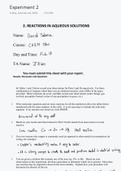
Friday, February 18, 2022 2:53 PM
2. REACTIONS IN AQUEOUS SOLUTIONS
Name:
Course:
Day and Time:
TA Name:
You must submit this sheet with your report.
Results, Discussion and Questions
In Tables 1 and 2 below record your observations for Parts I and II respectively. For those
combinations of reagents where there was no chemical reaction, write >NR= in the space
provided. Where reactions do occur, carefully record your observations (color change, gas
evolved, precipitate formed, colors of any precipitates or gases, etc.)
1. Write molecular equations and net ionic reactions for all the numbered cells in the tables below
(numbered with the same numbers in the cells). It is not necessary to include the total ionic
equation. If no reaction was observed, write ANR@.
1. Based on your results and observations for Part I list the metals from least reactive to most
reactive.
1. Give two reasons why copper is commonly used (as opposed to other metals) in construction (in
wiring, for example).
1. You are given a solution that contains one of the ions Ag+, Pb2+ or Ba2+. Based on your
observations in this experiment, develop a procedure to determine which ion is present. More than
one reaction may be required to discover the ion=s identity. Explain how your procedure will
determine the identity of the ion.


