

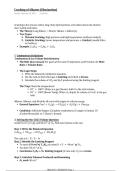
Cracking of Alkanes (Elimination)
Sunday, February 22, 2026 11:58 AM
Cracking is the process where long-chain hydrocarbons are broken down into shorter,
more useful molecules.
• The Theory: Long Alkane Shorter Alkane + Alkene(s).
• Two Types:
1. Thermal Cracking: High pressure and high temperature (without catalyst).
2. Catalytic Cracking: Lower temperature and pressure + Catalyst (usually Silica
or Zeolites).
• Example:
2. Combustion (Oxidation)
Combustion & Gas Volume Stoichiometry
• The Rule (Gay-Lussac): For gases at the same Temperature and Pressure, the Mole
Ratio = Volume Ratio.
• The Logic Steps:
1. Write the balanced combustion equation.
2. Use the ratio to find which gas is Limiting and which is Excess.
3. Calculate the volume of and produced using the limiting reagent.
The Trap: Check the temperature!
▪ If : Water is a gas (Steam). Add it to the total volume.
▪ If (Room Temp): Water is a liquid. Its volume is 0 in the gas
total.
Alkanes, Alkenes, and Alcohols all react with oxygen to release energy.
• General Equation:
• Condition: Sufficient Oxygen (Complete combustion). If oxygen is limited,
(Carbon Monoxide) or (Soot) is formed.
3. Solving the Nov 2025 Volume Question
Initial: and 50 of . Find total volume at the end.
Step 1: Write the Balanced Equation
The ratio is
Step 2: Identify the Limiting Reagent
• To react all , you need
• You have of .
• Conclusion: is the limiting reagent (it runs out). is in excess.
Step 3: Calculate Volumes Produced and Remaining
• used: 4 .
• remaining:
ORGANIC CHEMISTRY Page 1
Sunday, February 22, 2026 11:58 AM
Cracking is the process where long-chain hydrocarbons are broken down into shorter,
more useful molecules.
• The Theory: Long Alkane Shorter Alkane + Alkene(s).
• Two Types:
1. Thermal Cracking: High pressure and high temperature (without catalyst).
2. Catalytic Cracking: Lower temperature and pressure + Catalyst (usually Silica
or Zeolites).
• Example:
2. Combustion (Oxidation)
Combustion & Gas Volume Stoichiometry
• The Rule (Gay-Lussac): For gases at the same Temperature and Pressure, the Mole
Ratio = Volume Ratio.
• The Logic Steps:
1. Write the balanced combustion equation.
2. Use the ratio to find which gas is Limiting and which is Excess.
3. Calculate the volume of and produced using the limiting reagent.
The Trap: Check the temperature!
▪ If : Water is a gas (Steam). Add it to the total volume.
▪ If (Room Temp): Water is a liquid. Its volume is 0 in the gas
total.
Alkanes, Alkenes, and Alcohols all react with oxygen to release energy.
• General Equation:
• Condition: Sufficient Oxygen (Complete combustion). If oxygen is limited,
(Carbon Monoxide) or (Soot) is formed.
3. Solving the Nov 2025 Volume Question
Initial: and 50 of . Find total volume at the end.
Step 1: Write the Balanced Equation
The ratio is
Step 2: Identify the Limiting Reagent
• To react all , you need
• You have of .
• Conclusion: is the limiting reagent (it runs out). is in excess.
Step 3: Calculate Volumes Produced and Remaining
• used: 4 .
• remaining:
ORGANIC CHEMISTRY Page 1


