RNEXPLAINED
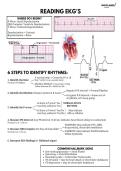
READING EKG’S
WHERE DO I BEGIN?
P-Wave: Atrial Depolarization
QRS Complex: Ventricle Depolarization
T-Wave: Ventricle Repolarization
Depolarization = Contract
Repolarization = Relax
small square → large square → 0.2 seconds
0.04 seconds
5 large squares → 1 second
6 STEPS TO IDENTIFY RHYTHMS:
6 second strip → Count the R’s x 10
1. Identify the Rate: Key: Verify it is a 6-second strip!
Normal: 60-100bpm
Big Box Method → Count the # of big
boxes between R’s / divide by 300
Regular R-R interval → Normal Rhythm
2. Identify the Rhythm: Distance between R waves
Irregular R-R interval → Some sort of
arrythmia, let’s keep going
Is there a P wave? Yes NORMAL SINUS
Are they uniform? Yes RHYTHM
3. Identify the P-wave:
Is there a P wave? Yes/No May indicate
Are they uniform? Yes/No Afib or Aflutter
4. Measure PR Interval: Any PR interval >0.20 sec indicates heart block (delay in conduction)
Normal: 0.12 - 0.20 sec
WIDENED: May indicate PVC, BBB,
drug toxicity, electrolyte imbalance
5. Measure QRS Complex: Do they all look alike?
Normal: 0.6 - 0.12 sec NARROW: May indicate Wolff-Parkinson-
White Syndrome
6. Interpret EKG findings! (+ Hallmark signs)
COMMON HALLMARK SIGNS
Saw tooth appearance → Atrial Flutter
Quivering → Atrial Fibrillation
Mountain peaks → Ventricular Tachycardia
ST elevation → may be heart attack or electrolyte imbalance
ST depression → may be electrolyte imbalance
, RNEXPLAINED
HALLMARK EKG CHANGES
Atrial Flutter : saw tooth appearance Atrial FIBRILLATION: qUIVERING OF atria
VENTRICULAR TACHYCARDIA: MOUNTAIN PEAKS VENTRICULAR FIBRILLATION: qUIVERING OF
ventricles
Torsades de pointes: Twisting of peaks
STEMI: ST ELEVATION MYOCARDIAL INFARCTION
V1 V2 V3 V4 V5 V6
ST DEPRESSION: many causes
PREMATURE VENTRICULAR CONTRACTION Unstable angina
Myocardial ischemia
Hypokalemia
Left bundle branch block
Medications: Digitalis
ATRIAL PACING
prematrure atrial contraction
VENTRICULAR PACING
READING EKG’S
WHERE DO I BEGIN?
P-Wave: Atrial Depolarization
QRS Complex: Ventricle Depolarization
T-Wave: Ventricle Repolarization
Depolarization = Contract
Repolarization = Relax
small square → large square → 0.2 seconds
0.04 seconds
5 large squares → 1 second
6 STEPS TO IDENTIFY RHYTHMS:
6 second strip → Count the R’s x 10
1. Identify the Rate: Key: Verify it is a 6-second strip!
Normal: 60-100bpm
Big Box Method → Count the # of big
boxes between R’s / divide by 300
Regular R-R interval → Normal Rhythm
2. Identify the Rhythm: Distance between R waves
Irregular R-R interval → Some sort of
arrythmia, let’s keep going
Is there a P wave? Yes NORMAL SINUS
Are they uniform? Yes RHYTHM
3. Identify the P-wave:
Is there a P wave? Yes/No May indicate
Are they uniform? Yes/No Afib or Aflutter
4. Measure PR Interval: Any PR interval >0.20 sec indicates heart block (delay in conduction)
Normal: 0.12 - 0.20 sec
WIDENED: May indicate PVC, BBB,
drug toxicity, electrolyte imbalance
5. Measure QRS Complex: Do they all look alike?
Normal: 0.6 - 0.12 sec NARROW: May indicate Wolff-Parkinson-
White Syndrome
6. Interpret EKG findings! (+ Hallmark signs)
COMMON HALLMARK SIGNS
Saw tooth appearance → Atrial Flutter
Quivering → Atrial Fibrillation
Mountain peaks → Ventricular Tachycardia
ST elevation → may be heart attack or electrolyte imbalance
ST depression → may be electrolyte imbalance
, RNEXPLAINED
HALLMARK EKG CHANGES
Atrial Flutter : saw tooth appearance Atrial FIBRILLATION: qUIVERING OF atria
VENTRICULAR TACHYCARDIA: MOUNTAIN PEAKS VENTRICULAR FIBRILLATION: qUIVERING OF
ventricles
Torsades de pointes: Twisting of peaks
STEMI: ST ELEVATION MYOCARDIAL INFARCTION
V1 V2 V3 V4 V5 V6
ST DEPRESSION: many causes
PREMATURE VENTRICULAR CONTRACTION Unstable angina
Myocardial ischemia
Hypokalemia
Left bundle branch block
Medications: Digitalis
ATRIAL PACING
prematrure atrial contraction
VENTRICULAR PACING