
Tijmen Lourens Summary Molecular Genetics
Summary Molecular Genetics
Lecture 2
- Genomes are copied faithfully, but are still very dynamic structures that change over
time → Genomes evolve
- Mutations are essential to evolution
o Mutations arise (harmful, silent or beneficial) and are repaired by the DNA
repair systems cell. Some mutation will pass to the next generation
Types of mutations: spontaneous or induced by a mutagen
- Spontaneous mutations
o Spontaneous errors during replication (mismatches)
o Mutation rate improves with proofreading activity of DNA polymerase (1 in
10^8 nt) and with DNA repair systems (1 in 10^10 or 11)
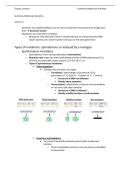
o Types of spontaneous mutations:
▪ Point mutations
• Change only one base, two types:
o Transitions: interchanges of purines (A, G) or
pyrimidines (T, C) (only A – G switch or T – C switch)
▪ Structure of DNA not affected
▪ Mostly silent mutation
o Transversions: substitutions of purines for pyrimidines
or vice versa (all other switches
▪ Structure of DNA is affected
▪ Mostly modify function or null mutation
▪ Insertions and deletions
• Can cause frameshift mutations which leads to aberrant
proteins
o Three-nucleotides insertion: just one amino acid added
to the protein
,Tijmen Lourens Summary Molecular Genetics
o One-nucleotide insertion: after the one nucleotide
insertion the following amino acids are changed
▪ Replication slippage
• Usually occurs due repetitions of short sequences
• Microsatellites (< 10 bp) and minisatellites ( 10 – 100 bp)
consist of tandem repeats of short sequences. Unstable regions
of the genome.
• Daughter DNA strand slips back one repeating unit during
replication
• It is associated with trinucleotide repeat expansions diseases
(Huntington disease).
▪ Tautomerization
• Tautomers are structural isomers of chemical compounds.
• During a tautomer shift of tautomerization, protons are
transferred from one tautomer to another.
• It is a transient change to an alternative form of the molecule
- Induced by a Mutagen
o A mutagen is a chemical or physical agent that changes the genetic material,
increasing the frequency of mutation
o The potency of a mutagen depends of how much increases the mutation rate
o Usually produce point mutations, insertions and deletions
o Common types of chemical mutagens:
▪ Base analogs
• 5 – Bromouracil is an analog of thymine
• it causes a tautomeric shift from a keto form to an enol form
▪ Deaminating agents
• Nitrous acid performs an oxidative deamination that converts
Cytosine into Uracil
• Removal of amino group
▪ Alkylating agents
• Alkylation is the transfer of an alkyl group from one molecule
to another
• Methylation is a type of alkylation, where methyl groups are
added to DNA
,Tijmen Lourens Summary Molecular Genetics
• Methylation changes DNA activity without changing the
sequence. It is a very important biological process involved in
epigenetics
▪ Intercalating agents
• Ethidium bromide used in agarose gel electrophoresis to
visualize DNA
• It intercalates between base pairs
o Physical mutagens
▪ Ionizing radiations: X-rays, Gamma rays, alpha particles
▪ Ultraviolet radiation (UV) at 260 nm, produces pyrimidine dimers
▪ Heat, hydrolysis of beta-N-glycosidic bond, forms a gap
Practice question:
Some mutagenic agents can cause lesions in the DNA, with the consequent activation of
the Base Excision Repair (BER) system in the cell.
1) There are two main BER pathways, but both start with the same enzymatic activity.
Describe the action of this enzyme
The system is initiated by a DNA glycosylase that recognizes and removes the
damaged base, leaving an abasic site which is further processed by short-patch repair
or long-patch repair
2) Describe in a number of discrete steps how the long-patch pathway repairs the damage
1) excision of the base
2) incision
3) end processing
4) repair synthesis, including gap filling and ligation
Lecture 2B: DNA repair systems
Types of DNA repair systems:
- Direct repair
- Excision repair
o Base excision repair (BER)
o Nucleotide excision repair (NER)
o Mismatch excision repair (MMR)
- Recombination repair
- Nonhomologous end-joining (NHEJ)
, Tijmen Lourens Summary Molecular Genetics
1) Direct repair:
- Reverse the damage back to normal of nucleotides that affect the structure of DNA
o Repairs alkylation
▪ Removing the methyl group so it matches to the ‘normal’ base
o Photoreactivation
▪ Light-induced (300 – 600 nm) enzymatic cleavage of a pyrimidine
dimer
▪ In E.Coli = carried out by a photolyase (DNA repair enzyme) not in
humans
2) Excision repair: BER
- Removes and replaces an individual single damage base
- Two main pathways: both start with glycosylase
o Glycosylase cleaves the bond between the damaged base and the
deoxyribose, leaving a baseless site
- Pathway 1: long-patch pathway (repairs 2-10 nucleotides)
o Endonuclease APE1 cleaves on the 5’ side
o Replication complex synthesizes 2-10 nt
o FEN1 (flap endonuclease) removes the displaced DNA
o Ligase seals the nick
- Pathway 2: short-patch pathway (repairs single nucleotide)
o Lyase breaks the sugar ring
o APE1 and DNA polymerase B replace a single nucleotide
o Ligase seals the nick
3) Excision repair: NER
- Excises sequences that includes the damaged base and synthesizes a new stretch of
DNA
- It can be summarized in a few steps:
o Recognition step, by surveillance proteins
o Incision step, by an endonuclease
o Excision step, by an exonuclease or a helicase
o Gap-filling step, by DNA polymerase and ligase
Repairs all the excision repair damages in E.coli (prokaryotes). Most of the time excises
short sequences (±21 nt). Consists of three genes: uvrA, uvrB and uvrC
In eukaryotes: similar steps to uvrABC but more complex. Repairs UV damage (pyrimidine
dimers). Lack of NER system leads to Xeroderma pigmentosum disease (XP).
Recognition of damaged DNA by:
1) Global Genome Repair
2) Transcription-coupled repair
Summary Molecular Genetics
Lecture 2
- Genomes are copied faithfully, but are still very dynamic structures that change over
time → Genomes evolve
- Mutations are essential to evolution
o Mutations arise (harmful, silent or beneficial) and are repaired by the DNA
repair systems cell. Some mutation will pass to the next generation
Types of mutations: spontaneous or induced by a mutagen
- Spontaneous mutations
o Spontaneous errors during replication (mismatches)
o Mutation rate improves with proofreading activity of DNA polymerase (1 in
10^8 nt) and with DNA repair systems (1 in 10^10 or 11)
o Types of spontaneous mutations:
▪ Point mutations
• Change only one base, two types:
o Transitions: interchanges of purines (A, G) or
pyrimidines (T, C) (only A – G switch or T – C switch)
▪ Structure of DNA not affected
▪ Mostly silent mutation
o Transversions: substitutions of purines for pyrimidines
or vice versa (all other switches
▪ Structure of DNA is affected
▪ Mostly modify function or null mutation
▪ Insertions and deletions
• Can cause frameshift mutations which leads to aberrant
proteins
o Three-nucleotides insertion: just one amino acid added
to the protein
,Tijmen Lourens Summary Molecular Genetics
o One-nucleotide insertion: after the one nucleotide
insertion the following amino acids are changed
▪ Replication slippage
• Usually occurs due repetitions of short sequences
• Microsatellites (< 10 bp) and minisatellites ( 10 – 100 bp)
consist of tandem repeats of short sequences. Unstable regions
of the genome.
• Daughter DNA strand slips back one repeating unit during
replication
• It is associated with trinucleotide repeat expansions diseases
(Huntington disease).
▪ Tautomerization
• Tautomers are structural isomers of chemical compounds.
• During a tautomer shift of tautomerization, protons are
transferred from one tautomer to another.
• It is a transient change to an alternative form of the molecule
- Induced by a Mutagen
o A mutagen is a chemical or physical agent that changes the genetic material,
increasing the frequency of mutation
o The potency of a mutagen depends of how much increases the mutation rate
o Usually produce point mutations, insertions and deletions
o Common types of chemical mutagens:
▪ Base analogs
• 5 – Bromouracil is an analog of thymine
• it causes a tautomeric shift from a keto form to an enol form
▪ Deaminating agents
• Nitrous acid performs an oxidative deamination that converts
Cytosine into Uracil
• Removal of amino group
▪ Alkylating agents
• Alkylation is the transfer of an alkyl group from one molecule
to another
• Methylation is a type of alkylation, where methyl groups are
added to DNA
,Tijmen Lourens Summary Molecular Genetics
• Methylation changes DNA activity without changing the
sequence. It is a very important biological process involved in
epigenetics
▪ Intercalating agents
• Ethidium bromide used in agarose gel electrophoresis to
visualize DNA
• It intercalates between base pairs
o Physical mutagens
▪ Ionizing radiations: X-rays, Gamma rays, alpha particles
▪ Ultraviolet radiation (UV) at 260 nm, produces pyrimidine dimers
▪ Heat, hydrolysis of beta-N-glycosidic bond, forms a gap
Practice question:
Some mutagenic agents can cause lesions in the DNA, with the consequent activation of
the Base Excision Repair (BER) system in the cell.
1) There are two main BER pathways, but both start with the same enzymatic activity.
Describe the action of this enzyme
The system is initiated by a DNA glycosylase that recognizes and removes the
damaged base, leaving an abasic site which is further processed by short-patch repair
or long-patch repair
2) Describe in a number of discrete steps how the long-patch pathway repairs the damage
1) excision of the base
2) incision
3) end processing
4) repair synthesis, including gap filling and ligation
Lecture 2B: DNA repair systems
Types of DNA repair systems:
- Direct repair
- Excision repair
o Base excision repair (BER)
o Nucleotide excision repair (NER)
o Mismatch excision repair (MMR)
- Recombination repair
- Nonhomologous end-joining (NHEJ)
, Tijmen Lourens Summary Molecular Genetics
1) Direct repair:
- Reverse the damage back to normal of nucleotides that affect the structure of DNA
o Repairs alkylation
▪ Removing the methyl group so it matches to the ‘normal’ base
o Photoreactivation
▪ Light-induced (300 – 600 nm) enzymatic cleavage of a pyrimidine
dimer
▪ In E.Coli = carried out by a photolyase (DNA repair enzyme) not in
humans
2) Excision repair: BER
- Removes and replaces an individual single damage base
- Two main pathways: both start with glycosylase
o Glycosylase cleaves the bond between the damaged base and the
deoxyribose, leaving a baseless site
- Pathway 1: long-patch pathway (repairs 2-10 nucleotides)
o Endonuclease APE1 cleaves on the 5’ side
o Replication complex synthesizes 2-10 nt
o FEN1 (flap endonuclease) removes the displaced DNA
o Ligase seals the nick
- Pathway 2: short-patch pathway (repairs single nucleotide)
o Lyase breaks the sugar ring
o APE1 and DNA polymerase B replace a single nucleotide
o Ligase seals the nick
3) Excision repair: NER
- Excises sequences that includes the damaged base and synthesizes a new stretch of
DNA
- It can be summarized in a few steps:
o Recognition step, by surveillance proteins
o Incision step, by an endonuclease
o Excision step, by an exonuclease or a helicase
o Gap-filling step, by DNA polymerase and ligase
Repairs all the excision repair damages in E.coli (prokaryotes). Most of the time excises
short sequences (±21 nt). Consists of three genes: uvrA, uvrB and uvrC
In eukaryotes: similar steps to uvrABC but more complex. Repairs UV damage (pyrimidine
dimers). Lack of NER system leads to Xeroderma pigmentosum disease (XP).
Recognition of damaged DNA by:
1) Global Genome Repair
2) Transcription-coupled repair


