
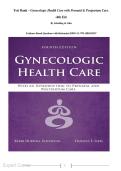
Test Bank – Gynecologic Health Care with Prenatal & Postpartum Care.
(4th Ed)
By Schuiling & Likis
Evidence-Based Questions with Rationales| ISBN-13: 978-1284182347
1
, Answers Provided at the end of each Chapter.
Chapter 1 A Feminist Perspective of Women's Health & Chapter 2 Racism and Health Disparities
MULTIPLE-CHOICE QUESTIONS
Select the one correct answer to each of the following questions.
1. Which of the following best defines the term “gender” as used in this text?
a) A person’s sex
b) A person’s sex as defined by society
c) A societal response to a person’s self-representation as a man or woman
d) A person’s biological presentation as defined by himself or herself
2. Which factor bears most on women’s health care today?
a) The complexity of women’s health
b) Women’s status and position in society
c) Population growth
d) The economy
3. Why is acknowledging the oppression of women
more difficult within Western societies?
a) The multiplicity of minority groups complicates the issue.
b) The availability of health care makes acknowledgment more difficult.
c) The diversity of the news media clouds the issue.
d) Affluence and increased opportunities mask oppression.
4. Which of the following most accurately defines “oppression” as used in the text?
a) Not having a choice
b) Not having a voice
c) An act of tyranny
d) A feeling of being burdened
5. In what way does a model of care based on a feminist
2
,perspective contrast sharply with a biomedical model?
a) It provides a forum for the exploration of gender issues.
b) It seeks equal distribution of power within the healthcare interaction.
c) It emphasizes women’s rights.
d) It opens new avenues for women’s health care.
6. Gender is rooted in and shaped by .
a) society, biology
b) self-representation, societal expectations
c) biology, environment and experience
d) biology, hormones
7. Women’s health risks, treatments, and approaches are not
always based in science and biology because
a) they are often based on outdated treatments and approaches.
b) they are determined by social expectations and gender assumptions.
c) they often rely on alternative treatments and approaches.
d) scientific research often fails to take women into consideration.
8. Reproductive rights were added to the World
Health Organization’s human rights framework in the last ?
a) 5 years
b) 10 years
c) 20 years
d) 40 years
9. “Safe Motherhood” was added to the human rights framework in order to
a) address maternal morbidity and mortality on a global level
b) meet a legal obligation
c) correct an injustice
d) correct an oversight
10. What is a chief failing of the biomedical model in regards to women’s health care?
3
, a) Its reliance on studies comprised exclusively of males
b) Its consideration of women as central the model
c) Its emphasis on science and medicine
d) Its limited definition of “health” as “the absence of disease”
11. The social model of health places the focus of health on
a) the community.
b) the individual.
c) environmental conditions.
d) scientific research.
12. Which question below supports the strategy: “Identify
women’s agency in themidst of social constraint and the biomedical
paradigm.”?
a) “Are ‘all women’ the same?”
b) “Why do you care about the issue?”
c) “Are women really victims or are they acting with agency?”
d) “Who has a choice within the context of health?”
13. What had been a significant problem in medical research well into the 1990s?
a) The focus on randomized clinical trials over epidemiological investigations
b) The lack of representation of women in research trials
c) The lack of research related to gynecology
d) The focus on randomized clinical trials over observational research
14. Gender differences in heart disease can be found in
a) diagnosis.
b) treatment.
c) identification of symptoms.
d) all of the above.
15. What opportunities are created by applying feminist strategies to gynecologic health?
a) Better insight into research methods related to gynecology
4
(4th Ed)
By Schuiling & Likis
Evidence-Based Questions with Rationales| ISBN-13: 978-1284182347
1
, Answers Provided at the end of each Chapter.
Chapter 1 A Feminist Perspective of Women's Health & Chapter 2 Racism and Health Disparities
MULTIPLE-CHOICE QUESTIONS
Select the one correct answer to each of the following questions.
1. Which of the following best defines the term “gender” as used in this text?
a) A person’s sex
b) A person’s sex as defined by society
c) A societal response to a person’s self-representation as a man or woman
d) A person’s biological presentation as defined by himself or herself
2. Which factor bears most on women’s health care today?
a) The complexity of women’s health
b) Women’s status and position in society
c) Population growth
d) The economy
3. Why is acknowledging the oppression of women
more difficult within Western societies?
a) The multiplicity of minority groups complicates the issue.
b) The availability of health care makes acknowledgment more difficult.
c) The diversity of the news media clouds the issue.
d) Affluence and increased opportunities mask oppression.
4. Which of the following most accurately defines “oppression” as used in the text?
a) Not having a choice
b) Not having a voice
c) An act of tyranny
d) A feeling of being burdened
5. In what way does a model of care based on a feminist
2
,perspective contrast sharply with a biomedical model?
a) It provides a forum for the exploration of gender issues.
b) It seeks equal distribution of power within the healthcare interaction.
c) It emphasizes women’s rights.
d) It opens new avenues for women’s health care.
6. Gender is rooted in and shaped by .
a) society, biology
b) self-representation, societal expectations
c) biology, environment and experience
d) biology, hormones
7. Women’s health risks, treatments, and approaches are not
always based in science and biology because
a) they are often based on outdated treatments and approaches.
b) they are determined by social expectations and gender assumptions.
c) they often rely on alternative treatments and approaches.
d) scientific research often fails to take women into consideration.
8. Reproductive rights were added to the World
Health Organization’s human rights framework in the last ?
a) 5 years
b) 10 years
c) 20 years
d) 40 years
9. “Safe Motherhood” was added to the human rights framework in order to
a) address maternal morbidity and mortality on a global level
b) meet a legal obligation
c) correct an injustice
d) correct an oversight
10. What is a chief failing of the biomedical model in regards to women’s health care?
3
, a) Its reliance on studies comprised exclusively of males
b) Its consideration of women as central the model
c) Its emphasis on science and medicine
d) Its limited definition of “health” as “the absence of disease”
11. The social model of health places the focus of health on
a) the community.
b) the individual.
c) environmental conditions.
d) scientific research.
12. Which question below supports the strategy: “Identify
women’s agency in themidst of social constraint and the biomedical
paradigm.”?
a) “Are ‘all women’ the same?”
b) “Why do you care about the issue?”
c) “Are women really victims or are they acting with agency?”
d) “Who has a choice within the context of health?”
13. What had been a significant problem in medical research well into the 1990s?
a) The focus on randomized clinical trials over epidemiological investigations
b) The lack of representation of women in research trials
c) The lack of research related to gynecology
d) The focus on randomized clinical trials over observational research
14. Gender differences in heart disease can be found in
a) diagnosis.
b) treatment.
c) identification of symptoms.
d) all of the above.
15. What opportunities are created by applying feminist strategies to gynecologic health?
a) Better insight into research methods related to gynecology
4


